


 For all latest news, follow the Daily Sun's Google News channel.


Sweden enforces new law requiring agencies to report undocumented migrants
Md Mahmodul Haque, Nordic Correspondent
Published: 14 Jul 2026, 07:59 PM
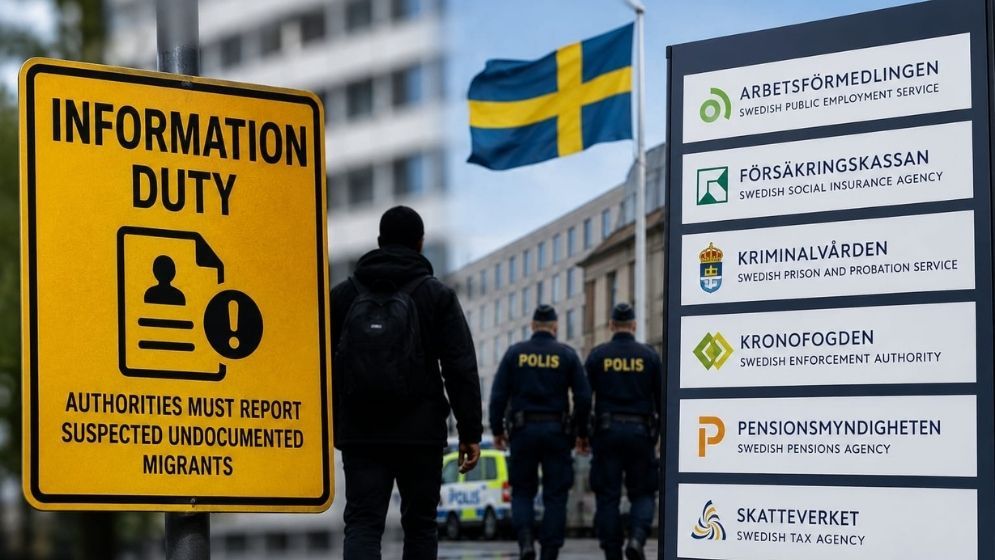
Photo: Collected
A new law requiring several Swedish government agencies to share information on suspected undocumented migrants with law enforcement authorities came into force on Monday, marking another step in the country's tougher immigration policy.
Under the legislation, six government agencies
are now legally required to notify the Police, the Swedish Security Service or
the Swedish Migration Agency if, in the course of their duties, they have
reason to believe that a person is residing in Sweden without legal permission.
The measure is officially known as the
Informationsplikt (Duty to Provide Information), although critics widely refer
to it as the Angiverilagen, or the "Informer Law".
The agencies covered by the law are the Swedish Public Employment Service, the Swedish Social Insurance Agency, the Swedish Prison and Probation Service, the Swedish Enforcement Authority, the Swedish Pensions Agency and the Swedish Tax Agency.
-6a564151069a0.jpg)
The Swedish government said the law is
intended to reduce the country's so-called "shadow society" by making
it easier to identify people who no longer have the legal right to remain in
Sweden, including those whose residence permits have expired or who have been
ordered to leave the country but remain.
Authorities said the information-sharing
system would also help law enforcement agencies enforce immigration decisions
more effectively.
The legislation triggered extensive public
debate before taking effect. The government had initially proposed extending
the reporting obligation to a wider range of public authorities.
However, following strong criticism from
healthcare professionals, teachers, social workers, human rights organisations
and opposition parties, the proposal was narrowed to the six government
agencies.
Critics argued that the reporting requirement
could undermine migrants' trust in public institutions and discourage
vulnerable people from seeking essential public services, particularly
healthcare and social support, for fear that their information could be shared
with immigration authorities.
The government, however, maintained that the
law is not aimed at any particular group but is intended to ensure the
enforcement of Sweden's immigration laws by identifying individuals who no
longer have the legal right to remain in the country.
Analysts said the implementation of the
legislation reflects Sweden's increasingly restrictive approach to immigration.
In recent years, the country has introduced a series of measures aimed at
tightening migration rules and strengthening the enforcement of immigration
decisions.