


 For all latest news, follow the Daily Sun's Google News channel.


East Asia braces for one of the strongest typhoons in decades
BBC
Published: 10 Jul 2026, 10:11 PM
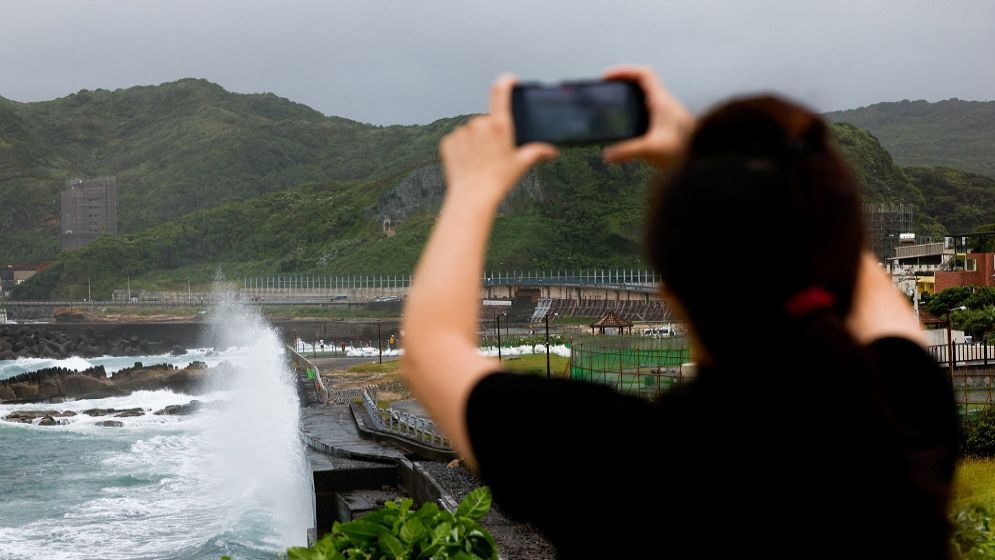
A person takes photo of waves crashing against the shoreline as Typhoon Bavi approaches in Keelung, Taiwan, 10 July 2026. Photo: REUTERS
Landslides triggered by one of the strongest storms in
decades have killed at least 15 people in the southern Philippines, as parts of
East Asia brace themselves for the looming storm.
Typhoon Bavi, which spans 1,000km (620 miles) at its widest
point – roughly the width of France - is sweeping across the Pacific towards
Taiwan.
It is expected to dump rain on Taiwan's north and east, and
on a chain of remote Japanese islands, before making landfall in south-eastern
China on Saturday.
Dozens of flights have been cancelled while schools have
suspended classes across the region. Supermarket shelves have been wiped clean
as residents stock up on supplies ahead of the typhoon.
On the Philippine island of Mindanao, families have been
buried overnight by landslides, and rescuers are still searching for those
missing.
Moderate to heavy rains will continue to drench parts of the
country throughout the weekend, officials say.
Taiwanese authorities have warned that Bavi could bring up
to 1m (39 inches) of rainfall. Some 29,000 soldiers have been put on standby to
help with relief efforts, according to the island's defence ministry.
Bavi is set to be the largest storm, by size, to hit the island
since 1987, Taiwan's Central Weather Administration told Reuters.
Farmers across the region rushed to harvest or protect their
crops while the weather held earlier on Friday, while fishermen made sure to
secure their vessels tightly.
"Don't be fooled by the nice and calm weather now. A
storm like this could be the most terrifying," 60-year-old fisherman Chen
Ming-hui told Reuters.
Thousands of sandbags have been distributed to residents and
shop-owners in flood-prone areas.
Across the strait, China has also warned of
"significant impact" from the typhoon that could move northward after
smashing into the south-eastern Fujian province.
"Bavi's large size and abundant energy mean its
remnants and outer rainbands could move from Jiangsu and Anhui provinces toward
the Bohai Sea region," said Ma Jun, director of China's Institute of
Public and Environmental Affairs.
The northern provinces, which have "less
experience" dealing with typhoons in comparison with the south, should
"strengthen preparations", he warned.
Some forecasts suggest Bavi could make landfall twice in
China.
In Japan, residents on the remote Sakishima Islands are also
on high alert. Photographs shared online show some of them taping up windows
and draping windproof nets across their homes and shops.
Various airlines have grounded flights in the region. Japan
Airlines, for instance, has axed more than 100 flights for Friday and Saturday,
disrupting travel for nearly 20,000 passengers.
All Nippon Airways, another Japanese carrier, has cancelled
more than 160 flights through Sunday, also affecting about 20,000 people,
according to Reuters.
Thai Airways and Malaysia Airlines have also grounded
flights to and from Taipei.
Parts of southern China are still reeling from the
devastation brought by Typhoon Maysak earlier this week.
Maysak left at least 39 people dead, with rescuers still
combing through wreckage for missing people. More than 130,000 were evacuated,
mostly in the Guangxi region.
Maysak killed large swathes of livestock and resulted in massive agriculture loss. It also spurred two rare tornadoes in the central Hubei province.