


 For all latest news, follow the Daily Sun's Google News channel.


Venezuela quake death toll more than doubles to 589
Agencies
Published: 26 Jun 2026, 07:35 PM
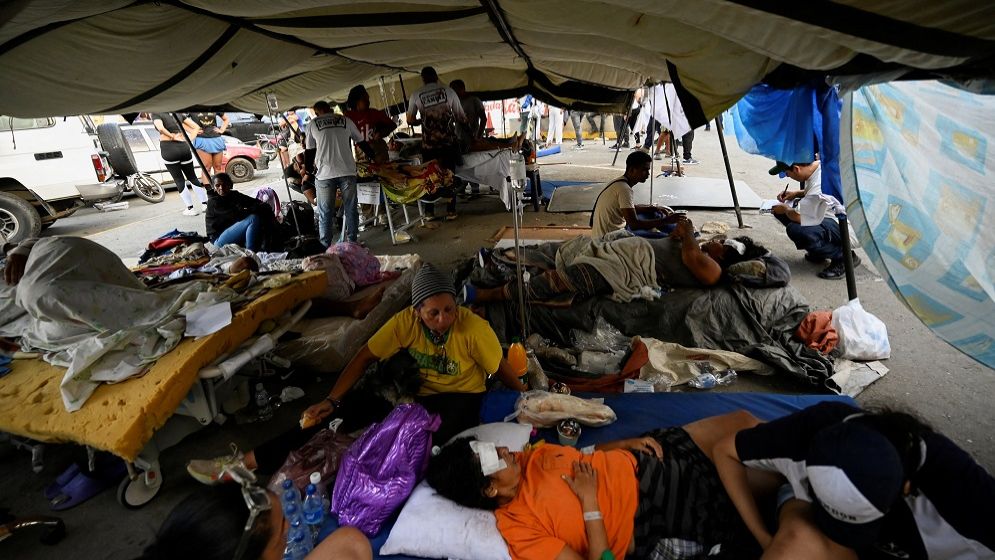
Injured people are being treated outside a community clinic, in the aftermath of earthquakes in La Guaira, Venezuela, 25 June 2026. Photo: REUTERS
The earthquake-related death toll in Venezuela has risen to
589, more than doubling from the previous count, and the number of injured is
now 2,980, said Acting President Delcy Rodríguez on Friday afternoon.
On Thursday night, the official death toll was 235, with
4,300 injured.
She said there have been 214 aftershocks so far since the
twin earthquakes struck on Wednesday evening. "This demonstrates and
reflects the seismic activity in our territory."
She also said the state of La Guaira will be
"militarised" to help the emergency response.
La Guaira is one of the areas worst affected by the twin
earthquakes, which were measured at 7.2 and 7.5 magnitude and were the
strongest to hit the country in more than a century.
Venezuela is a country already mired in uncertainty – it has
been less than six months since Nicolás Maduro, the leader who had ruled the
country since 2013, was seized by US forces in a dawn raid.
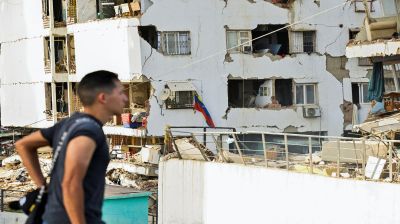
More than 100 buildings in the La Guaira state have
collapsed, and at least 70,000 families have been affected, said Venezuela’s
Interior Minister Diosdado Cabello.
La Guaira is an economically important region as it is home
to one of the country's two main seaports and the main international airport,
which has been closed due to damage.
Nearly 600 people have been reported dead and 3,000 others
are wounded, according to Venezuela’s Health Minister Carlos Alvarado. Hundreds
more are believed to be
trapped under rubble.
The hospitals are “full of patients,” Carlos Alvarado added.
Medics told the BBC that even before the earthquake, medical
supplies were insufficient for the population.
International rescue teams have joined an urgent search for
survivors in Venezuela, where people remain trapped under collapsed buildings
after two devastating earthquakes on Wednesday.
Countries from across the Americas – including Brazil,
Canada, Mexico, Colombia, El Salvador, Cuba and the United States – as well as
the United Nations, continued on Friday to send search and rescue teams and
humanitarian aid in the aftermath of the quakes.
The United Nations said more than 1,000 international search
and rescue workers had been deployed, including teams of sniffer dogs.
Many other international teams are on their way or preparing
to help.
These include Italy, Czechia, France, Germany, Luxembourg,
Portugal and the Netherlands - which we saw depart a short while ago. They are
all sending search and rescue teams, according to European Commission President
Ursula von der Leyen.
Spanish rescue workers have been pictured arriving in
Venezuela, after Swiss workers were reported to have arrived earlier today.
The UK Foreign Office said on Thursday that the UK's
International Search and Rescue team "stands ready for deployment".
The images coming out of the La Guaira state are a reminder
of another catastrophe in December 1999, when torrential rains triggered a
series of landslides. The death toll then was in the thousands.
La Guaira never fully recovered from those landslides. Even
today, the enormous rocks that destroyed buildings are still there.
On Friday, volunteers in La Guaira city dug through wreckage
with their bare hands as families waited for news of missing relatives.
Along the Caracas-La Guaira highway, streams of civilians
headed towards the coast carrying water, food and medicine, stepping in as the
scale of the disaster overwhelmed initial rescue efforts.
“We lost everything. We have no food or medicines … We hope
help arrives quickly,” said Pedro Perez, 64, an upholstery workshop owner who
said he had lost both his home and business and was sleeping on the street with
his wife and children.
Scenes of panic and destruction also played out in Caracas,
where many spent the night sleeping on the streets or in their cars due to fear
of more buildings collapsing.
“People are afraid to go back into their houses,” journalist
Maria Emilia Miro Quesada told Al Jazeera from Caracas. “They are very
uncertain … about the structures, the damages.”
Venezuela’s recovery from the disaster is being hampered by
years of economic collapse and strained infrastructure.
“Venezuela was already in a very difficult situation” before
the quakes, with frequent power outages and public services in “shambles”, said
Al Jazeera’s Alessandro Rampietti, reporting from Bogota in neighbouring
Colombia.
On Friday afternoon, BBC chatted with several people in
Venezuela who have missing relatives in La Guaira.
They know the buildings where their relatives lived have
collapsed, and despite their best efforts, they cannot get any information.
Phones are going unanswered. And official information for them feels virtually
non-existent.
One of them told BBC that she finally found her aunt, who
had left her apartment to walk her dog minutes before it collapsed. Both her
aunt and the pet have lost their home, but they are unharmed.
Another person – who lives in Europe – said Thursday they
had two close relatives trapped in the rubble in a neighbourhood also close to
the coast.
They were trying to do what they could from miles away, and
across a five-hour time difference. People in the area told them they heard voices
from the rubble. They thought it was one of their relatives.
This morning I woke up to her message confirming that both
of her relatives were found, but they did not survive.