


 For all latest news, follow the Daily Sun's Google News channel.


Iran foreign minister leaves Pakistan, heads to Russia for more talks
There was no indication that direct talks between Iran and the United States would resume with both sides holding out on Tehran's nuclear programme
Agencies
Published: 27 Apr 2026, 04:47 AM
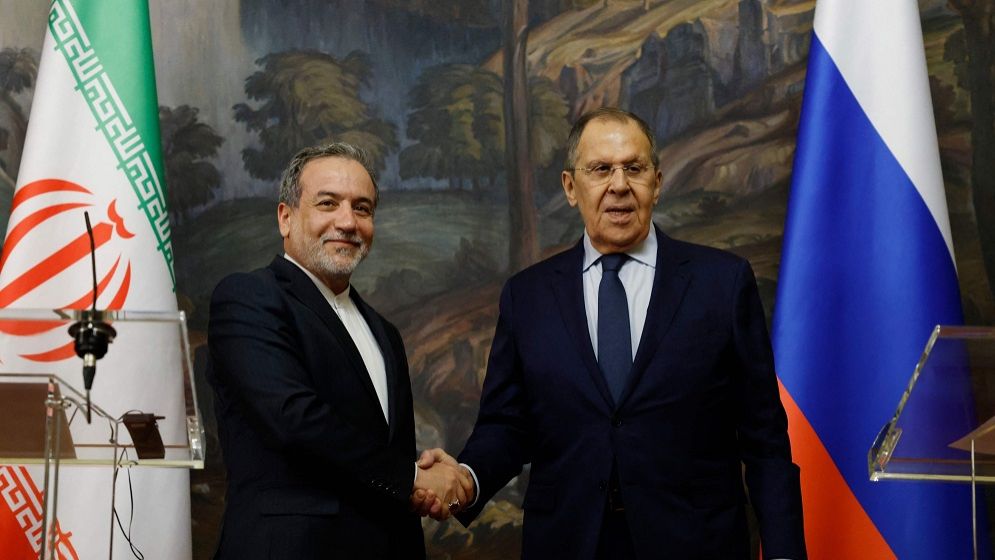
Russia's Foreign Minister Sergei Lavrov shakes hands with Iran's Foreign Minister Abbas Araghchi during a joint news conference following their talks in Moscow, 18 April 2025. File Photo: AFP
Iran Foreign Minister Abbas Araghchi has left Islamabad for
Moscow, the Iranian Ministry of Foreign Affairs said, as mediators hope to keep
the prospect of more Tehran-Washington talks alive.
Araghchi sandwiched a trip to Muscat, Oman, in between
visits to the Pakistani capital, leaving on Sunday to be in Russia the
following day.
In Russia, Iran’s Foreign Ministry said he would speak with
“senior officials”.
Russia’s Ministry of Foreign Affairs confirmed that Araghchi
would visit Moscow, but did not say if he would meet President Vladimir Putin.
But there was no indication that direct talks between Iran
and the United States would resume.
However, in a sign that indirect efforts were ongoing, the
Fars news agency reported that Iran had transmitted “written messages” to the
Americans via mediator Pakistan, which were “about some of the red lines of the
Islamic Republic of Iran, including nuclear issues and the Strait of Hormuz”.
But the messages were not part of any negotiations, Fars
said.
Separately, US President Donald Trump said on Sunday that
Iran could call if it wanted to negotiate an end to the war launched by the US
and Israel.
"They know what has to be in the agreement. It's very
simple: they cannot have a nuclear weapon, otherwise there's no reason to
meet," Trump said.
Iran has long demanded Washington acknowledge its right to
enrich uranium, which Tehran says it only seeks for peaceful purposes but which
Western powers and Israel say is aimed at building nuclear weapons.
US President Donald Trump last week indefinitely extended
the ceasefire that Washington and Tehran agreed to on 7 April, which has
largely halted the fighting that began with joint US-Israeli strikes on Iran on
28 February.
But a permanent settlement remains elusive, and the economic
shockwaves of the war continue to reverberate around the globe.
Iran has effectively blocked the vital Strait of Hormuz,
cutting off vast quantities of oil, natural gas and fertiliser from the global
market, and sending prices soaring. The US has imposed a blockade of Iranian
ports in response.
There had been hopes for a new round of talks on Saturday,
with US envoys Steve Witkoff and Jared Kushner due to visit Islamabad, but
Trump later told Fox News he had scrapped the trip, saying there was no point
“sitting around talking about nothing”.
On Sunday, Trump told the same channel: “I said, we’re not
doing this any more. We have all the cards. If they want to talk, they can come
to us, or they can call us. You know, there is a telephone. We have nice,
secure lines”.
Asked earlier whether cancelling the trip meant a return to
open hostilities, Trump said: “No, it doesn’t mean that.”
On Saturday, Araghchi met Pakistan’s military chief, Asim Munir, a key mediator, Prime Minister Shehbaz Sharif and Minister of Foreign Affairs Ishaq Dar, before flying on to Muscat. He returned to Islamabad on Sunday.
Amid the flurry of meetings, Araghchi signalled scepticism
over Washington’s intentions, saying he had “yet to see if the US is truly
serious about diplomacy”.