


 For all latest news, follow the Daily Sun's Google News channel.


Pope Leo again takes jibe at Trump, decries world 'ravaged by tyrants'
Reuters, Cameron
Published: 16 Apr 2026, 08:22 PM
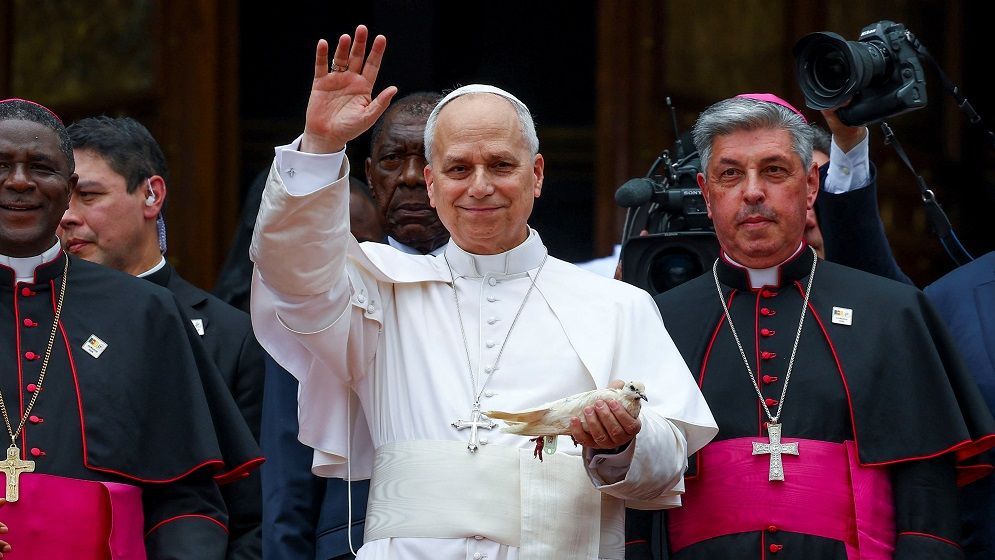
Pope Leo XIV waves as he holds a bird after a meeting for peace with the community of Bamenda in Saint Joseph’s Cathedral in Bamenda, Cameroon, 16 April 2026. Photo: Reuters
Pope Leo blasted leaders who spend billions on wars and said
the world was "being ravaged by a handful of tyrants", in unusually
forceful remarks in Cameroon on Thursday after US President Donald Trump
attacked him again on social media.
Leo, the first US pope, also decried leaders who used
religious language to justify wars and urged a "decisive change of
course" in a meeting in the biggest city in Cameroon's anglophone regions,
where a simmering conflict going back nearly a decade has left thousands dead.
"The masters of war pretend not to know that it takes
only a moment to destroy, yet often a lifetime is not enough to rebuild,"
the pontiff said.
"They turn a blind eye to the fact that billions of
dollars are spent on killing and devastation, yet the resources needed for
healing, education and restoration are nowhere to be found."
'A world turned upside down'
Trump's attacks on Leo, first launched on the eve of the
pope's ambitious four-country tour of Africa and repeated late Tuesday, have caused
dismay in Africa, where more than a fifth of the world's Catholics live.
Leo, who kept a relatively low profile for most of his first
year as leader of the 1.4-billion-member Church, has emerged as an outspoken
critic of the war that began with US-Israeli strikes on Iran.
On Thursday, the pontiff sharply criticised leaders who
invoked religious themes to justify wars.
"Woe to those who manipulate religion and the very name
of God for their own military, economic and political gain, dragging that which
is sacred into darkness and filth," he said.
"It is a world turned upside down, an exploitation of
God’s creation that must be denounced and rejected by every honest
conscience."
The pope made similar remarks last month, saying God
rejected prayers from leaders with "hands full of blood", in comments
widely interpreted as aimed at US Defense Secretary Pete Hegseth, who has
invoked Christian language to justify the Iran war.
Trump began his criticism of Leo on Sunday, when he called
the pope "WEAK on Crime, and terrible for Foreign Policy" in a post
on Truth Social.
The US president attacked him again on social media late on
Tuesday, and on Wednesday Trump posted an image of Jesus embracing him, after
an earlier image he posted that portrayed him as a Jesus-like figure prompted
widespread criticism.
Clergy caught up in Cameroon conflict
Leo told Reuters on Monday that he would not stop speaking
out about the Iran war and has avoided responding to Trump directly since then.
After arriving in the Cameroon capital Yaounde on Wednesday,
he urged the government of the Central African nation - led by President Paul
Biya, at 93 the world's oldest ruler - to root out corruption and resist
"the whims of the rich and powerful".
Leo's trip on Thursday to the anglophone city of Bamenda has
stirred faint hope that steps might be taken to resolve the conflict there,
rooted in the country's complex colonial and post-colonial history.
Cameroon, a former German colony, was partitioned by Britain
and France after World War One. The French part won independence in 1960 and
was joined a year later by the smaller English-speaking British area to the
west.
More than 6,500 people have been killed and more than half a
million displaced in fighting between government forces and anglophone
separatist groups, according
to the International Crisis Group.
Priests are frequently kidnapped for ransom and some have
been killed. A separatist alliance said
it would observe a three-day ceasefire to allow civilians and visitors to move
freely during the pope's visit.
Biya has not travelled to the anglophone regions since the
fighting began.
Efforts to broker a peace deal have so far amounted to
little, though on Thursday Leo said he was heartened that the crisis "has
not degenerated into a religious war" and expressed hope that Christian
and Muslim leaders could mediate an end to the fighting.