


 For all latest news, follow the Daily Sun's Google News channel.


Myanmar junta turns to Pakistan amid Rohingya genocide case
The Irrawaddy
Published: 05 Feb 2026, 12:01 AM
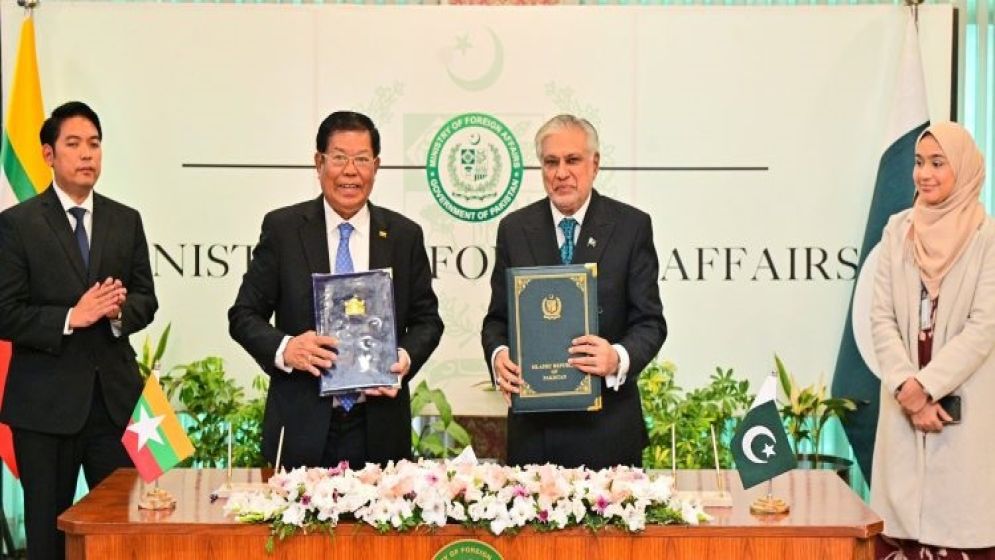
Myanmar junta Foreign Minister Than Swe (second from left) and his Pakistani counterpart Ishaq Dar (second from right) attend an event to sign a memorandum of understanding on political consultations between the countries’ foreign ministries, in Islamabad on Jan. 26. / MOFA-Pakistan
In January, Myanmar junta Foreign Minister Than Swe made a landmark four-day official visit to Pakistan. The trip marked the first high-level ministerial engagement between Myanmar and Islamabad in over a decade, reflecting a significant shift in Myanmar’s diplomatic strategy under its military government. The timing of the visit coincided with Myanmar’s delegation traveling to The Hague to defend against allegations of genocide related to the Rohingya crisis.
According to Pakistani media reports, Myanmar’s last ministerial visit to Pakistan occurred in 2015 and Pakistan’s last top-level visit to Myanmar took place in 2012.
Myanmar’s motivation for engaging with Pakistan seems to stem from the International Court of Justice (ICJ) case, initiated by Gambia and strongly backed by the Organization of Islamic Cooperation (OIC), concerning Myanmar’s treatment of the Rohingya. Pakistan, as a key OIC member, plays a critical role in shaping the organization’s stance and responses.
In September 2017, weeks after the Myanmar military launched a crackdown on Rohingya communities, Pakistan summoned Myanmar’s ambassador to Islamabad to lodge a formal protest against the persecution of Rohingya Muslims, demanding an end to the violence. At the time, representing the OIC, Pakistan demanded that Myanmar allow a UN fact-finding mission access to affected areas and bring the perpetrators of the violence to justice.
Pakistan’s foreign minister expressed “deep anguish” at the situation, labeling the actions against the Rohingya as “ethnic cleansing” and “crimes against humanity”.
Myanmar junta Foreign Minister Than Swe (second from left) and his Pakistani counterpart Ishaq Dar (second from right) attend an event to sign a memorandum of understanding on political consultations between the countries’ foreign ministries, in Islamabad on Jan. 26. / MOFA-Pakistan
This time around, Myanmar’s military regime likely aimed to temper Pakistan’s criticism within the OIC and gauge the organization’s perspective on Myanmar’s recent political developments—specifically, the military-backed elections held in December and January, in which the junta’s proxy party, the Union Solidarity and Development Party, claimed a decisive victory.
China, a close ally of Pakistan, has welcomed Myanmar’s elections, adding another layer of strategic support.
During the visit, Pakistani Foreign Minister Ishaq Dar emphasized “regional reconciliation,” signaling an openness to the Myanmar junta’s efforts to establish a government with a nominally “civilian” face. Pakistan, itself navigating international sanctions and Western scrutiny, offers Myanmar a platform to argue for its return to normalcy. But this raises questions about whether Islamabad’s willingness to engage the regime undermines the cause of pursuing accountability for the Rohingya genocide.
Despite previous tensions over the Rohingya crisis, a discreet military-to-military relationship has persisted between Myanmar and Pakistan, underpinned by defense cooperation such as the operation and maintenance of the Myanmar Air Force’s Pakistani-Chinese-made JF-17 fighter jets. Myanmar acquired the JF-17 Thunder multi-role fighter jets in 2015.
Myanmar was the first country to purchase the JF-17 Block 2, placing orders for at least 16 jets, with deliveries starting around 2018-19.
In spite of the fact that many of the delivered jets were grounded shortly after arrival due to technical faults, including structural issues, the junta has used these jets, alongside others, to conduct aerial campaigns against resistance forces. Pakistan has also provided training to Myanmar’s armed forces.
The deployment of these jets is part of a larger, long-term military cooperation between Myanmar, Pakistan and China, with the junta relying on these partnerships for defense procurement. The regime has deployed these jets to attack civilians in the country.
Both Myanmar and Pakistan confront internal insurgencies and are often influenced by powerful neighboring states—India and China—leading to a pragmatic “middle-power” approach in their foreign relations.
Than Swe’s visit resulted in tangible developments, including a formal arrangement signed by him and Dar establishing a framework for ongoing “Foreign Office Consultations,” laying the groundwork for sustained political engagement.
Pakistan extended an invitation to Myanmar visitors to explore its Gandhara Buddhist heritage sites, utilizing religious tourism as a soft-power tool to foster people-to-people connections despite underlying religious tensions linked to the Rohingya crisis.
Economic cooperation was also a focal point, with Than Swe encouraging Pakistani investors to consider opportunities in Myanmar.
During the discussions, both countries explored avenues to enhance cooperation between their ministries of foreign affairs. Key sectors identified for further collaboration included the economy, agriculture, livestock, manufacturing and trade. Technology, healthcare and cultural exchanges were also discussed, alongside coordination within international and regional organizations such as the United Nations, the Association of Southeast Asian Nations (ASEAN), the Shanghai Cooperation Organization and the ASEAN Regional Forum.
Though not the primary focus of joint press conferences, the Rohingya crisis significantly influenced the timing and tone of the visit. The ICJ’s hearings on the merits of the genocide case were underway, and Myanmar’s regime likely sought candid exchanges with Pakistan to alleviate diplomatic tensions, given Pakistan’s influential role within the OIC.
Pakistan’s Foreign Minister reiterated support for a “peaceful, stable, and prosperous Myanmar” and stressed the importance of national reconciliation—a diplomatic reference to resolving ethnic conflicts, including the Rohingya situation.
Both sides agreed to cooperate on consular assistance for victims of human trafficking and online scams, recognizing the link between these issues and displaced populations in the region.