


 For all latest news, follow the Daily Sun's Google News channel.


Trump launches controversial Board of Peace for Gaza
Reuters, Davos
Published: 22 Jan 2026, 06:13 PM
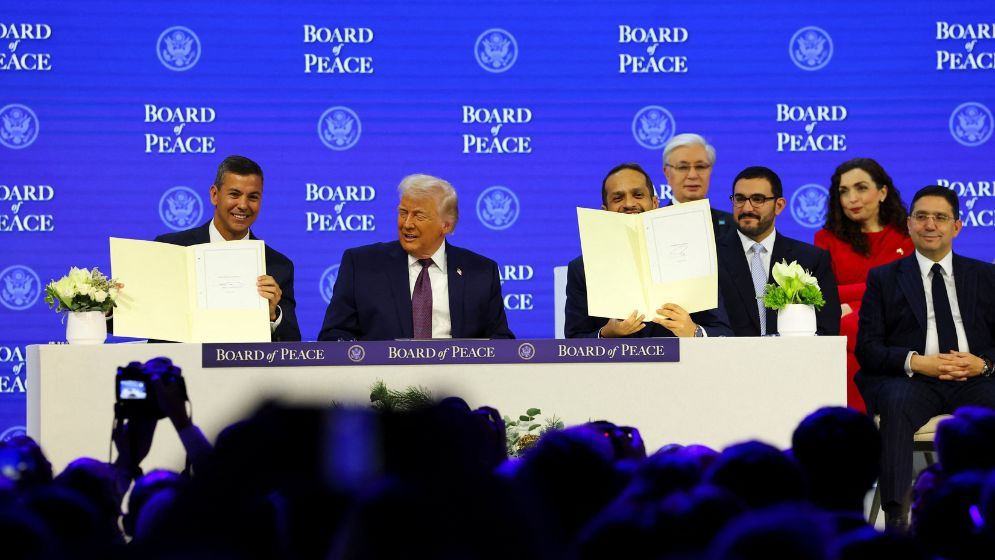
Paraguay's President Santiago Pena and Qatar's Prime Minister and Minister for Foreign Affairs Sheikh Mohammed bin Abdulrahman bin Jassim Al-Thani hold signed Charter of the Board of Peace next to US President Donald Trump, as they take part in a charter announcement for his Board of Peace initiative aimed at resolving global conflicts, alongside the 56th annual World Economic Forum (WEF), in Davos, Switzerland, 22 January 2026. Photo: REUTERS
US President Donald Trump on Thursday launched his Board of
Peace, initially designed to cement Gaza's rocky ceasefire but which he
foresees taking a wider role worrying to other global powers, although he said
it would work with the United Nations.
"Once this board is completely formed, we can do pretty
much whatever we want to do. And we'll do it in conjunction with the United
Nations," Trump said, adding that the UN had great potential that had not
been fully utilised.
Trump, who will chair the board, invited dozens of other
world leaders to join, saying he wants it to address challenges beyond the
stuttering Gaza ceasefire, stirring misgivings that it could undermine the UN's
role as the main platform for global diplomacy and conflict resolution.
While regional Middle East powers including Turkey, Egypt,
Saudi Arabia and Qatar, as well as major emerging nations such as Indonesia,
have joined the board, global powers and traditional Western US allies have
been more cautious.
Trump says permanent members must help fund with a payment
of $1 billion each, and Reuters could not immediately spot any representatives
from governments of top global powers or from Israel or the Palestinian
Authority at the signing ceremony.
US Secretary of State Marco Rubio said the board's focus
would be on making sure the plan for peace in Gaza was fulfilled but that it
could also "serve as an example of what's possible in other parts of the
world".
Global role
Apart from the US, no other permanent member of the UN
Security Council - the five nations with the most say over international law
and diplomacy since the end of World War Two - has yet committed to join.
Russia said late on Wednesday it was studying the proposal
after Trump said it would join. President Vladimir Putin said Moscow was
willing to pay $1 billion from frozen US assets in the US "to support the
Palestinian people", state media said.
France declined to join. Britain said on Thursday it was not
joining at present. China has not yet said whether it will do so.
The board's creation was endorsed by a United Nations
Security Council resolution as part of Trump's Gaza peace plan, and UN
spokesperson Rolando Gomez said on Thursday that UN engagement with the board
would only be in that context.
Few of the countries that have signed up for the board are
democracies, although Israel, Argentina and Hungary, whose leaders are close
allies of Trump and supporters of his approach to politics and diplomacy, have
said they will join.
"There's tremendous potential with the United Nations,
and I think the combination of the Board of Peace with the kind of people we
have here ... could be something very, very unique for the world," said
Trump, who has long disparaged the UN and other institutionsof multilateral
cooperation.
Board members also include Rubio, the US Gaza negotiators
Jared Kushner and Steve Witkoff, and former British Prime Minister Tony Blair.
Brittle Gaza ceasefire
Kushner, who is Trump's son-in-law, said the next phase of
the Gaza ceasefire deal would address funding for reconstruction in the
territory, which lies mostly in ruins, as well as disarmament by Gaza's dominant
Palestinian militant group Hamas, one of the most intractable unresolved
issues.
"If Hamas doesn't demilitarise, that would be what
holds this plan back," Kushner said.
"The next 100 days we're going to continue to just be
heads down and focused on making sure this is implemented. We continue to be
focused on humanitarian aid, humanitarian shelter, but then creating the
conditions to move forward."
In a sign of progress on unresolved elements of the first
phase of the truce, the Palestinian technocratic committee leader Ali Shaath
said the Rafah border crossing with Egypt, Gaza's main gateway, would reopen
next week.
The ceasefire in Gaza, agreed in October, has sputtered for
months with Israel and Hamas trading blame for repeated bursts of violence in
which several Israeli soldiers and hundreds of Palestinians have been killed.
Both sides accuse each other of further violations, with
Israel saying Hamas has procrastinated on returning a final body of a dead
hostage and Hamas saying Israel has continued to restrict aid into Gaza despite
an ongoing humanitarian disaster.
Each side rejects the other's accusations.
Israeli Prime Minister Benjamin Netanyahu accepted an
invitation to join the board, the Israeli leader's office said. Palestinian
factions have endorsed Trump's plan and given backing to a transitional
Palestinian committee meant to administer the Gaza Strip with oversight by the
board.
Even as the first phase of the truce falters, its next stage
must address much tougher long-term issues that have bedevilled earlier
negotiations, including Hamas disarmament, security control in Gaza and
eventual Israeli withdrawal.