


 For all latest news, follow the Daily Sun's Google News channel.


Ukraine endures its bitterest winter as Russia targets heating and power
Reuters, Kyiv
Published: 21 Jan 2026, 08:34 PM
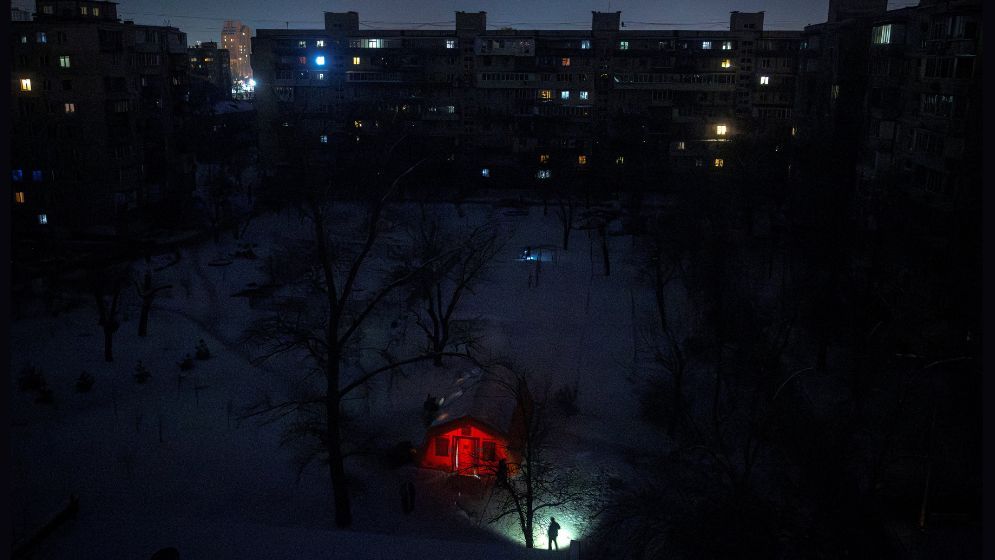
A person carrying a torch approaches a tent provided by emergency services for residents whose apartments are left without heating during sub-zero temperatures, amid Russia's attack on Ukraine, during a winter night in Kyiv, Ukraine, 17 January 2026. Photo: REUTERS
Collecting snow for water at home; sleeping in gloves, coats
and hats; heating bricks on gas stoves for warmth; erecting tents indoors –
Kyiv residents are doing everything they can to survive the coldest, darkest
winter of the war.
On Wednesday, around 60% of Kyiv was still without
power a day after Russian strikes on energy facilities knocked out
power for over a million households, the country’s president Volodymyr
Zelenskiy said.
"When there is no electricity, there is no heating: it
means the apartment freezes," said Anton Rybikov, father of three-year-old
David and two-year-old Matvii, speaking to Reuters in their home, where he and
his wife Marina have stocked up on backup batteries and sleeping bags.
The 39-year-old military chaplain said one of his sons
recently contracted pneumonia after temperatures in the apartment fell to 9
degrees Celsius (48 Fahrenheit) during a power blackout of more than 19 hours
following Russian airstrikes.
"It's emotionally very difficult. There is constant
worry," Rybikov added, as he prepared to heat water in a metal milk churn.
"This winter is the hardest."
Russia has intensified its attacks on Ukraine's energy
infrastructure in recent months, concentrating missile and drone strikes on the
cities of Kyiv, Kharkiv and Dnipro.
British military intelligence estimated that Russia launched
55,000 unmanned aerial systems at Ukraine last year, around five times the
number in 2024, according to one of its regular reports on the war posted on X.
Ukraine has called for more Western air defences to cope
with the drone and missile barrages.
With temperatures plunging to minus 18 degrees Celsius
across snow-covered Kyiv, the attacks mean hundreds of thousands of the
capital's three million residents are struggling with lengthy interruptions to
power and water supplies.
Simple routines like showering and cooking are now a
challenge. For the first time since the full-scale Russian invasion nearly four
years ago, the government last week declared a state of emergency related to
the energy crisis.
Strikes aim to 'break Ukrainians' spirit'
Russia says its attacks on Ukraine are designed to degrade
its military and denies targeting civilians.
Kyiv mayor Vitali Klitschko told Reuters that the strikes on
the capital were meant to "break resistance, break the Ukrainians' spirit,
to do everything for people to become depressed and pack their bags and vacate
the territory."
"Kyiv has always been and remains the target for the
aggressor," he said in an interview in his office.
Across the city, thousands of people now gather in schools
and at makeshift street "invincibility points" where generators allow
them to warm up, charge their phones and connect to the internet.
At a food distribution point in Kyiv run by World Central
Kitchen, 66-year-old pensioner Valentyna Kiriiakova queued for hot food along
with her granddaughter, Yeva Teplova.
"We don't complain," said Kiriiakova, whose high-rise
apartment had no power, leaving her unable to cook. "We understand that
there is a war going on and we have to endure. We have to survive."
Russia's onslaught on Ukraine's energy system has led to
power and water outages in Kyiv that typically last three to four times longer
than previous winters.
Economy Minister Oleksii Sobolev said that since October,
Russia had damaged 8.5 gigawatts of Ukraine's generation capacity — nearly half
of typical power consumption — forcing record electricity imports.
Russia has also struck Ukrainian gas production facilities,
said energy company Naftogaz. The central bank governor said late last year
that Ukraine lost about a half of its gas output, forcing it to spend more on
imports.
"Ukraine's energy system is not broken, but it is
operating in a mode of constant degradation," said Olena Lapenko, general
director for safety and resilience at energy think-tank Dixi Group.
Energy emergency
Schools and universities have extended their winter
holidays, and many companies have moved to remote work or reduced their
operating hours.
Dozens of repair teams hurry across Kyiv from site-to-site
to patch up the damage caused by Russian strikes.
"There is a lot of work. The grids cannot withstand
such pressure all at once," said Hennadii Barulin, 55, a digger operator,
as his team worked to restore power to residents.
"This is a real winter. It is very difficult to break
through the ground, through the asphalt, through everything."
Sobolev said Ukraine's stocks of energy equipment had been
depleted and that urgent financial support of about $1 billion was required to
deal with the current emergency.
Ukraine's Western partners rushed in hundreds of generators,
powerful batteries and industrial boilers to help cover some gaps, according to
the foreign ministry.
Newly appointed Energy Minister Denys Shmyhal said Ukraine
has made some progress installing small, independent generation capacity to
reduce reliance on the heavily centralised, Soviet-era system. He said 762
megawatts were installed in 2025, compared with 225 megawatts in 2024.
"Given the critical state of the energy sector, such
pace is clearly insufficient."
Shmyhal also said Kyiv lagged behind other Ukrainian cities
in installing independent generation capacity – criticism the mayor rejected.
With freezing temperatures forecast for several more weeks
and further Russian strikes expected, energy experts say the situation is
unlikely to improve soon.
Rybikov said he would consider sending his sons out of Kyiv
if the blackouts worsen.
"We need the warmth so that the children do not freeze.
The rest we will get through," he said. "If there is a blackout, I
will send the children away."