



 For all latest news, follow the Daily Sun's Google News channel.


Damien Rice wrote Cheers Darlin' drunk, at three in the morning, still wearing the clothes from an evening that had ended the wrong way.
He had met someone at a bar. There had been something like a current, a possibility, a moment where, had he leaned in, everything might have changed. Well of course, he didn't. She called her boyfriend. He came and took her home.
Rice went back to his flat, picked up his guitar, and sang, “I should have kissed you when we were alone.” The rest of the song is a toast, very bitter, boozy, beautiful. “Cheers darlin', here's to you and your lover boy. I got years to wait around for you.” He is not absent from the story. He was there. He had the moment. He simply didn't take it. And so now he stands at the bar with a glass raised to someone else's happiness, performing a grace he does not feel.
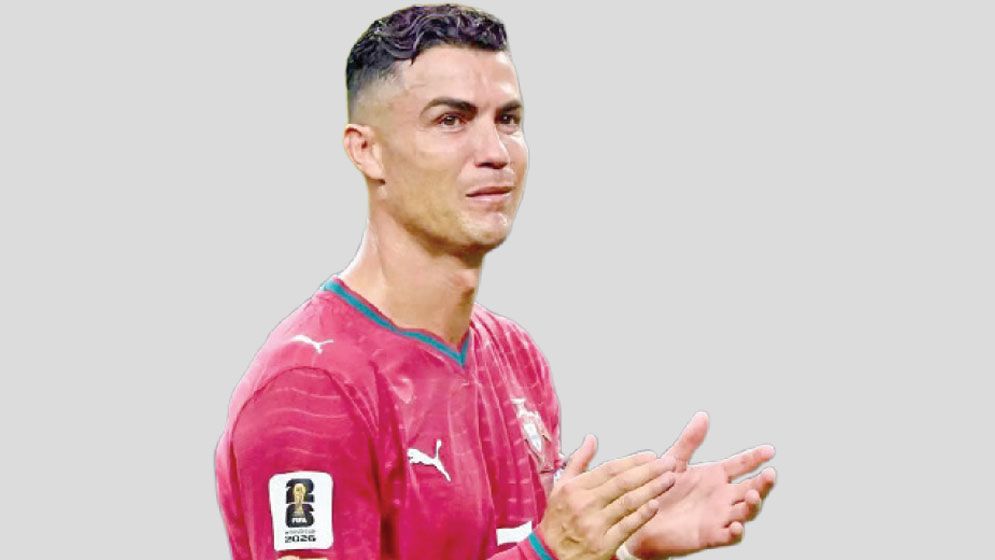
Cristiano Ronaldo has been at that bar for 20 years. Six World Cups and 27 appearances to show for his efforts. One semi-final in 2006, that too, in his debut, when he was 21 and full of fire and no one had yet named the thing he was racing against. Then a round of 16 exit, a group stage humiliation, and three more last-16 eliminations in a row. He was there. He was always there. And on Monday night in Arlington, Texas, Mikel Merino's 91st-minute goal against Portugal ended the final chapter and Ronaldo walked off the pitch, saying the things he has been practising for years. "I leave with a clear conscience." "The 2016 Euros title is on the same level as a World Cup. Honestly."
"I don't need it. I have a good life."
Last November, on Piers Morgan's show, he had gone a bit further, building the philosophy in advance, in case the tournament ended badly, which it did. "If you ask me, Cristiano, is it a dream to win the World Cup? No, it's not a dream," he said. "To define if I'm one of the best in history? To win one competition? Six games, seven games - you think it's fair?"
And then the closer, the one that landed hardest, "To win the World Cup, it won't change my name in the history of football. I'm not going to lie." Six games, seven games. A tournament that has made men weep in countless streets over the globe, that stopped wars in Ivory Coast, that gave Lionel Messi the one thing his genius was somehow missing was compressed, in Ronaldo's mouth, into a formality.
Rice's narrator, the morning after, could have said the same. She had a boyfriend anyway. “I was probably too good for her. I've got a beauty queen sitting not very far from me.” The rationalisation is human, forgivable, recognisable. What makes the song devastating is that Rice doesn't believe any of it and doesn't pretend to. He ends the song not with resolution but with a lot of questions, “What am I darlin'? A whisper in your ear? A piece of your cake? The boy you can fear? Or your biggest mistake?” That is not a man at peace. That is a man still asking. Ronaldo, to his credit, does not ask. He answers. He has always answered very loudly, decisively, with the full weight of his considerable self-belief deployed against the doubt. But the contradiction is its own kind of answer. In 2022, after Morocco knocked Portugal out in the quarter-finals, he posted on Instagram in grief, "Winning a World Cup for Portugal was the biggest and most ambitious dream of my career." He “fought” for it. He described it as the end of something. The word “dream” was there, unguarded and real. Three years later, the same dream was reclassified as a six or seven game inconvenience. What changed? Messi won it. Messi, given the same question, said simply, “There's nothing more after the World Cup. That was the missing piece. It was like closing out my entire career with that trophy."
He said it the way a man describes a thing he has held. Ronaldo describes it the way a man describes a thing he has decided he no longer wants.
Rice sings, “I got wedding bells in my ear.” The bells are there whether he wants them or not. The sound will not stop just because he raises his glass with a sneer. In Dallas, the bells rang for Spain. Ronaldo walked around the pitch, gave the fans a brief wave. He had been there before, in this stadium, metaphorically, six times. He had the chance on at least some of those evenings. In 2006 he was young enough. In 2022 Portugal were a better side than the one that eventually won the thing. He had the moment when they were alone. He didn't take it. Now the boyfriend has come to take the trophy home. And Ronaldo stands at the bar, glass raised, clear conscience, 2016 is the same as a World Cup, honestly and somewhere behind the stoicism, somewhere beneath the brand and the biceps and the relentless noise of being Ronaldo, the question Rice asked is still hanging in the air, unanswered.