



 For all latest news, follow the Daily Sun's Google News channel.


BETWEEN ISOLATION AND SURVIVAL
Why the next FTP may define Bangladesh’s place in world cricket
Muhammad Jubair, Dhaka
Published: 05 Feb 2026, 12:00 AM
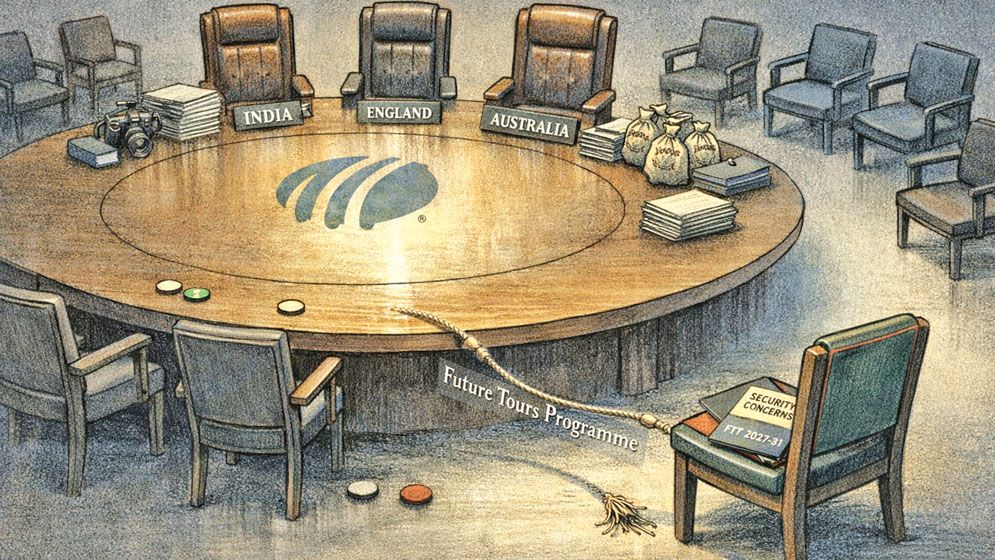
REPRESENTATIONAL AI IMAGE
Bangladesh cricket is now going through an unprecedented phase following their dramatic pullout from the forthcoming T20 World Cup, citing security reasons.
The Bangladesh Cricket Board (BCB) has effectively opened a Pandora’s box by taking on the International Cricket Council (ICC) and the Board of Control for Cricket in India (BCCI) by deciding to skip the forthcoming global tournament.
Many feel the Tigers’ future is in a state of uncertainty while there is widespread speculation surrounding Bangladesh’s position on the global cricketing stage.
To understand the depth of the situation and what lies ahead, Daily Sun spoke to multiple current and former BCB officials, as well as individuals familiar with international cricket administration, to assess the consequences of the World Cup snub and how Bangladesh might navigate its way forward.
What is the current state of Bangladesh cricket after the World Cup no-show?
By challenging the ICC and the BCCI over the decision to stage the T20 World Cup in India, the BCB has found itself in an uncomfortable position in the international cricketing ecosystem. According to officials familiar with the process, Bangladesh’s request to move the tournament from India to Sri Lanka due to security and political concerns received almost no support from other member boards.
When the matter was put to a vote, Bangladesh lost heavily by 14–2 margin, with Pakistan being the only board to vote in its favour. The scale of that defeat has led many within the cricketing fraternity to conclude that Bangladesh currently does not enjoy much backing among the ICC’s Full and Associate Members.
That result has raised critical questions about Bangladesh’s diplomatic standing in world cricket at a time when the next Future Tours Programme (FTP) is approaching. With the current FTP cycle nearing its end, boards are already beginning to negotiate bilateral tours and scheduling priorities for the next cycle.
If Bangladesh is indeed isolated within ICC circles, it could have serious implications for how many high-profile tours the national team receives in the coming years.
Financial impact of missing the T20 World Cup
There is, of course, a financial dimension to Bangladesh’s absence from the T20 World Cup.
Under ICC regulations, each participating team in the 2026 T20 World Cup would receive approximately Tk3.30 crore simply for taking part. Bangladesh will now miss out on that participation fee. Beyond that, teams earn additional prize money for progressing through different stages of the tournament.
Bangladesh’s absence also means its players will personally lose out on earnings, including match fees, performance bonuses and prize money — a significant issue in a country where many players rely heavily on international cricket income.
However, senior BCB officials insist that, while the loss is regrettable, it does not pose an existential threat to the board’s finances.
The BCB’s biggest revenue source remains its annual ICC distribution, which is estimated at around Tk350 crore. In contrast, the board’s annual operational budget is roughly Tk250 crore, leaving a surplus of around Tk100 crore each year. In addition, the BCB earns substantial income from fixed deposits and other financial instruments. With comparatively low operational costs inside Bangladesh, the board has been able to run its cricketing programmes without major cash-flow problems.
“The World Cup money is helpful, but it does not define the BCB’s survival,” one official noted. “Our financial structure is not built around one tournament.”
However, things might change if ICC decides to impose fine on BCB for not taking part in the tournament, a possibility that cannot be ruled out.
“If ICC sanctions us because we did not take part in T20 World Cup, in that case we might feel some pinch, considering that they will determine it on the basis of losses they are likely to incur from broadcast due to absence of Bangladesh in the tournament as the Tigers have a huge fan following,” said the official.
The India series in question
One of the biggest concerns in the Bangladesh cricket arena is whether the BCB is overly dependent on hosting India.
India is by far the most commercially attractive opponent in world cricket, and an Indian tour of Bangladesh brings massive interest from broadcasters, sponsors and advertisers. But does that mean the BCB’s future depends on India?
According to both current and former BCB officials, the answer is no.
“I will put it this way,” said a former senior official. “The BCB doesn’t really sell the India series — or, if you like, it can’t sell it. So we were never heavily dependent on Indian money the way some other boards are. Yes, it generates big revenue and huge interest, but it is not our financial backbone.”
A current BCB official echoed that view.
“One benefit of India touring is that Indian sponsors come along with them,” he said. “That helps. Otherwise, it mostly balances the books. You might host a weaker team that is not very profitable, then India or Australia comes in and the big series makes up for it.”
India last toured Bangladesh in 2022, when the two sides played three One Day Internationals and two Tests. They were also scheduled to tour Bangladesh in 2025 for an all-white-ball series, but political instability led to that tour being postponed to this year.
After the T20 World Cup controversy however, doubts have emerged over whether India will still tour Bangladesh as planned — a question that remains unanswered.
The IPL future
Another major concern is the Indian Premier League (IPL).
There has been widespread speculation that the BCCI might restrict or ban Bangladeshi players from participating in the IPL as retaliation for Bangladesh’s stance against India.
However, BCB officials believe that is unlikely.
“I don’t think the BCCI will ban Bangladeshi players or stop them from playing the IPL,” said a current official. “Bangladesh is a big market, and the IPL makes money from Bangladesh. Commercial logic will win.”
Bangladeshi players have not historically featured heavily in the IPL, but the league still attracts millions of Bangladeshi viewers, making the country an important market for Indian broadcasters and advertisers.
Cricket diplomacy — Bangladesh’s next move
With Bangladesh facing a degree of isolation, cricket diplomacy will now be more important than ever.
A former BCB official who previously worked in international correspondence explained that communication is crucial.
“What we say is the biggest issue,” he said. “We talk a lot. Sometimes we say the right thing, but sometimes we say things that should not be said. Those things get picked up and damage relationships. We need fewer voices and more discipline. If we do that, this situation can be solved through diplomacy.”
He added: “Diplomacy sounds like a fancy word, but that is exactly what international cricket administration is — managing relationships with other boards.”
The official believes that the World Cup snub itself is not catastrophic, but warned that Bangladesh’s next steps will define whether the situation improves or deteriorates.
“I don’t think Bangladesh are in a serious problem right now. It is not a huge loss. But things can go either way — better or worse. This is a new type of challenge for Bangladesh cricket.”
FTP and Bangladesh’s future
The FTP is the real battlefield.
Since 2014, when the ICC effectively shifted power to the so-called ‘Big Three’ — India, England and Australia — bilateral cricket has become increasingly commercial.
Previously, stronger teams were required to play weaker nations at least once in a 24-month period. That safeguard no longer exists.
“Earlier, you could think about cricket a bit more. But since 2014, it has all become business. There are no real rules. The big teams keep playing series after series, while the rest are left begging for cricket. That is why cricket diplomacy has grown. You have to find a win-win situation for everyone, with benefits involved. If I play you, you support me at ICC meetings — it has become an unwritten rule,” he said. He described the new system as an unwritten political economy.
“But cricket should have some level of balance. Otherwise it becomes like a milk business — you start compromising on quality and mixing in water. From that point on, voting, dependency, relationships and mutual backing all began to shape the game,” he added.
Despite this, Bangladesh has, over the last decade, established itself as a regular presence in international cricket through careful diplomacy.
“Mushfiqur (Rahim) used to say, ‘I debuted in that year, and players from that country debuted after me but have now gone past me in the number of matches.’ Back then, we used to see headlines like: Bangladesh playing Test matches after a certain number of months and so on. Now things have changed. From that situation, we have come to a point where players are fatigued. We have to maintain that position,” he said.
A current BCB official remains confident that Bangladesh will not be shut out.
“As long as the ICC championships continue, we should not have problems,” he said. “We will get six Test Championship series in two years. That is guaranteed.”
But even he acknowledged that political tensions — particularly with India — could complicate matters.
“We have very good relations with other boards, including India,” he said. “If India does not play any role from behind, and our political situation remains stable, then there should not be any issues.”
Recommended Stories
Pakistan–India head-to-head
Following the snubbing of Bangladesh from the T20 World Cup, Pakistan showed solidarity by announcing a boycott of their group-stage match against arch-rivals India. However, this perceived collaboration with Pakistan may not help Bangladesh in the long run.
Former BCB director Sirajuddin Mohammad Alamgir explained the situation by outlining Bangladesh’s vulnerable position in the global game.
“Look, we’re not a superpower in cricket. We’re a growing nation. Now imagine if the ICC stops supporting us. Pakistan can survive something like that because they have a legacy and a long history. But if Bangladesh has to ‘survive’ like this, the damage will be far greater for Bangladesh,” he said.
“If Pakistan thinks Bangladesh is creating a new front, then Pakistan knows it has the strength to absorb the pressure that will come from it. But Bangladesh does not have that strength — and will not have it either. Look at the financial strength the BCB has: you could say it exists mainly because of ICC events. You could also say many of those opportunities came through ICC favour. You got the Asia Cup, you got the World Cup, and you got big series,” he added.
“Now imagine the ICC starts avoiding you — India avoids you, Australia avoids you, England avoids you. You won’t get any major events here. So what does that loss really mean? It’s not just financial loss. It also means our players won’t get the chance to play against the best performers. That means there will be no top-level cricket. And it’s not just about the national team. It’s about the age-group teams too. If India don’t tour, if Australia don’t come, if New Zealand don’t come — and if that doesn’t happen — then because we won’t be playing competitive cricket, it will directly affect our performers,” he explained.