



 For all latest news, follow the Daily Sun's Google News channel.


“Morality is an invaluable asset in human life. A person devoid of moral integrity can never stand with dignity in society.”
This statement was written by Prof Md Ataullah, a professor in the Department of Persian Language and Literature at the University of Rajshahi, and published in the 24th issue of the Rajshahi University Faculty of Arts Research Journal (December 2017), which carries ISSN 1813-0402.
Ironically, questions have been raised over his academic practices.
According to a Daily Sun investigation, Prof Ataullah obtained his PhD degree in 2011 for research on Nizami Ganjavi, considered one of the greatest romantic epic poets in Persian literature.
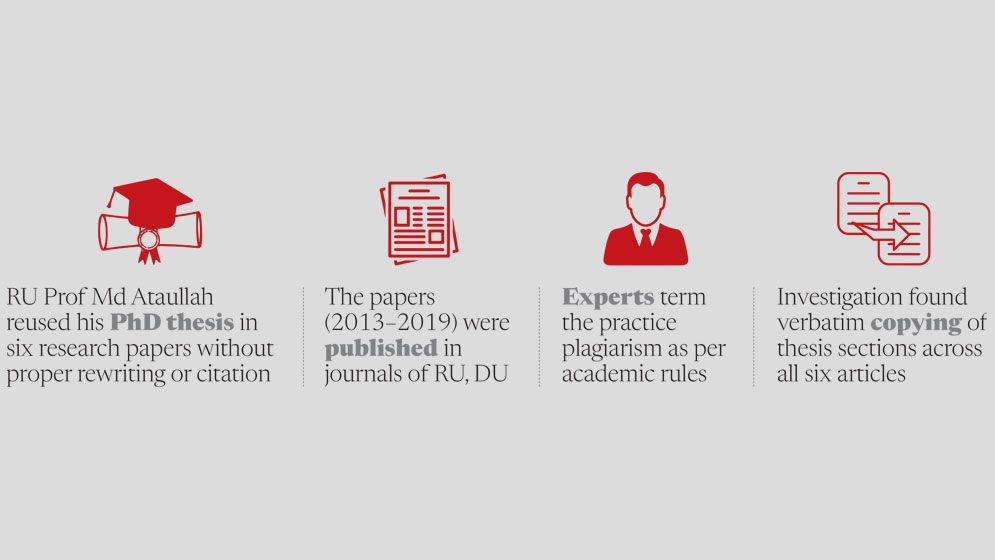
However, between 2013 and 2019, he authored six research articles on the same subject without editing or paraphrasing, which was published in the arts faculty research journals of the University of Rajshahi and the University of Dhaka.
These publications have been described by critics as highly unethical, academically questionable and unlawful under plagiarism rules as well as international standards.
Dr Syed Anwar Husain, a prominent academician and historian, told the Daily Sun that rephrasing and acknowledgement were essential. The language must be changed and proper credit must be given, either in endnotes or footnotes.
Without this, he said, the work would be considered plagiarism.
According to the University of Oxford, plagiarism is defined as presenting work or ideas from another source as one’s own, with or without consent, without full acknowledgement. The definition covers all published and unpublished materials, whether in manuscript, printed or electronic form, as well as the use of material
generated wholly or in part through artificial intelligence, unless authorised. It also includes reusing one’s own work without citation and treats intentional or reckless plagiarism as a disciplinary offence.
The Daily Sun collected copies of the articles and the PhD thesis of Prof Ataullah. It found that he reproduced page after page verbatim from his thesis in all six articles, disregarding internationally accepted research methodology.
Analysis shows that, in each paper, the introduction, biographical section and author profile were directly copied from different parts of his thesis. In all six articles, several statements in the introduction and the short biographical overview of Nizami Ganjavi are identical, which falls under academic plagiarism. In the main body, relevant sections from the PhD thesis were copied verbatim, including punctuation marks, without any citation.
In article no. 1, titled “The Poetic Talent of Nizami Ganjavi: A Review,” the introduction and biographical parts were taken from pages 1, 53, 54, 55, 57 and 58 of the thesis. The main body reproduced content from pages 101 to 117 without reference to the thesis.
In article no. 2, titled “The Influence of the Holy Quran in the Poetry of Nizami Ganjavi,” the introduction and biographical section were copied from pages 53, 57 and 58, while the main section was reproduced verbatim from pages 147 to 161 without citation. In article no. 3, titled “Wisdom in the Poetry of Nizami Ganjavi,” the introduction and biographical section were taken from pages 53, 54 and 57, and the main body copied from pages 140 to 147 without reference.
In article no. 4, titled “The Diversity of Themes in the Poetry of Nizami Ganjavi,” the introduction and biographical section were copied from pages 164, 54, 57 and 74, while the main section reproduced pages 164 to 173 without any citation.
In article no. 5, titled “Morality in the Poetry of Nizami Ganjavi,” the introduction and biographical section were copied from pages 134 and 58, and the main body reproduced pages 134 to 140 without reference to the thesis.
It was published in the Faculty of Arts Journal, Vol. 24 (2017), which was issued under the then Dean of the Faculty, Prof Dr FMAH Taqui.
Speaking to the Daily Sun, he said that even if the material was taken from the author’s own thesis, it still required revision and modification before publication.
In article no. 6, titled “The Philosophical Thoughts of Nizami Ganjavi,” the introduction and biographical section were taken from page 57, while the main section copied pages 122 to 132 and 135 without citation.
Meanwhile, he did not mention his supervisor as a co-author, although he used sentences from a 2016 published article in a 2017 paper.
Prof Dr Md Abu Reza, director of the Institutional Quality Assurance Cell at the University of Rajshahi, said that according to protocol, the supervisor was usually the corresponding author as they hold a permanent position at the university and serve as a reliable point of contact for future communication regarding the data or research.
He added that even if it was one’s own writing, once an article has been published, the same paragraph or text cannot be reused in any subsequent paper.
According to a research guide, self-plagiarism occurs when an author reuses previously submitted or published work without proper citation or disclosure, misleading readers about the originality of the submission.
The rules for the prevention of plagiarism at the University of Dhaka, under part-1, clause 5.1(h), define republishing or reusing one’s own work without acknowledgement as self-plagiarism.
When the Daily Sun contacted Prof Ataullah, he was asked whether he wrote the six articles from his PhD thesis without referencing. He responded positively. He further said that the articles did not violate university rules and suggested contacting higher authorities.
Dr Md Faridul Islam, vice-chancellor of the University of Rajshahi, told the Daily Sun he had no information about the matter but would proceed according to university laws and regulations if evidence was found.
Seeking position at DU
The professor has applied for a vacant post as professor in the Persian department at the University of Dhaka where at least 12 research articles are required.
Sources said Prof Ataullah listed these six articles, but the Curriculum and Development Committee did not detect the self-plagiarism when scrutinising his documents.
Dr Md Mumit Al Rashid, chairman of the Department of Persian Language and Literature at the University of Dhaka, told the Daily Sun that plagiarism was not checked during the meeting.
He said the committee would discuss the matter further after being informed.
Read More