



 For all latest news, follow the Daily Sun's Google News channel.


DU delegation joins research symposium in Japan
Daily Sun Report, DU
Published: 09 Oct 2026, 07:03 PM
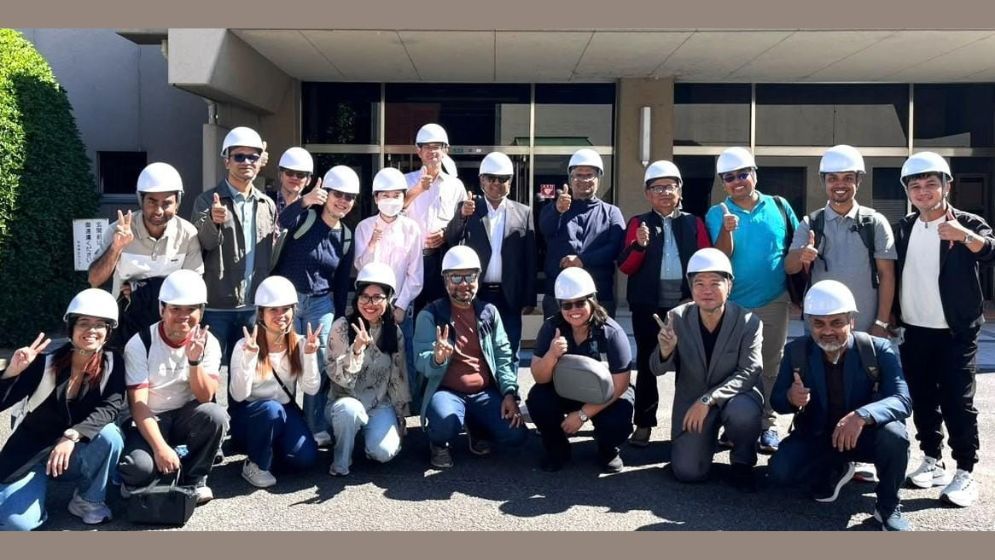
Photo: Daily Sun
A six-member delegation from the University of Dhaka (DU), led by Pro-Vice-Chancellor (Academic) Prof Abdus Salam, participated in an international symposium on chemical risk management and environmental protection at Ehime University in Japan from 6 to 8 October.
The JSPS Core-to-Core Symposium on One Health Approaches to
Chemical Risk Management brought together researchers from Bangladesh, Japan,
the Philippines, Thailand, Malaysia, Indonesia, Vietnam, Mozambique and other
countries to discuss research and strategies for protecting public health and
ecosystems from chemical pollution.
The delegation included Prof Md Humayun Kabir, dean of the
Faculty of Earth and Environmental Sciences; Prof Mohammad Mamun Chowdhury,
chairman of the Department of Fisheries; Prof Anwar Hossain and Dr Md
Habibullah-Al-Mamun of the Department of Fisheries; and Associate Professor KM
Azam Chowdhury of the Department of Oceanography and director of the
International Centre for Ocean Governance (ICOG).
The Centre for Marine Environmental Studies (CMES) at Ehime
University organised the symposium, with Leading Academia in Marine and
Environment Pollution Research (LaMer) as co-organiser and support from the
Japan Society for the Promotion of Science (JSPS).
Prof Kozo Watanabe, deputy director of CMES and head of its
Office for International and Social Cooperation, initiated the programme and chaired
its organising committee.
The symposium focused on research priorities for sustainable
development in South and Southeast Asia, particularly ways to reduce the
environmental impact of chemicals used in medicine, agriculture, aquaculture
and animal husbandry while safeguarding public health and livelihoods.
Participants took part in oral and poster presentations,
plenary sessions and special talks.
During the first oral session, Prof Abdus Salam presented an overview of air quality in Bangladesh, discussing its status, sources and effects on human health.
Prof Humayun Kabir presented a poster on fire hazards associated with chemical warehouses in the Dhaka South City Corporation area.
Prof Mamun Chowdhury presented research on the effects of
dietary selenium and zinc nanoparticles on the growth of pangasius in
Bangladesh.
Prof Anwar Hossain discussed antibiotic contamination and
antimicrobial resistance in Bangladesh's aquatic environments, outlining
strategies to mitigate the associated risks.
Meanwhile, Dr KM Azam Chowdhury presented a poster on
seasonal variations in dissolved oxygen dynamics and the oxygen minimum zone in
the northern Bay of Bengal, based on a study combining modelling and
observational data.
Alongside the symposium, ICOG and CMES held a bilateral
meeting on 8 October to explore opportunities for academic cooperation and
joint research.
Prof Abdus Salam led the meeting, while Prof Xinyu Guo
represented CMES. Prof Akihiko Morimoto, director of CMES, also attended.
Dr KM Azam Chowdhury presented ICOG's research activities at
the meeting. Prof Abdus Salam emphasised the importance of strengthening ocean
research, modelling and forecasting, expressing hope for collaboration with
CMES in these areas.
He also highlighted the relevance of CMES's work on
physical-ecosystem interactions and pollution-coupling models to the
development of Bangladesh's blue economy.
The marine research of Prof Morimoto was also identified as
valuable for advancing the country's marine sector.
The two sides exchanged crests and discussed future academic
exchanges and joint research initiatives. They also agreed to move forward with
a memorandum of understanding (MoU) between the University of Dhaka and Ehime
University.
The proposed agreement is expected to be signed soon under
the supervision of DU Vice-Chancellor Prof ABM Obaidul Islam.
Both sides expressed hope that the MoU would create new
opportunities for collaborative research, faculty and student exchanges, and
capacity building in marine science, environmental monitoring and public
health.