


 For all latest news, follow the Daily Sun's Google News channel.


AI-based Applied ICT to be game changer in future job market: NU VC
Daily Sun Report, Gazipur
Published: 19 Jul 2026, 11:56 PM
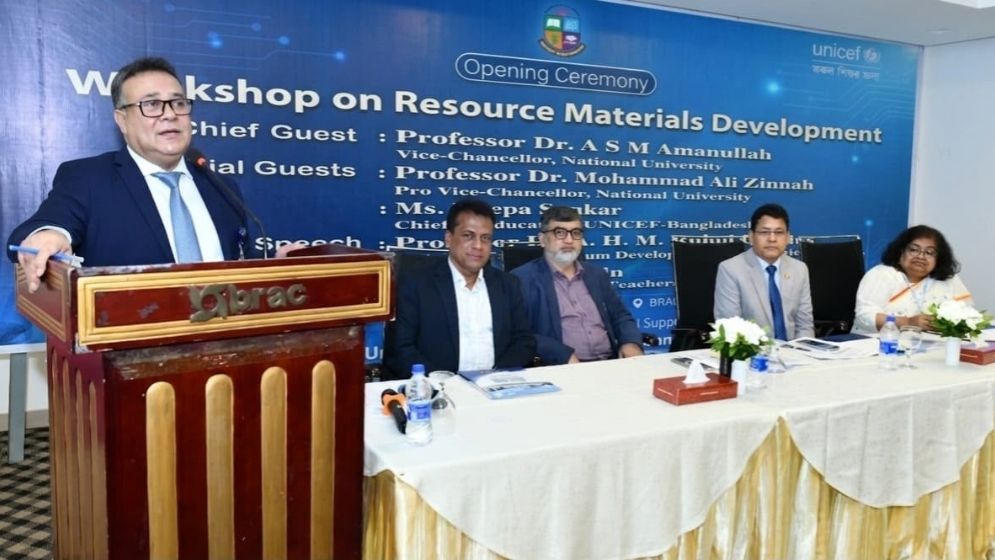
Photo: Daily Sun
National University Vice-Chancellor Prof ASM Amanullah has said artificial intelligence-based Applied ICT will be a game changer in the future job market.
“Higher
education must develop skilled, creative and responsible human resources
capable of leading in a changing world,” he said, stressing that digital
competence and the ability to solve practical problems through information
technology were essential for every student.
He
made the remarks as the chief guest at the inaugural ceremony of a four-day
workshop titled ‘Resource Materials Development’ at BRAC CDM in Savar on
Sunday.
National
University organised the workshop with technical support from UNICEF Bangladesh.
Considering
current technological realities, National University has made Applied ICT
compulsory for students of all subjects in the second year of its Bachelor
(Honours) programme, the vice-chancellor said.
Amanullah
said the country had failed to develop an advanced and timely curriculum
despite more than five decades of independence.
While
there were debates over the quality of education and certificates at National
University, he said many of its graduates had established themselves in
important positions at home and abroad through their own merit.
However,
many students were being deprived of job-market skills because of a lack of
skills-based curricula, he said, adding that policymakers, rather than students
or teachers, were responsible for the situation.
The
ongoing reforms at National University aim to prepare students for their future
careers, he said.
By
making ICT education practical and application-oriented, students will gain
skills in cybersecurity, digital marketing, the gig economy and freelancing,
preparing them for higher education and the global job market, he added.
Highlighting
his recent visits to educational institutions in Rajshahi, Bogura and Naogaon,
Amanullah said students in remote areas were persevering despite inadequate resources
and teacher shortages.
In
some cases, a single teacher was required to conduct an average of 16 to 17
classes, he said. Even in the absence of ICT labs, teachers were conducting
classes using projectors.
The
issues had been reported to the relevant departments, which had assured him of
swift action, he added.
Amanullah
said the National University had undertaken significant investments and
multifaceted initiatives for the 2026-27 academic year to enhance students’ ICT
skills.
He
described the technical partnership with UNICEF Bangladesh as an example of
effective collaboration in implementing the reforms.
The
workshop was moderated by Salma Parveen, director of the Teacher Training Department
at National University.
National
University Pro-Vice-Chancellor Prof Mohammad Ali Jinnah and UNICEF Bangladesh
Chief of Education Deepa Sankar attended the event as special guests.