


 For all latest news, follow the Daily Sun's Google News channel.


‘July Memorial Plaque’ inaugurated at JU
JUCSU Vice-President Abdur Rashid Jitu said commemorative programmes would be organised every year to preserve the memory of the July events for future generations
Daily Sun Report, JU
Published: 15 Jul 2026, 12:14 AM
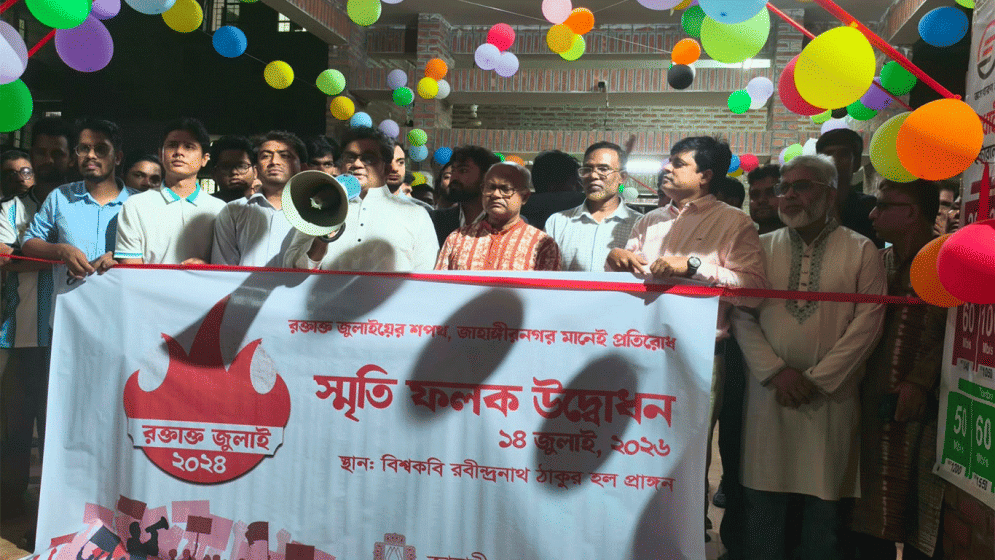
JU administration unveiling a memorial plaque in the campus on Tuesday. Photo: Daily Sun
A ‘July Memorial Plaque’ has been inaugurated in front of Rabindranath Tagore Hall at Jahangirnagar University (JU), commemorating the events of the July uprising.
Vice-Chancellor Prof Dr Mohammad Kamrul Ahsan
unveiled the plaque at around 8:30pm on Tuesday. Pro-Vice Chancellor (Academic)
Prof Dr Md Shamsul Alam, Pro-Vice Chancellor (Administration) Prof Dr Md Nazrul
Islam, Treasurer Prof Dr Md Abdur Rab, the provost of the hall, teachers,
students and university officials were present at the ceremony.
Speaking at the inauguration, the vice-chancellor
said the attack on students at Rabindranath Tagore Hall on 14 July 2024 marked
the beginning of the resistance movement at Jahangirnagar University.
“The movement against the discriminatory quota
system had already begun. But instead of responding to the students’ legitimate
demands, the then government chose repression,” he said. “History shows that
when students and the public unite, even the strongest opponents can be
defeated.”
Referring to the attack on 15 July, he said the
movement gained further momentum after the incident and eventually spread
across the country.
Describing the Jahangirnagar University Central
Students’ Union (JUCSU) election as one of the movement’s major achievements,
the vice-chancellor said students had regained representation in the
university’s decision-making process after 33 years.
He also claimed that the current administration had
improved residential facilities and the environment for coexistence on campus, saying
all students admitted over the last three academic sessions had been provided
accommodation. He added that students were now able to study in a normal
environment, free from the culture of overcrowded dormitory rooms and abuse.
“The changes were made possible through the
sacrifices of around 1,500 people who were martyred during the 2024 mass
uprising,” he said. “We remember them with deep respect, as well as the
students, journalists and teachers who showed courage during the movement.”
Announcing a series of programmes to commemorate the
July events, the vice-chancellor said 14 July was not merely the memory of a
single day but part of the university’s history of democratic movements. He
said the programmes were intended to help the new generation learn about that
history.
JUCSU Vice-President Abdur Rashid Jitu said
commemorative programmes would be organised every year to preserve the memory
of the July events for future generations.
He said a cultural programme would be held in front
of the vice-chancellor’s residence at 10:30pm on Wednesday, followed by a
symbolic blackout programme at midnight. He called on students to participate
in all the observances marking July.
Mohammad Rubel, a member of the convening committee
of the JU unit of Jatiyatabadi Chhatra Dal, who was involved in the initiative
to build the memorial plaque, said activists of the then Bangladesh Chhatra
League attacked students after they chanted slogans at Rabindranath Tagore Hall
on 14 July 2024.
He said students staged overnight protests following
the attack, and the incident later helped strengthen the Anti-Discrimination
Student Movement across the country.
“We have been demanding the construction of this
memorial plaque since the July movement,” he said. “It is not only a memorial
to a single incident but also a symbol of students’ struggle for justice,
equality, voting rights and democracy.”