


 For all latest news, follow the Daily Sun's Google News channel.


JU students urge univ admin to address existing crises before launching six new depts
Daily Sun Report, Jahangirnagar University
Published: 27 Jun 2026, 11:29 PM
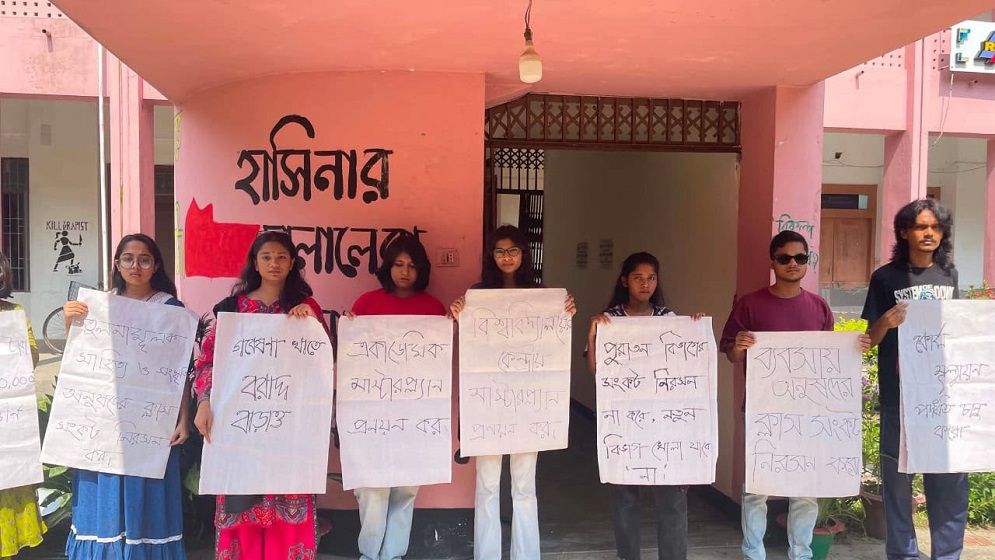
Photo: Daily Sun
Leaders of several progressive student organisations at
Jahangirnagar University (JU) on Saturday urged the university administration
to resolve longstanding academic and infrastructural problems in existing
departments before launching six new departments under the planned Institute of
Islamic Studies and Theology.
The students staged a sit-in in front of the Senate Building
around 2:00pm, ahead of the university’s 43rd annual Senate meeting, and later
submitted a memorandum to Vice-Chancellor Prof Mohammad Kamrul Ahsan.
The constitution of the proposed Institute of Islamic
Studies and Theology was placed before the Senate for consideration at the
meeting.
The proposed institute includes six departments: Al-Quran
and Islamic Studies, Al-Hadith and Islamic Studies, Islamic History and
Culture, Islamic Law, Fiqh and Jurisprudence, Islamic Philosophy, Ethics and
Comparative Religion, and Arabic Language and Literature.
The memorandum, signed by Sanjida Afrin of Jahangirnagar
Bachao Andolon, Tasnim Yasmin Tanvi of Nipironer Biruddhe Jahangirnagar
Platform, Faizan Ahmed Orko, general secretary of the Bangladesh Students’
Union JU unit, Sajib Ahmed Jenich of Socialist Students’ Front, and Soma Dumri
of Biplobi Chhatra Maitree, said they had learned through media reports that
the Senate might take a final decision on opening the six departments.
They argued that the university’s existing 37 departments
continue to face serious shortages of classrooms, laboratories and teachers,
while the university still lacks a comprehensive academic master plan.
The student leaders said launching new departments without
addressing these structural problems and formulating a long-term academic
roadmap would not be practical. They also pointed to the lack of adequate
residential facilities for students who would enrol in the proposed
departments.
In the memorandum, they also demanded increased allocations
for research, activation of research centres, a minimum Tk10,000 grant for
thesis research, establishment of a university printing press, resolution of
classroom and laboratory shortages, implementation of a full-fledged medical
centre, introduction of teacher evaluation, discontinuation of evening and
weekend programmes, and full automation of administrative services.
“Our objection is not to opening new departments. Our
concern is the tendency to make such decisions without considering the
university’s existing realities,” said Faizan Ahmed Orko.
He said JU currently has 37 academic departments but still
lacks a coordinated academic master plan. Many departments continue to suffer
from classroom shortages, delays in examinations, session backlogs and academic
year gaps, while allocations for the Central Computer Centre have not been
increased and administrative automation has seen little visible progress.
“We consider the
initiative to open six new departments unreasonable without first resolving
these fundamental problems in the existing departments,” he said.
Orko also said the university suffers from significant infrastructure
deficiencies, including the absence of a modern sewerage system and a
university-owned printing press, while many development projects have been
carried out without adequate planning, affecting the campus environment and
overall sustainability.
He urged the administration to formulate an integrated academic and infrastructure master plan before expanding academic programmes, noting that the Faculty of Business Studies, the Institute of Comparative Literature and Culture (ICLC), the Law department and several other academic units continue to face acute classroom shortages. “Opening new departments before addressing these basic problems is not a realistic decision,” he added.