


 For all latest news, follow the Daily Sun's Google News channel.


Face of capital market to change within one year: Amir Khosru
BSS, Dhaka
Published: 04 Oct 2026, 10:38 PM
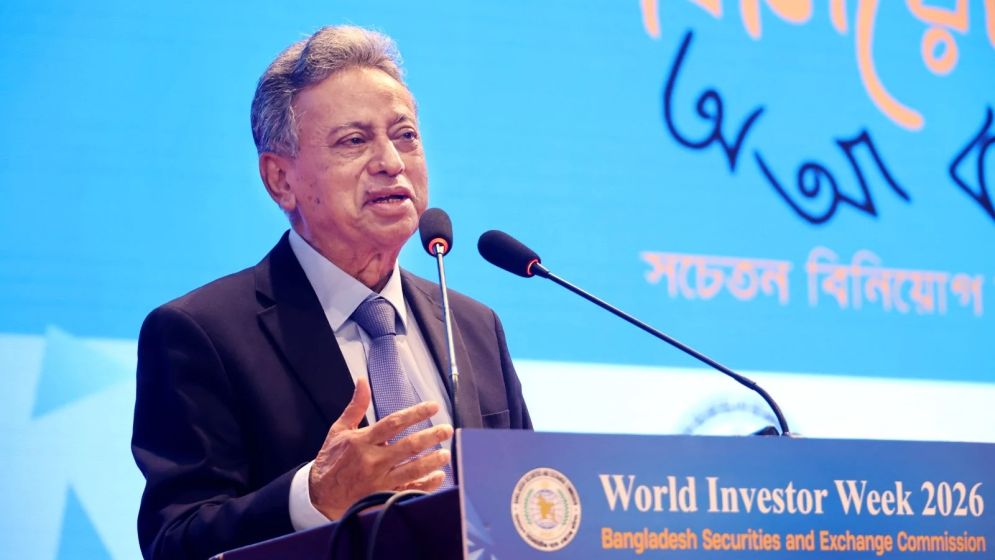
Photo: BSS
Finance Minister Amir Khosru Mahmud Chowdhury on Sunday said
the face of Bangladesh's capital market will change within the next one year as
the government has undertaken a comprehensive initiative to revive and deepen
the market.
"We are trying to revive the capital market through a
holistic approach. Inshallah, within the next one year, you will see a changed
face of the Bangladesh capital market," he said.
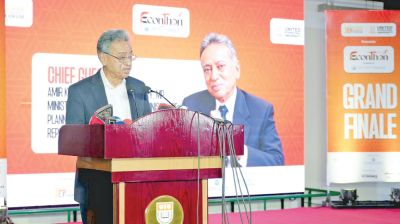
The finance minister was speaking at the inauguration of the
World Investor Week 2026 at the Krishibid Institution Bangladesh Auditorium in
the capital.
On the occasion, Special Assistant to the Prime Minister for
Investment and Capital Market Affairs Tanvir Shahriar Ghani spoke as the guest
of honour.
Secretary of the Financial Institutions Division of the
Ministry of Finance Nazma Mobarek and Chairman of the Insurance Development and
Regulatory Authority Mir Nadia Nivin spoke as special guests.
Bangladesh Securities and Exchange Commission (BSEC)
Chairman Masud Khan chaired the programme.
BSEC Commissioner Hossain Sadat gave the welcome address
while another BSEC Commissioner Tanwir Habib Rahman made a power-point
presentation at the event.
DSE Chairman Mominul Islam and Bangladesh Association of Banks (BAB) Chairman Abdul Hai Sarker also spoke.
Khosru said the government has already taken a number of
measures to strengthen the capital market, including institutional reforms,
automation, the establishment of the Central Depository Bangladesh Limited
(CDBL) and development of necessary infrastructure.
But the market failed to achieve its expected potential
because subsequent reforms and policy support did not continue adequately, he
said.
"Some institutional changes took place, automation was
introduced, CDBL was established and infrastructure was developed. But
unfortunately, subsequently, things did not work," the minister continued.
He said the capital market now needs a practical
"rescue operation" and "salvage operation", which may
require difficult decisions for some stakeholders.
The finance minister said Bangladesh is now moving towards a
fundamental change in its financial architecture instead of relying excessively
on traditional sources of financing.
"Those days are over. We are changing the financial
architecture of Bangladesh," he said, adding that the government also seeks
to transform the country's public finance and private-sector financing
structures.
He said the government wants businesses to raise funds
through the market rather than relying heavily on banks at high interest rates.
"Why will you borrow so much money from banks at such
high interest rates? There is no need," Khosru said, stressing the need to
reduce the cost of funds through a stronger capital market.
He said the government is also working to develop a range of
financial products for both the private sector and the government, including
different types of bonds.
"We are talking about securities. We are moving towards
securities. There are many products for the private sector and the
government," he said.
Khosru said the government cannot continue financing
commercial activities with taxpayers' money.
"Find your money in the market and make money to repay
the government. Government cannot run enterprises and behave like a cheque
writer," he said.
Referring to the International Monetary Fund (IMF), Khosru said
Bangladesh needs to reduce its dependence on external financing and mobilise
resources from the international market.
"We have cancelled the IMF programme. You know, you
have seen it. I cancelled the IMF programme because its conditions were not
acceptable to us," he said.
He said Bangladesh needs substantially larger annual
financing to achieve its development ambitions and cannot depend solely on
multilateral lenders.
"I am going to the market. I am going to raise my
money," he said. The finance minister said the government is preparing to
access international capital markets through different instruments and
initiatives.
He said Bangladesh is considering floating a dollar bond in
New York and launching a Bangladesh-dedicated fund in Hong Kong, alongside
other instruments such as panda bonds, samurai bonds and local-currency bonds.
"We are changing the financial architecture of
Bangladesh," he said, adding that the country needs to build its capacity
to mobilise funds from international capital markets.
Khosru also referred to his recent engagement with the
international financial community in New York.
He said he was surprised by the level of knowledge and
interest among international investors about Bangladesh's capital market.
"I was surprised. I did not expect Wall Street to know
so much about the Bangladesh capital market," he said.
He said the response reflected growing confidence in
Bangladesh's leadership, deregulation initiatives and professional development
of the capital market.
"We have taken the plunge. We have to go to Wall Street
and send the message," he said.
Khosru said the capital market cannot develop through the
efforts of the Bangladesh Securities and Exchange Commission (BSEC) alone.
"BSEC cannot do this alone. Everybody has to do it
together," he said.
He identified regulators, banks, insurance companies, the
National Board of Revenue (NBR), Bangladesh Bank, financial reporting
institutions, accountants, exchanges, brokers and other market participants as
important components of the capital-market ecosystem.
He said the stakeholders previously worked largely in
isolation. "Everybody has been functioning like islands, like silos.
Everybody was working in their own place, but they were never connected,"
he said.
According to him, lack of coordinated efforts has remained
one of the major weaknesses of Bangladesh's capital market.
"We never had a coordinated effort," he said,
calling for a combined effort among all stakeholders to build a sustainable
market ecosystem.
The finance minister also urged market participants and
professional organisations to strengthen self-regulation, transparency and
professional standards.
"Please self-regulate," he told the stakeholders.
He said market confidence and credibility depend on the
ability of professional and self-regulatory organisations to maintain standards
without excessive dependence on government intervention.
"Trust and credibility come when we develop
self-regulatory institutions and build their capacity," he said.
He also urged financial reporting professionals and
accountants to improve the quality and credibility of corporate financial
statements, saying investors and the financial sector depend heavily on
reliable financial reporting.
Companies with good governance and a commitment to
self-regulation would be more likely to participate in the capital market if
the government and regulators could create an appropriate environment, Khosru
said, adding, "If we create the environment, there is no dearth of
companies. They are waiting."
The finance minister said confidence has started returning
to Bangladesh's capital market following recent reform initiatives.
He said multinational companies are considering investment
opportunities in Bangladesh and international investors are showing greater
interest in the country's capital market.
"Many multinationals are thinking about bringing
capital to Bangladesh," he said.
He, however, stressed that maintaining investor confidence
requires professionalism, transparency, effective regulation and coordinated
action by all stakeholders.
Khosru also recalled his experience as commerce minister,
when exporters faced administrative difficulties in obtaining utilisation
declaration certificates from the Export Promotion Bureau.
He said the government could transfer certain regulatory
responsibilities to capable self-regulatory organisations if those
organisations demonstrate that they can regulate themselves effectively.
"If you can self-regulate, then we can give you that
authority," he said, citing the example to underline the importance of
effective self-regulation.
The minister called upon all stakeholders in the
capital-market ecosystem to work together instead of spending time debating
past failures.
"We do not need to waste time discussing what happened
in the past. Going forward, we have to think about professionalism,
self-regulation and transparency," he said.
He expressed optimism that coordinated implementation of the
reforms would strengthen the capital market and contribute to a broader
transformation of Bangladesh's financial architecture.
The World Investor Week programme seeks to enhance investors' knowledge and awareness and encourage informed, safe and responsible investment in the capital market.