


 For all latest news, follow the Daily Sun's Google News channel.


CAPITAL MARKET IN FOCUS – PART 1
Dead companies, live trading
Factories closed, offices locked – yet investors crowd the shares

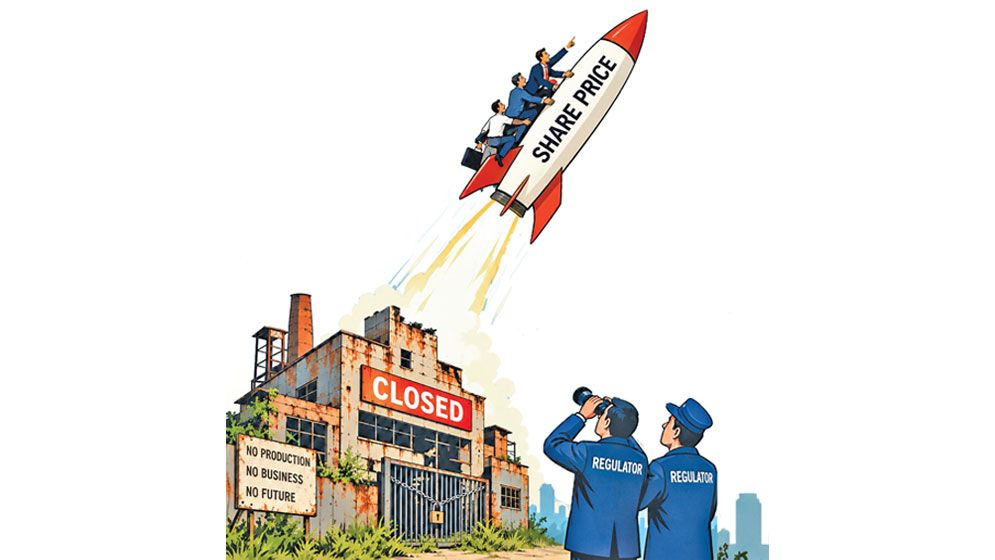
Factory gates are locked. There is no production. In some
cases, financial reports have not been published for years. The head offices of
some companies are shut, while factories and assets of others have already been
transferred or sold.
Yet the shares of these very companies sometimes become
among the market’s biggest gainers or most actively traded stocks.
Even companies whose production has been suspended for
years have seen heavy trading and sharp price rises.
According to Dhaka Stock Exchange (DSE) data, 35 listed
industrial companies are currently closed or non-operational.
The oldest is Meghna Pet Industries, whose factory has
been shut since 2002. Tung Hai Knitting and Dyeing has been non-operational
since 2019, GBB Power since 2023 and Ratanpur Steel Re-Rolling Mills since
2021.
Yet on 17 September 2026, Meghna Pet Industries was
trading at Tk73.20, GBB Power at Tk14, Tung Hai Knitting at Tk4, Ratanpur Steel
at Tk7, Rahima Food at Tk76.40, Familytex at Tk2.30 and New Line Clothings at
Tk5.40.
By comparison, BRAC Bank, which made a profit of Tk1,000
crore, was trading at Tk63, while Unique Hotel & Resorts PLC, which made a
profit of Tk152 crore last year, was trading at Tk38.
BSEC Chairman Masud Khan told the Daily Sun that a
shortage of quality shares has left a significant portion of trading concentrated
in weak and speculative stocks.
He said good companies need to be brought to the market
quickly, while investors need greater access to fundamentally sound companies.
Incentives are being considered to encourage good
companies to list, including possible direct listing options for multinational
companies, well-governed banks, state-owned enterprises and good local
companies.
Dhaka University Professor Al-Amin questioned the rapid
rise in Meghna Pet Industries’ share price despite the company having remained
closed for 24 years.
He also questioned why BSEC and DSE had not investigated
the rise in share prices of non-operational companies and taken necessary
action.
No factory, no assets either
The situation is particularly serious at Familytex (BD) Limited.
A special inspection by the Chittagong Stock Exchange found that both its
factory and head office were closed, while the Bangladesh Export Processing
Zones Authority had transferred the company’s factory and assets to another
organisation.
Familytex raised Tk34 crore through an IPO in 2013. The
company entered the capital market with a face value of Tk10 per share and now
has paid-up capital of Tk354 crore. However, it has not published financial
reports since December 2020.
Factory closed, but shares jump
Meghna Pet Industries is one of the clearest examples of
the paradox. DSE inspection information shows that its factory has been closed
since 2002.
Yet during the first four months of the current year, its
share price rose from Tk17.50 to Tk58.80 – an increase of nearly 225%. Because
of the abnormal price and trading volume, DSE issued a show-cause notice.
The company replied that there was no unpublished
price-sensitive information behind the rise in its share price and trading
volume.
Questions have also arisen over its audited accounts for
2025.
The auditor raised accounting objections concerning
Tk98.67 crore of property, plant and equipment and noted that the company’s
books had not been properly maintained.
For the nine months to March 2026, the company reported a
loss per share of Tk0.63. Its share price stood at Tk73.20 on 17 September.

New Line Clothings: office and factory closed
A DSE on-site inspection of New Line Clothings on 8 April 2025 found both its head office and factory in Gazipur completely closed. Attempts to contact Managing Director and CEO Zakir Chowdhury were unsuccessful. The company raised Tk30 crore through an IPO in 2019 to increase production capacity through machinery purchases, loan repayment and civil works. Its prospectus envisaged increasing production capacity by up to 80%.Within a few years of listing, however, the company stopped publishing regular financial reports and was moved to the Z category for failing to hold AGMs. Its share was trading at Tk5.40 on 17 September. In September 2026, Southeast Bank also initiated moves to auction mortgaged assets to recover more than Tk424 crore in non-performing loans against the company’s assets.
RSRM: from an industrial group to a closed factory
Ratanpur Steel Re-Rolling Mills presents another picture of the crisis. A DSE inspection in Chittagong found the factory closed, while the company has not published financial reports since the 2021-22 financial year. At one point, nearly 800 people worked in Ratanpur Group’s production activities and the group’s annual turnover reached almost Tk700 crore. But from December 2020, its two steel plants were shut because of outstanding electricity bills and working-capital shortages. Company Secretary Mohammad Moin Uddin said the company was facing a working-capital shortage and was trying in various ways to restart operations, although no final decision had been taken on when production could resume.
Office exists, but no business
GBB Power has a corporate office address in Dhanmondi, Dhaka, and a power-plant address in Bogura in the CSE database. Yet the DSE lists the company as non-operational since 17 June 2023.Its power plant was shut after its power purchase agreement expired, following instructions from BPDB. Although the company reported a net profit of Tk2.03 crore in 2025, turnover for the six months to December 2025 was zero. Its share price was Tk14 on 17 September. Active Fine Chemicals presents a similar contrast: although the CSE database lists an office in Niketan, Dhaka, a DSE inspection on 25 June 2026 found production activities closed at its factory in Munshiganj. AFC Agro Biotech’s factory was likewise found closed during a DSE inspection on 9 July 2026.
S Alam Cold Rolled Steels: company gives reasons for closure
S Alam Cold Rolled Steels is the latest major name to be added to the list. Its factory has been closed since 1 August 2026. The company said production could not continue because of frozen bank accounts, restrictions on importing raw materials and chemicals through LCs, and a shortage of skilled workers. It said it would try to resume production once conditions normalised. However, the company has not published financial reports since March 2024. In its latest financial information, published in early 2026, revenue for the first nine months stood at Tk388.82 crore, down 18% from the previous year, while net profit fell 56% to Tk2.50 crore. Its share price was Tk12.30 on 17 September. Company Secretary Shohel Amin ACS said all relevant information had already been provided on the DSE website. Asked when production might restart, he said the company was trying but could not give a specific timeframe.
Why the interest in closed companies?
The phenomenon is not limited to individual cases. In March 2026, Z-category stocks dominated the weekly gainers’ list. Familytex rose 31.82% in a week, Tung Hai Knitting 30.77%, Nurani Dyeing 29.63% and Generation Next 25%. Several were still non-operational at the time. The trend continued in August. Tung Hai Knitting, a closed company, rose 53.6%, while GBB Power gained 50%. Alltex Industries rose 20%, Baraka Power 19% and Nurani Dyeing 14%.BSEC Chairman Masud Khan told the Daily Sun that Bangladesh is unusual in allowing regular trading in shares of companies that have remained out of production for long periods. He said many companies have remained listed and traded despite being non-operational for 10 to 20 years. He said steps would be taken to stop trading in shares of non-operational companies. The DSE has also been given additional powers to take swift action in cases of abnormal price rises or suspicious trading.