


 For all latest news, follow the Daily Sun's Google News channel.


Late promotion, instant impact from Nasir
Muhammad Jubair, Sylhet
Published: 07 Jan 2026, 10:16 PM
TANVIN TAMIM PHOTO
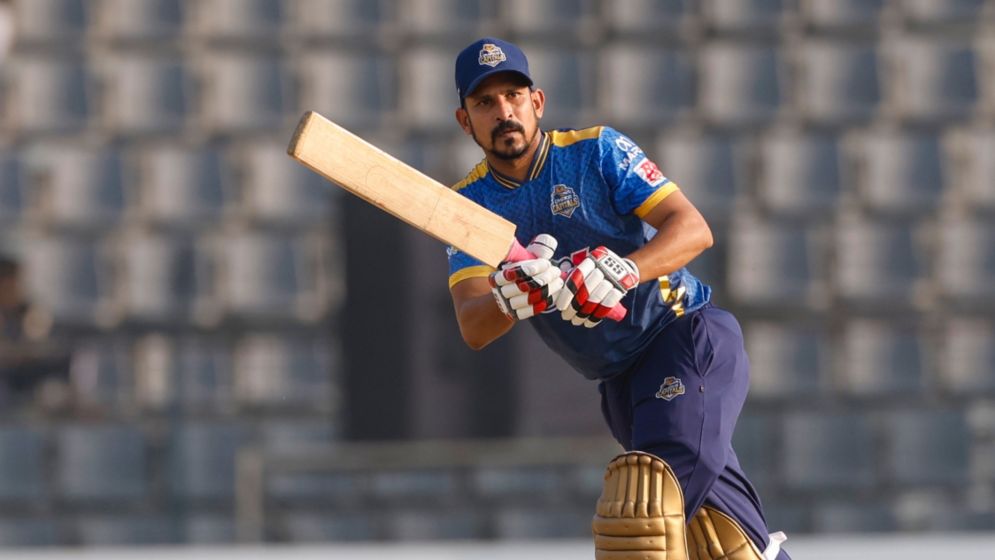
Nasir Hossain has been enjoying an excellent domestic season with Rangpur Division. The 34-year-old all-rounder helped Rangpur win both the NCL T20 and the NCL four-day competitions with his batting, bowling and tactical awareness. But his BPL side — Dhaka Capitals — did not fully use his form and experience until Wednesday against Noakhali Express at the Sylhet International Cricket Stadium, where he was finally given his preferred batting position and the experienced campaigner did not disappoint.
Chasing a modest target of 133, Nasir batted at number three
for the first time this season and rolled back the clock to blast the fastest
half-century of this year’s tournament, racing to fifty from just 21 balls,
before finishing unbeaten on 90 off 50 deliveries with 14 fours and two sixes.
It was his highest T20 score and guided Dhaka to a seven-wicket victory — their
second of this BPL.
Until last afternoon, Nasir’s highest T20 score had been 80,
which he made back in 2012. When reminded of that, Nasir was quick to point out
that he usually bats down the order, where big runs are harder to come by.
“Well, no one gave me a chance at number three before,” he
laughed. “It feels good. Wherever you perform, if you do well, it always feels
good. And in T20s especially, I really like batting up the order. I feel that
period is slightly easier to score runs because if you think overall, in the
powerplay there are only nine fielders inside. So if you take a bit of risk,
that phase is comparatively easier for scoring,” he explained.
Nasir scored back-to-back fifties in the knockout matches of
the NCL T20 to guide two tricky run chases. But in the first four matches of
this year’s BPL, he batted twice at number five and once at number eight, and
did not bat in one match, before finally getting a promotion up the order. To
do that, the Capitals dropped national team vice-captain Saif Hassan, who had
been batting at number three for them without much success.
“I think the decision (to drop Saif) was taken by the
captain,” Nasir said. “The plan was that if a left-hander got out, maybe Irfan
would go in first. So we had a plan that if Mithun bhai (a right-hander) got
out, I would go in, and if a left-hander got out, Irfan would go in. Because
the opposition had a left-arm spinner and also a right-arm off-spinner. We
didn’t want two right-handers or two left-handers batting together in the
powerplay,” he added.
Nasir, predominantly a middle-order finisher, also questioned
the broader approach to selecting middle-order batters in Bangladesh.
“If you think overall, even in the Premier League, players
who score 800–900 runs at the top end up batting at six. But an opener batting
at six will succeed maybe one or two days — mostly they won’t. The chance of
success is low because the situation is totally different. That’s why those who
bat at six or seven for the national team should bat there in domestic leagues
too — so they learn that situation. Batting at six often means you need seven,
eight, nine runs an over — that’s not easy,” he said.
Nasir also shared his desire to play another five or six
years of professional cricket before thinking about quitting, when asked about
this phase of his career.
“I wouldn’t call this the late part of my career. If Allah
keeps me healthy, I can play another five or six years. I always try to play
well, use my experience, read the wicket — whether bowling or batting. That’s
all I can say,” he said.
Nasir is known in cricketing circles as one of the most
tactically sharp players and a good reader of pitches. Players from the younger
generation are often compared to him in terms of tactical awareness. When his
attention was drawn to that issue, he replied, “You could almost be from another
national team without the regular players and there won't be much difference.
But as a player, reading the wicket is very important — understanding where to
score, how the ball is behaving. The better you read the wicket, the longer and
better you can perform.”