


 For all latest news, follow the Daily Sun's Google News channel.


Inside the long silence that shapes Bangladesh cricket
Muhammad Jubair, Dhaka
Published: 12 Dec 2025, 10:44 PM
FILE PHOTO
For more than two decades, the National Cricket League (NCL) has stood as Bangladesh’s most traditional and meaningful first-class competition — a tournament that shapes careers, tests temperament, and builds the country’s long-format identity. While it rarely commands the spotlight enjoyed by white-ball cricket, the NCL remains the primary arena where players learn discipline, endurance, and the pure grind of four-day cricket.
This year’s edition proved one of the most
competitive in recent memory, with five teams still in contention deep into the
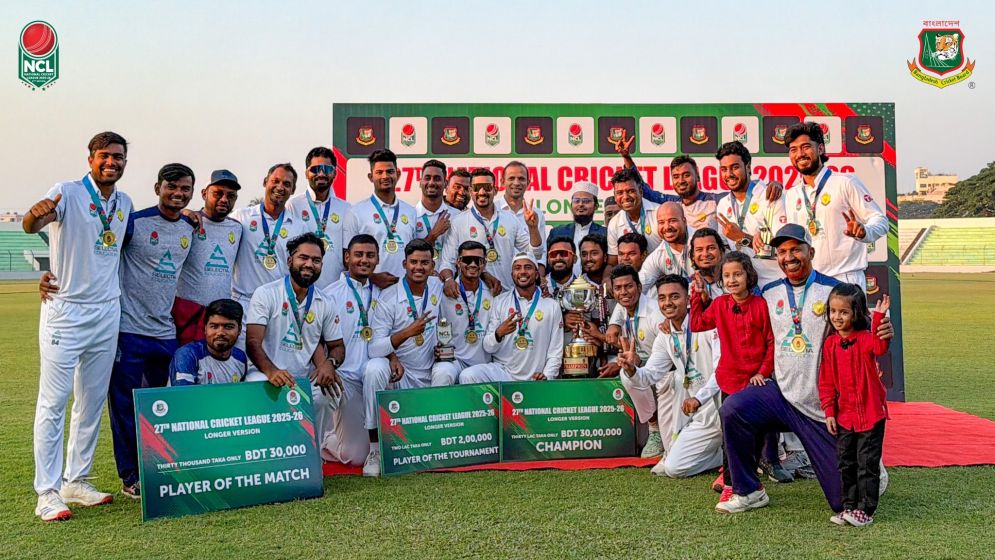
season. In the end, Rangpur Division emerged as champions, securing a historic
and hard-earned title in a campaign defined by narrow finishes and fluctuating
fortunes.
Daily Sun spoke to several of the country’s
most accomplished first-class performers — along with the Bangladesh Cricket
Board (BCB) — to explore what the league means to them and what its evolving
landscape reveals about the future of Bangladesh’s red-ball cricket.
Naeem Islam: A champion’s perspective on a changing NCL
“I’ve been playing NCL since 2004,”
Rangpur’s senior batter Naeem Islam said. “Over the years, the biggest change
has been the playing surfaces. We used to play on many turning wickets, but now
most are batting-friendly. Competition has always existed, but this season was
unique: three to four teams, even five, were genuinely in the title race. I’ve
never seen such an equation before.”
For Rangpur, the title demanded grit. They
suffered an innings defeat in the previous round, yet responded with conviction
in the most decisive phase of the season.
“That’s why becoming champions felt
special,” Naeem said. “Our batters didn’t score big, but our bowlers were
outstanding. We’re proud of how we performed as a team.”
He reflected on the unique challenges of
Rangpur’s home conditions. “Because we play many games in Rajshahi and Bogura,
where fast-bowling pitches dominate, high scores are rare. Sylhet is also tough
to get results unless you outplay them. That’s why we always know the
challenge.”
For Naeem, who has spent nearly two decades
in the league, first-class cricket is an identity — a matter of pride.
“Representing my division feels like representing my home and family. People
used to mock the NCL as ‘picnic cricket’, but I never understood that. From my
first season under Pilot bhai — a very disciplined captain — I learnt
professionalism. I always share this with younger players: talent isn’t enough;
discipline is everything if you want to play long. Our young players are eager
to learn. Give them a year or two, and they’ll be much better.”
Marshal Ayub: Crossing 10,000 runs and redefining value
Marshal Ayub’s season was shaped by one of
the most significant milestones in Bangladesh’s domestic history. Before the
campaign began, he knew he was approaching the 10,000-run mark — and planned
accordingly.
“Alhamdulillah, I reached the milestone,”
he said. “It feels great because this is a big achievement for our cricket, and
we hope the next generation will surpass it.”
Marshal believes the perception of red-ball
specialists in Bangladesh is slowly evolving. “Compared to other countries,
we’re still behind in how we value first-class and Test players. But that
culture is slowly shifting. In recent years, senior players have started
receiving more respect. There are retirement ceremonies, acknowledgements —
things we never saw before.”
His milestone triggered an overwhelming
response. “So many people called or messaged me. It shows that if we highlight
first-class and Test cricket properly, audiences will also grow.”
Marshal belongs to the generation shaped by
the earliest long-format stalwarts. “Players like Rajin bhai, Alok da, Sazzad
bhai — they were the early generation. They left early because back then there
were fewer matches, and the home-and-away formats were different. We learnt
from them that longevity matters. That mindset kept me going in first-class
cricket for so many years.”
Tushar
Imran: Guiding the next custodians of Bangladesh’s first-class legacy
Few names symbolise first-class excellence
in Bangladesh like Tushar Imran. As the former domestic run machine transitions
into coaching, his reflections on Khulna’s campaign come with equal parts pride
and realism.
“The season wasn’t bad for us — we were
still in the race till the last moment,” he said. “Competition has definitely
increased, but Khulna have suffered in recent years. Since Raj bhai retired,
we’ve lacked a quality spinner. To win matches, you need 20 wickets, and our
bowling resources have become thin.”
The decline has been gradual and unavoidable. “Many of our fast bowlers retired — Rubel, Dollar, Shariful — and Al-Amin couldn’t play this season. Without bowlers, you suffer. National team players also miss matches due to their duties. If we could field our full-strength XI, results would be different.”
Injuries further strained Khulna’s
campaign. “We begin a season with a full attack, but injuries reduce our
options. The last match especially exposed this.”
Even when the national team door closed,
his drive never faded. “I was driven to maintain my place in the first-class
XI. No one — not even a national star — could take that No. 4 spot from me.”
Now, as a coach, Tushar sees his role as a
continuation of the legacy he helped build. “First-class records stay for ever;
globally, first-class achievements carry great value. I take pride in knowing I
contributed and that my teammates could learn something from me.”
Enamul Haque Jr: 510 wickets, hard lessons and the soul of Sylhet cricket
For former left-arm spinner Enamul Haque
Jr, now based in the United Kingdom, the NCL is not just a tournament — it is
where he grew up. His memories stretch back to the nerves of his very first
match.
“I still remember my debut against Barishal
— I was extremely nervous, and Rajin bhai and Parvez bhai guided me on how to
survive and grow in first-class cricket,” he said. “I’m grateful to them, as
well as to our managers Arman bhai and Mawdud bhai.”
Wickets kept him going — 510 of them for
Sylhet. “I enjoyed first-class cricket because I always had the hunger for
wickets,” he said.
He believes Bangladesh could have produced
more Test cricketers with stronger early structures. “If our first-class system
had been stronger earlier, we would have produced many more Test players by
now.”
The financial realities, he said, were
stark. “Back then we played for a daily allowance of 400 taka. Slowly things
improved to match fees, but I still think remuneration is low. If match fees
and facilities improve, the quality of first-class cricket will rise.”
But Sylhet remained home — and pride. “I
loved representing Sylhet. I am proud that I could contribute 510 wickets for
them. First-class cricket is always the pinnacle for any Test nation.”
BCB
perspective: Building a sustainable First-Class ecosystem
Daily Sun also spoke to Ahsan Iqbal
Chowdhury, chairman of the BCB Tournament Committee, about the season’s
significance and future plans.
“We are proud to host an NCL that was
genuinely competitive — we really didn’t know who would emerge as champion,” he
said. “That’s a hallmark of a successful tournament in my mind.”
Looking ahead, the BCB hopes to raise the competition’s standing.
“We are planning to make it even bigger in
the coming years. Our goal is to make the NCL our flagship tournament. If our
first-class structure gets sorted, every sector of our cricket will benefit —
from national selections to the development of young talent. We hope to achieve
that.”