


 For all latest news, follow the Daily Sun's Google News channel.


BFF PHOTO
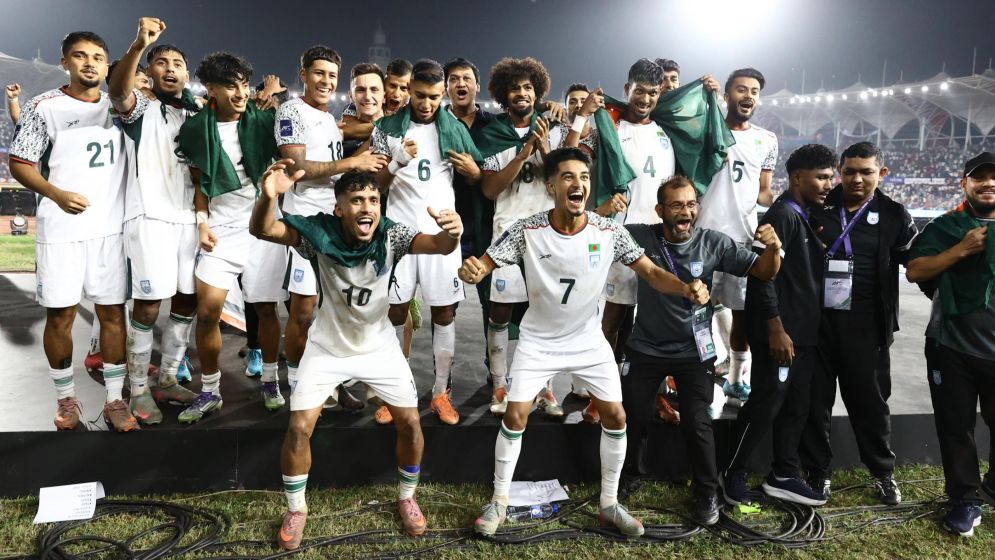
Tuesday night was a historic moment for Bangladesh football. The National Stadium shook with jubilation as the red-and-green triumphed over India for the first time in 22 years.
For millions of Bangladeshis, this wasn’t just a win; it was
a long-awaited release of frustration.
The echoes of past heartbreaks — drawn matches, late
concessions, and defeats — faded as fans reveled in a victory soaked in emotion
and hope.
The triumph was not merely the result of chance but the
culmination of tactical discipline, resilience, and growing maturity.
At the heart of this transformation is Hamza Choudhury,
Leicester City’s defensive midfielder and a beacon of hope for Bangladesh
football. Born and raised in England, Hamza has brought a fresh spark to the
national team, blending European professionalism with raw passion for the
badge.
For Hamza, the victory held deep personal significance.
Comparing it to his famous FA Cup triumph with Leicester
City, he said, “There are 180 million people that we all made happy today. You
can’t really compete with that anywhere else. So yeah, it’s definitely right up
there with the FA Cup win.”
The joy of lifting a prestigious trophy and uniting a nation
after decades of waiting resonates on both sides of the pitch.
Yet Hamza was not carried away by celebration alone.
“We know we’ve got steps to take,” he said.
“We kept saying, the coach kept saying, everyone kept saying
that we’re putting in the performances, now we need the results. Now, maybe the
performance, the results are there without the performance. So, now we’re going
to build again in March and, inshallah, put both of them together as a team.”
His measured optimism extends to the future.
“Definitely, dream come true (beating India). You can have
more than one dream, you know. So, this is one of my dreams, and inshallah,
we’ll qualify for a tournament very soon. I think we’ve shown we’re capable as
a team now. So, just time and patience.”
Hamza’s words capture a team still learning how to balance
tactical control with resilience, and a nation hungry for progress.
The victory, while monumental, is just one milestone on a
longer journey. And the reality is Bangladesh is already out of the AFC Asian
Cup 2027 Qualifiers with a match in hand (against Singapore in March 2026).
Major challenges loom ahead for the men in red and green —
the 2026 SAFF Championship, the 2030 FIFA World Cup qualifiers, and the 2031
Asian Cup qualifiers will test Bangladesh’s mettle.
Unfortunately, the deeper reality behind the celebrations
reveals a football ecosystem still riddled with cracks.
The Bangladesh Football Federation (BFF) often prioritizes
flashy pre-match ceremonies over solving these fundamental problems. Worse,
even the country’s top domestic leagues suffer from a lack of sponsorship and
visibility — the First Division League recently began without an official
sponsor, and the Bangladesh Premier League continues to struggle to attract
sustainable commercial support.
The domestic football infrastructure remains fragile at
best. Most Premier League clubs operate without their own grounds, with scant
fan support and little financial backing. Club management often lacks
professionalism, and player salaries are irregular and insufficient, making it
hard to attract and retain talent.
Beyond the top tier, the situation worsens.
Many districts have no active leagues or football
associations. Youth development programs — including under-14 and under-16
competitions — are irregular or nearly dead in several regions. Grassroots
football, the lifeblood of any nation’s pipeline, is severely neglected.
In this context, the national team’s reliance on expatriate
players like Hamza, Jamal Bhuyan, and Tariq Kazi is both a strength and a
warning. These players bring skill, experience, and international exposure, but
the national side cannot build a lasting future on imported talent alone.
Without a robust domestic system to nurture young players,
the current crop risks being an exception, not the norm.
This fragile state of affairs evokes a vivid image: the
team’s current glow is like a kite flying high on a thinning thread —
spectacular to watch, but vulnerable if the thread snaps.
The challenge for Bangladesh football is clear: the moment
of joy from Tuesday’s win must ignite a determined, long-term effort to rebuild
the foundations of the game. The BFF and all stakeholders must commit to
revitalizing the domestic leagues, ensuring clubs become financially and
operationally stable, and building grassroots and youth development programs
across every district.
Coaching, refereeing, and administration need reform and
professionalization. Player welfare — including consistent wages and career
support — must become a priority.
Only with these reforms can Bangladesh hope to turn a
historic win into the start of a new era. Otherwise, the victory risks becoming
a beautiful but fleeting spark — a brief moment of glory before the game
returns to familiar struggles.
Beating India after two decades is cause for celebration,
but it is not the finish line. It is a crucial stepping stone on a difficult
journey. Without a plan to build, to nurture, and to invest deeply, Bangladesh
football will find itself back at square one — celebrating moments instead of
milestones.
The question now is whether Bangladesh’s football
authorities can match Hamza’s optimism with action. Can they build from this,
or will the joy of Tuesday night fade into just another missed opportunity?