


 For all latest news, follow the Daily Sun's Google News channel.


 Prime Minister Tarique Rahman’s three-day visit to Türkiye for the 31st United Nations Climate Change Conference (COP31), which ended on Thursday, strengthened Bangladesh-Türkiye ties through discussions on defence, trade, investment and energy, while allowing Dhaka to press for climate justice and adaptation finance.
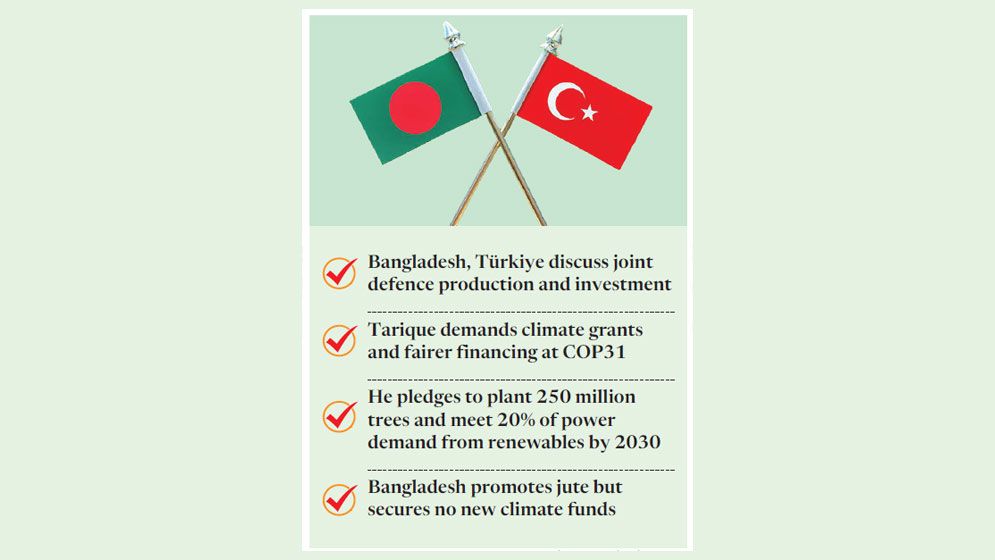
During a bilateral meeting on 10 November, Tarique and Turkish President Recep Tayyip Erdoğan discussed cooperation in defence, trade, investment, energy, renewable power and mineral resources, reflecting their shared interest in elevating ties to a strategic level.
State Minister for Foreign Affairs Humaiun Kobir described the meeting as a significant step, saying both sides were interested in joint investment in defence and other strategic sectors, including a possible defence industrial park in Bangladesh through Turkish investment and joint ventures.
Former ambassador Mahfuzur Rahman said the two countries’ expectations were aligned.
“The Turkish attitude and Bangladesh’s expectations are matching. Dhaka wants technology transfer and joint investment so that it can develop its own expertise apart from producing defence materials,” he told the Daily Sun.
Such cooperation would reduce Bangladesh’s dependence on imported defence equipment, he said.
“In this case, if we can develop expertise, we would be able to meet our internal demands and if we can build confidence in our capabilities, we might export such items in future,” he added.
The talks also covered deep-sea energy and mineral exploration, renewable energy and aviation. Erdoğan described Tarique as a “valuable friend and brother” and expressed interest in elevating bilateral relations.
Tarique thanked Erdoğan for Türkiye’s humanitarian assistance to the Rohingya and support for Bangladesh at international forums, including the International Court of Justice.
He urged Ankara to maintain diplomatic engagement to ensure the safe, dignified and sustainable repatriation of the displaced people to Myanmar.
Climate diplomacy takes centre stage
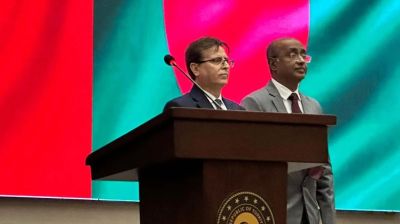
Addressing COP31’s high-level segment on 12 November, Tarique proposed five measures to address climate-vulnerable countries’ needs and reform global climate financing.
He called for developed countries to allocate at least 50% of international climate finance to adaptation, introduce debt-relief mechanisms such as debt-for-climate swaps, ensure fair access to climate-friendly technologies, accelerate renewable energy transition and adopt the proposed “Belém-Antalya Action Mechanism” for a just energy transition based on fair financing and trade.
He argued that vulnerable countries need grants, not additional loans, noting that Bangladesh contributes less than 0.5% of global greenhouse gas emissions but remains on the frontline of climate change.
Outlining domestic commitments, Tarique announced a target to plant 250 million trees over five years and meet 20% of electricity demand from renewable sources by 2030.
He also highlighted plans to generate 4,000 megawatts of solar power, excavate 20,000 kilometres of rivers and canals, restore mangrove forests and promote green industrialisation. Bangladesh has around 300 LEED-certified garment factories, he said.
Prof Ahmad Kamruzzaman Majumder, head of the Centre for Atmospheric Pollution Studies, said Bangladesh emits little carbon but needs $230 billion by 2050 to tackle climate change.
“A previous request for $137 billion in mitigation funding was not met, making loss and damage central to current COP discussions as the government approaches the final stages of a national loss and damage framework to seek compensation for past harms. Therefore, the prime minister’s presence and demand for grants instead of debt was a timely one,” he said.
Jute diplomacy and wider engagement
Bangladesh showcased environmentally friendly jute products as alternatives to plastic through a pavilion in COP31’s Green Zone, with two side events promoting climate resilience and biodegradable, zero-waste jute products.
On the sidelines, Tarique met Australian Prime Minister Anthony Albanese to discuss climate cooperation, Australian investment and Rohingya repatriation. He invited Albanese to Bangladesh, and the Australian leader expressed hope of visiting next year.
Although the visit secured no immediate climate-financing commitments, it strengthened Bangladesh’s diplomatic engagement and provided a platform to press for climate justice, equitable financing and international cooperation.
Mahfuzur Rahman called for a coalition of climate-vulnerable countries, noting that Bangladesh ranks eighth among the most vulnerable, while around 155 countries have been seeking $350 billion in climate finance.
“We go to participate in every COP. But our achievements remain limited to assurances and insignificant amounts of debt. If we could form an alliance comprising the top 30 or 40 most climate-vulnerable countries, it could raise its voice more powerfully,” he said.
He said such a group could pressure developed countries by threatening to boycott COP until their demands were met.