


 For all latest news, follow the Daily Sun's Google News channel.


Bangladesh outperforms India, Pakistan in hunger progress
Nepal, Sri Lanka fare better than Bangladesh
Daily Sun Report, Dhaka
Published: 23 Oct 2026, 12:00 AM
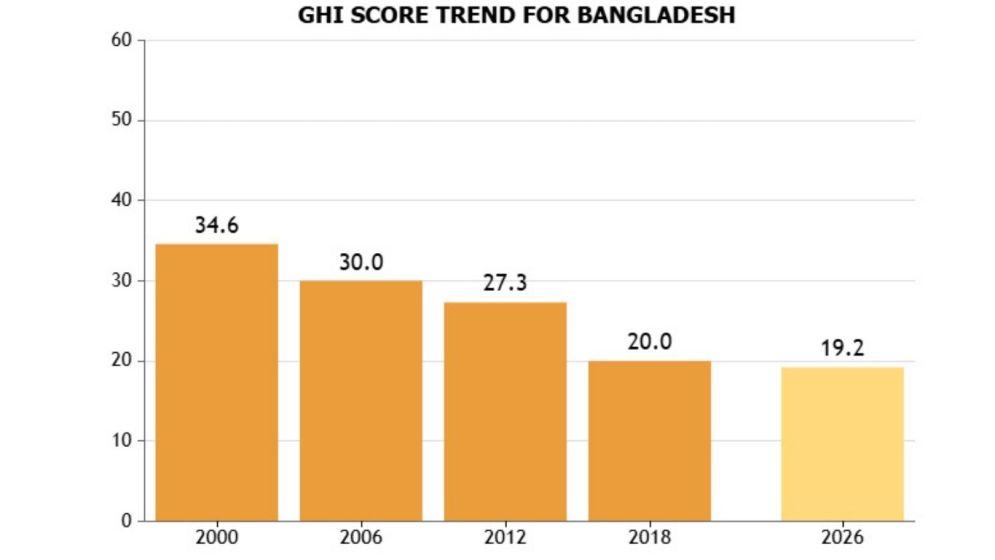
Bangladesh’s Global Hunger Index score stands at 19.2 in 2026, placing the country in the moderate hunger category.
Bangladesh has made substantial progress in reducing hunger over the past two decades, but its latest performance reveals a mixed picture compared with neighbouring South Asian countries, with child wasting and a slowdown in recent gains emerging as major concerns.
The 2026 Global Hunger Index (GHI) gives Bangladesh a score of 19.2, placing it in the moderate hunger category. The score is lower than those of India, Pakistan and Afghanistan, but higher than those of Nepal and Sri Lanka, according to the report published in October by Welthungerhilfe, Helvetas and the Institute for International Law of Peace and Armed Conflict at Ruhr University Bochum.
Bangladesh’s score dropped from 34.6 in 2000 to 19.2 in 2026, reflecting significant long-term improvement. However, the reduction since 2018 was only 0.8 points, from 20.0 to 19.2.
The comparison suggests that Bangladesh has substantially reduced hunger over the long term but still faces challenges in translating that progress into consistent improvements in child nutrition.
Bangladesh among the middle performers in South Asia
Bangladesh’s performance is particularly notable against Pakistan and Afghanistan, whose scores increased between 2018 and 2026. India improved, but still remained in the serious category.
Nepal recorded a larger reduction than Bangladesh, with its score falling by 3.9 points, from 18.4 to 14.5. Sri Lanka’s score declined by 1.2 points, from 11.4 to 10.2.
The comparison shows that progress across the region has been uneven. It also demonstrates why the direction of change matters alongside a country’s current score.
Nepal provides an important comparison for Bangladesh because both countries have achieved substantial long-term improvements in hunger indicators.
Nepal’s GHI score fell from 37.0 in 2000 to 14.5 in 2026, moving from the alarming category to the moderate category.
The report identifies Nepal as the country in South Asia with the strongest progress since 2000. Its child wasting rate nearly halved over that period, reaching 6.6%.
Bangladesh also made substantial long-term gains, but its recent progress has been slower than Nepal’s.
For Bangladesh, the comparison reinforces the importance of focusing on the remaining nutrition challenges rather than relying solely on improvements in national food availability.
Sri Lanka’s score lowest among six countries
Sri Lanka has the lowest GHI score among the six countries compared here, at 10.2, followed by Nepal at 14.5.
Bangladesh’s score of 19.2 is nearly nine points higher than Sri Lanka’s, although the GHI alone cannot establish which individual policies explain the difference.
The index combines undernourishment, child stunting, child wasting and mortality among children under five. Differences in these indicators can therefore shape the overall score even when countries share similar regional food-security challenges.
India still in ‘serious category’
India’s GHI score declined from 25.8 in 2018 to 24.1 in 2026. Despite that improvement, the country remains in the serious hunger category.
Bangladesh’s score is lower by 4.9 points in the 2026 index.
The report’s South Asia analysis describes a slowdown in progress across the region. It also identifies child wasting as a persistent concern, with the regional rate reaching 15.8%, the highest among the regions covered by the index.
India’s experience illustrates that a declining overall score does not mean every nutrition indicator is improving at the same pace.
For Bangladesh, the comparison underlines the need to examine individual indicators, particularly acute child undernutrition, rather than interpreting the overall score in isolation.
Pakistan and Afghanistan face setbacks
Pakistan’s GHI score increased from 24.0 in 2018 to 25.5 in 2026, while Afghanistan’s rose from 28.4 to 28.6.
Both countries remain in the serious category.
Afghanistan’s situation is particularly concerning in the report’s regional assessment. The country’s undernourishment rate increased from 23.0% in the 2018 reference period to 27.8% in the 2026 reference period.
The report attributes Afghanistan’s worsening food insecurity to overlapping pressures, including weather extremes, economic deterioration, displacement and reductions in humanitarian assistance.
Pakistan’s score also deteriorated, although the index’s overall figures alone do not establish the specific causes of that change.
These developments show how economic and environmental shocks can undermine progress against hunger. Bangladesh faces a different national context, but its exposure to floods, climate extremes and external market disruptions makes resilience an important policy priority.
Child wasting Bangladesh’s major nutrition concern
Despite its better overall score than India, Pakistan and Afghanistan, Bangladesh faces a significant challenge in child nutrition.
The 2026 GHI reports that child wasting affects 12.9% of children under five in Bangladesh, the highest rate recorded for the country across the reference years since 2000.
Child wasting measures low weight relative to height and is associated with acute undernutrition.
Bangladesh has made greater progress in reducing child stunting, with the report noting a decline of more than 30 percentage points since 2000. However, the persistence of wasting indicates that improvements in chronic undernutrition have not been matched by equivalent progress in every aspect of child nutrition.
This distinction matters for policy. Food production and availability are essential, but children also need access to sufficiently nutritious diets, appropriate feeding practices, healthcare and safe living conditions.
Bangladesh’s challenge is therefore not simply to maintain adequate food supplies, but to ensure that families can consistently afford and access diets that meet children’s nutritional needs.
Bangladesh’s position in the 2026 Global Hunger Index reflects both significant progress and unfinished work.
The most important challenge is to convert long-term gains into sustained progress in child nutrition and household access to affordable, healthy food.
Read More