


 For all latest news, follow the Daily Sun's Google News channel.


Police buckle under manpower crisis
Face mounting pressure from rising operational demand amid purge of experienced officers

At a police station in the capital’s Gulshan, Sub-Inspector (SI) Maruf Ahmed has been on duty for nearly 18 hours. Between visiting crime scenes, overseeing patrols and preparing charge sheets, he has not seen his family for four days.
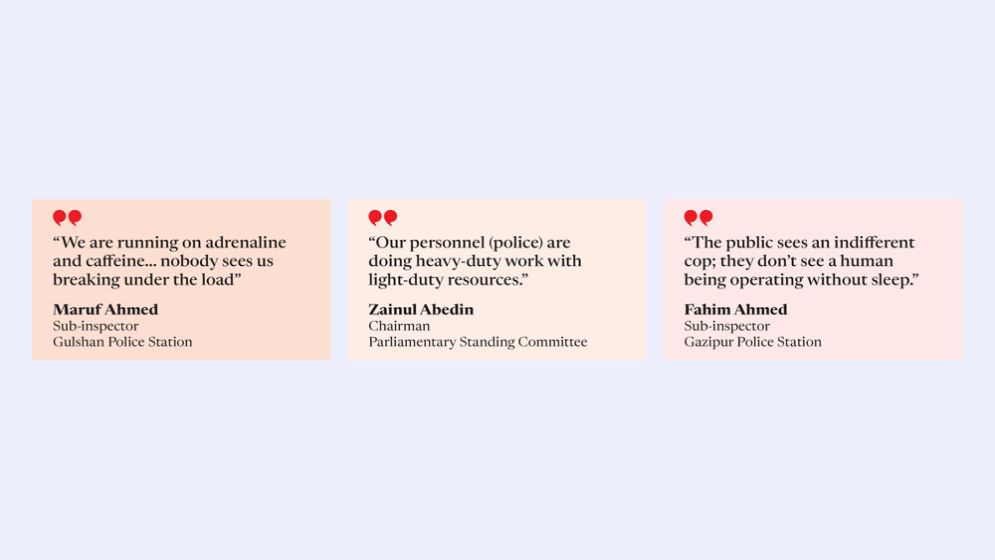
“We are running on adrenaline and caffeine,” Maruf says, rubbing his bloodshot eyes.
His station serves more than 150,000 residents, with around 50 to 52 SIs, 20 to 25 assistant sub-inspectors (ASIs) and 24 to 25 constables. Despite these numbers, the workload often leaves officers struggling to respond to emergencies.
“If a riot breaks out while we are investigating two robberies, we physically cannot respond to everything. People call us inefficient, but nobody sees that we are breaking under the load,” he says.
Maruf’s experience reflects a nationwide crisis as staff shortages, the removal of experienced officers and mounting operational demands put Bangladesh Police under severe pressure.
According to figures presented by Police Headquarters at the fifth meeting of the Parliamentary Standing Committee on the Home Ministry on Thursday, Bangladesh has one police officer for every 868 people, compared with an international peacetime benchmark of one for every 400.
With the country’s population estimated at 179.3 million, Police Headquarters says 354,123 personnel are required. However, the police have 207,938 sanctioned posts, leaving a shortfall of 146,185 against the estimated requirement.
The staffing crisis has been compounded by disciplinary and administrative changes following the July 2024 uprising, including dismissals, compulsory retirements, suspensions and arrests across ranks.
According to Police Headquarters, 147 officials holding the rank of assistant superintendent of police (ASP) and above have been sent into compulsory retirement in the public interest.
Another 57 senior officers were suspended for allegedly remaining absent from duty or going into hiding around 5 August 2024. Of them, 28 have been dismissed and one has retired.
In addition, 29 officials face suspension following arrests in criminal cases and cases filed with the International Crimes Tribunal (ICT). A total of 78 inspectors have been dismissed, removed or sent into compulsory retirement.
Departmental cases were also filed against 62 Bangladesh Civil Service (Police) cadre officials over allegations that they had fled their posts. Of them, 31 have been dismissed.
A senior Police Headquarters official, speaking on condition of anonymity, said the measures were necessary to ensure accountability but had increased pressure on those remaining in service.
“The purge was necessary to establish accountability, but the transitional cost is crushing the rank-and-file,” the official said.
“You cannot remove hundreds of supervisory officers and middle-tier commanders overnight without the remaining personnel absorbing the pressure. Station chiefs are handling double jurisdictions, and morale remains fragile.”
For officers in the field, staff shortages and administrative changes mean longer hours and less time to recover. Maintaining eight-hour shifts has become difficult, particularly during intensive security operations.
“When public security operations intensify, leave is cancelled indefinitely,” says Fahim Ahmed, a police officer deployed at a checkpoint in Gazipur.
He says some junior officers are suffering from hypertension, chronic back problems and acute anxiety because of the pressure.
“When an officer is exhausted, judgment slips, tempers flare and community policing suffers. The public sees an indifferent cop; they don’t see a human being operating without sleep,” he says.
Meanwhile, police continue to conduct operations against public unrest, smuggling, drugs, terrorism, robbery and cybercrime.
Between July and September, police recovered 557 illegal firearms, 672 locally made weapons and more than 5,000 rounds of ammunition and cartridges. Firearm seizures rose from 120 in July to 251 in September. During the same period, police arrested 9,073 people linked to public unrest and more than 30,000 suspected smugglers and drug dealers.
“Our personnel are doing heavy-duty work with light-duty resources,” Parliamentary Standing Committee Chairman Zainul Abedin said, calling for swift government intervention to restore institutional stability.
To address the shortage, authorities have proposed creating 24,677 posts under the revenue budget and establishing 107 new police stations, investigation centres and outposts. The recruitment plan includes 10,000 constables and 4,000 sub-inspectors. Their proposals are being processed by the Home Ministry for submission to a secretary-level committee.
Approval from the Ministry of Public Administration is pending for 450 ASPs and 400 sergeants. Another 9,943 posts are planned across specialised units, outposts and police stations.
Former Inspector General of Police (IGP) Muhammad Nurul Huda warned that bureaucratic delays could prevent the force from receiving timely support.
“Processing posts through the Home Ministry, Public Administration and Finance Division takes months, if not years,” he said.
Even after approval, recruitment, background checks and academy training must be completed before new officers can begin field duties.
Huda said the training process takes about a year, delaying any relief. “What Bangladesh needs right now is emergency fast-tracking,” he said.
For officers already working extended shifts, the shortage means fewer colleagues to share the workload, less time to rest and greater pressure to respond to emergencies.