


 For all latest news, follow the Daily Sun's Google News channel.


Abdullah Al Mamun, from Noakhali Sadar, drives a company lorry in Riyadh, Saudi Arabia. He returned to Bangladesh two months ago for the first time in his five years as an expatriate worker.
His return flight to Riyadh was scheduled for 11 October, but it was cancelled. A second flight, booked for 12 October, was also cancelled, leaving him anxious as only five days remained on his visa.
He finally secured a ticket for a flight to Madinah on Friday. Despite fears over the ongoing conflict between Saudi Arabia and the Houthis, he was relieved to be able to return to Saudi Arabia.
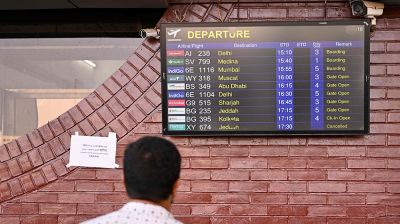
Speaking at the departure terminal of Hazrat Shahjalal International Airport (HSIA), Mamun said his visa was about to expire, but he had been unable to leave, putting him under tremendous pressure.
“Finally, I can return via Madinah. I have already been through so much hassle. Now, I have to face further trouble in Madinah. It will take 12-14 hours to travel from there to Riyadh by bus, and it will incur additional expenses. But I have no choice – I must go,” he said.
Mamun’s company would not be affected significantly if he failed to return, but he could lose his job.
Another expatriate worker, Shakil Ahmed, has also faced difficulties after returning home on leave. His flight from Dhaka to Dammam was scheduled for Tuesday but was cancelled.
He reissued his ticket the following day for a flight scheduled at 9:20pm, only for that flight to be cancelled as well. When he visited the Biman Bangladesh Airlines office, he discovered that his flight had been rescheduled to depart Dhaka for Madinah at 4pm.
Madinah is about 1,300 kilometres from Dammam, and travelling from there to Dammam would cost him an additional Tk20,000 to Tk30,000.
“My visa still has 11 months of validity, but my leave was due to end on 18 October. I could have extended my leave by talking to my kafeel (sponsor), but after seeing my ticket, they are no longer willing to grant me an extension. Yet I will not receive any compensation for the additional expenses,” he said in front of the Biman ticket counter at HSIA.
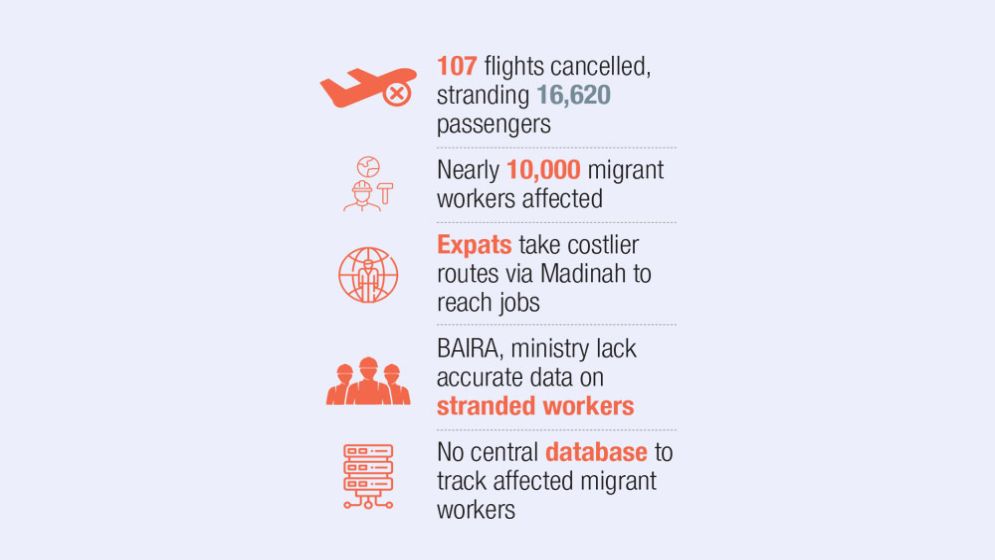
The cases of Mamun and Shakil are not isolated. Following a deadly missile attack on King Khalid International Airport in Riyadh on 10 October, Riyadh and Dammam airports have remained closed, resulting in the cancellation of 107 flights from Dhaka to the two destinations between 10 October and Friday and leaving 16,620 passengers stranded.
Biman cancelled all its flights to Riyadh and Dammam. It has indicated that flights to Riyadh might resume after 18 October, though this remains uncertain.
As a result, some stranded workers are waiting for the airports to reopen, while others are seeking alternative routes, as Mamun has done.
Neither BAIRA nor ministry has accurate data on workers
Neither the Bangladesh Association of International Recruiting Agencies (BAIRA) nor the Ministry of Expatriates’ Welfare and Overseas Employment has precise data on how many of the 16,620 stranded passengers are migrant workers.
BAIRA says the ministry should have taken the initiative to collect the information, while ministry sources say no steps have been taken to prepare a separate list of affected workers.
The Civil Aviation Authority of Bangladesh (CAAB) has data on the total number of passengers on the affected flights but does not maintain a breakdown of how many are migrant workers.
According to the expatriate welfare desk at HSIA, however, migrant workers account for 60% to 70% of the stranded passengers. This suggests that nearly 10,000 expatriates have been affected by the flight suspensions.
Estimates by BAIRA members also point to a similar figure, as around 2,000 workers travel to Saudi Arabia and other Middle Eastern countries every day.
Former BAIRA joint secretary general Tipu Sultan said daily travel includes workers returning home on leave and those going abroad on new visas.
“Some return home on leave, while others travel on new visas. With flights suspended for five days, the number of stranded workers is likely to have exceeded 10,000,” he said.
BAIRA member Shamim Ahmed Chowdhury Noman said the Ministry of Expatriates’ Welfare and Overseas Employment should have contacted recruiting agencies to collect the necessary information.
“There are around 2,500 recruiting agencies in Bangladesh. It is not possible to collect information from all of them individually. Had the ministry sent letters seeking the data, we could have obtained a clear picture,” he said.
He said registering workers returning home on leave through the Bureau of Manpower, Employment and Training (BMET) could help establish a central database, enabling the government to make better-informed policies and plans.
Asked whether the ministry had taken any initiative to collect the information, Expatriates’ Welfare and Overseas Employment Minister Ariful Haque Chowdhury declined to comment.
“I do not have specific information on this matter. I do not want to say anything without data,” he said.