


 For all latest news, follow the Daily Sun's Google News channel.


WORLD FOOD DAY TODAY
Food production rises, innovation lags
Weak processing capacity, post-harvest losses and limited research investment threaten Bangladesh’s food security, competitiveness

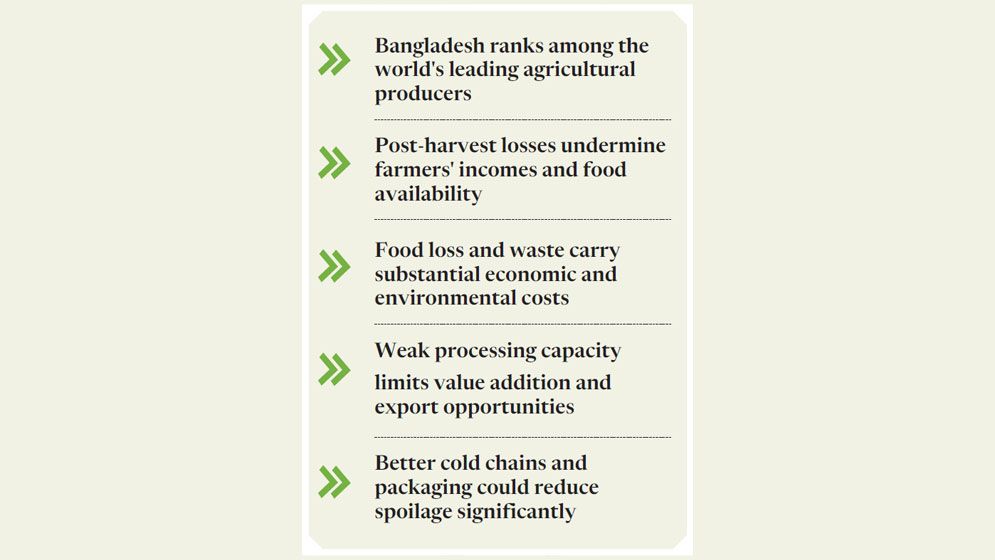
Bangladesh has made significant strides in producing rice, fish, vegetables and fruits, but weak food processing, inadequate storage and substantial post-harvest losses continue to undermine these gains, preventing the country from building a competitive, value-added food industry.
As the world observes World Food Day today, experts say Bangladesh must look beyond boosting agricultural output and invest more in preservation technologies, food processing, research and climate-resilient food systems. The challenge is not simply to produce more food, but to reduce waste, ensure safety and quality, and make nutritious food available at affordable prices throughout the year.
According to the UN Food and Agriculture Organization (FAO), Bangladesh ranks third globally in rice, inland freshwater fish and vegetable production, second in jute and jackfruit, eighth in mangoes and potatoes, and ninth in onions. It ranks among the world's top 10 producers of 22 agricultural products.
Yet production gains have not translated into an equally strong food industry. A study titled “Towards Zero Food Waste and Loss: Building a Sustainable Food Value Chain in Bangladesh”, published last year, estimates that 34% of food produced in the country is lost or wasted.
The consequences are substantial: 27% of the country's land is used to produce food that is never consumed, food loss and waste account for 13% of greenhouse gas emissions, and the economic value involved is equivalent to 4% of gross domestic product (GDP).
The study identifies production, transport, handling, storage and processing as major sources of food loss, while waste is concentrated at the retail and consumer levels. Reported net loss rates stand at 23% for rice, 27% for lentils, 36% for fish and 29% for mangoes.
Losses among horticultural products range from 17% to 32%. Mangoes account for losses of 31.7%, bananas 19.9%, potatoes 21.8%, carrots 26.8%, tomatoes 27.9% and red amaranth 16.9%. Tomatoes also suffer field losses of around 10%.
These losses cut farmers' earnings and reduce the supply reaching consumers. Seasonal gluts depress farm-gate prices, while shortages later in the year drive up retail prices. Better post-harvest management could therefore improve food availability and farm incomes without requiring additional agricultural land.
Processing potential untapped
Food processing could generate greater value from domestic produce through frozen vegetables, processed fruits, packaged fish, fortified foods and industrial starch. But limited processing capacity leaves many farmers reliant on selling fresh produce, often at low prices during peak harvests.
Farm economist ASM Golam Hafiz told the Daily Sun that Bangladesh's production achievements had not been matched by adequate investment in post-harvest management, processing and transport technologies.
“Inadequate cold storage, outdated storage facilities and inappropriate transportation systems are contributing to the problem, particularly for perishable fruits and vegetables,” he said.
He called for specialised transport and improved packaging to prevent damage in transit, noting that fruits are often carried in sacks or tightly packed containers. Rough handling by courier services can further damage mangoes and other produce. Hafiz also pointed to the shortage of processing industries for jackfruit and pineapple despite strong domestic production. Facilities producing dried fruit, jackfruit-based products and pineapple juice could reduce waste, improve farmers' returns and open up export opportunities.
“Production alone cannot ensure food security. Food must also be safe, nutritious and accessible. We need innovation across the entire food value chain, from climate-resilient crop varieties to modern storage, transportation and processing facilities,” he said.
Although researchers are developing climate-resilient crop varieties, rapidly changing weather and difficulties in sustaining the adoption of new varieties remain significant challenges, he added.
Government initiatives
Agriculture Minister Mohammed Aminur Rashid told the Daily Sun that the government had introduced new rice varieties to reduce crop losses caused by floods, including early floods, and taken initiatives to limit post-harvest losses of perishable produce.
“Problems that have accumulated over many years cannot be solved overnight. It will take some time to address these long-standing challenges. However, we have already made progress in several areas,” he said.
He cited onion preservation as an example, saying the government had developed and distributed airflow machines this year to help prevent spoilage. The initiative, he said, had helped keep onions available at more reasonable prices. Mangoes present a similar challenge. Higher productivity, supported by improved cultivation methods and assistance from the Department of Agricultural Extension, has increased output, but markets struggle to absorb the entire harvest during peak season.
The government is exploring ways to improve mango marketing and reduce waste, including training farmers to process the fruit into different products. Some have already become small-scale entrepreneurs, while work is under way to develop methods of preserving mangoes in solid form, the minister said.
He also identified a lack of reliable production and market data as a major obstacle in managing the country's substantial potato output.
Explaining the rationale behind the Farmer Card initiative launched by Prime Minister Tarique Rahman, Aminur Rashid said the programme was intended to build a reliable database of agricultural production and demand.
Accurate information on the number of farmers, the area under cultivation, fruit-bearing trees, production volumes and consumer demand would help the government coordinate supplies across production regions and major markets, including Dhaka, he said.
Better coordination, he added, could help prevent farm losses, reduce waste and protect consumers from excessive prices and market distortions.