



 For all latest news, follow the Daily Sun's Google News channel.


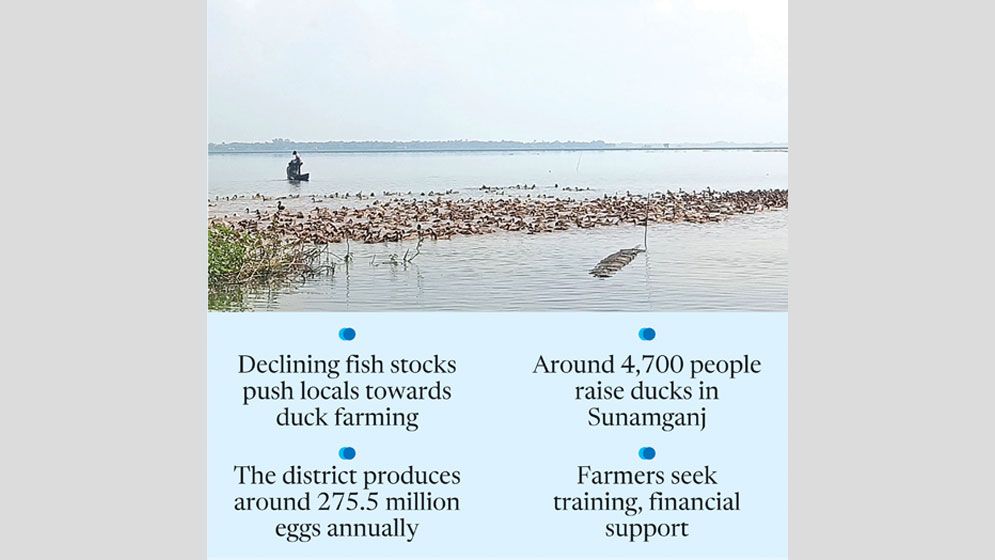
Duck farming has emerged as an alternative source of livelihood for unemployed youths and fishermen in Sunamganj’s haor areas as declining fish stocks reduce their traditional income, but a lack of training, feed shortages, disease outbreaks and financial constraints continue to threaten the sector.
During the six-month monsoon, fishing traditionally provides a major source of income for people in the haor region. However, with fish becoming less available, many residents have turned to duck farming, attracted by growing demand for duck eggs and meat among local consumers and tourists.
Many farmers have established small and large farms near the haors, often taking loans to start their businesses without receiving proper training or technical support. According to local sources, around 4,700 people in the district raise ducks on farms and in household settings. Sunamganj produces 275,511,186 eggs annually against a reported demand of 256,666,900, indicating a substantial surplus.
Farmers generally buy day-old or young ducklings and rear them at home or in the haor areas. Some keep ducklings at home for about a month before releasing them into the haors to forage for natural food, supplementing their diet with rice. They bring the ducks back to shelters in the evening. After three to four months, the ducks can be sold for Tk400-500 each. Others purchase adult laying ducks and raise them for egg production before replacing them with new birds.
Despite the growing interest in duck farming, producers face recurring difficulties, including declining egg production, disease outbreaks, shortages of feed and limited access to training and affordable veterinary services.
Ibrahim Khalil, a farmer with a farm on the bank of Shani Haor, said he had purchased 2,500 ducklings of one-day age from Derai at Tk60 each, including transportation costs. He plans to rear the ducklings for three months before selling them at around Tk500 each. The total rearing cost is expected to range between Tk2 lakh and Tk3 lakh.
He said the ducks would receive supplementary feed during the first month, while rice and natural food available in the haor would be used during the remaining period. However, the business involves considerable risks.
Salim Uddin, who has been raising ducks for 25 years, said “Ducks suffer from various diseases. If they survive, we may make a profit; otherwise, we risk losing our entire investment. He added that government financial assistance and training would help farmers manage their farms more effectively and reduce losses.
Faruk Mia, another duck farmer, said although the ducks lay eggs in the morning, production remains low because of insufficient natural food in the haors, he said.
“If farmers were allocated specific areas of the haors for duck farming, it would be easier to rear ducks and increase egg production,” he added.
Farmers believe the sector could expand further if designated areas of the haors were kept open for duck farming, allowing them to rear their flocks more efficiently.
Tahirpur Upazila Animal Resources Officer (acting) Md Harun Or Rashid said the government could not provide vaccines to farmers free of charge, but they could purchase them at government-fixed prices. He said the department provided assistance to farmers as far as possible and offered round-the-clock advice to duck farmers in the haor areas.