



 For all latest news, follow the Daily Sun's Google News channel.


Rohingya camp security infrastructure missing or dysfunctional
Govt decides to repair the fence, reinstall the missing equipment

Seventy kilometres of barbed-wire fencing, 83 watchtowers and 760 CCTV cameras were installed in and around the Rohingya camps in Cox’s Bazar. Most of them are now missing or dysfunctional.
The Office of the Refugee Relief and Repatriation Commissioner (RRRC) disclosed this on Thursday at the second meeting of a 16-member national committee led by the home minister to discuss Rohingya issues, held at the Secretariat.
The RRRC office said that it wrote to the deputy inspector general (FDMN) of Cox’s Bazar on 22 October 2025, asking him to set up checkpoints in camps 8, 16, 18 and 20. It also wrote to the Disaster Management and Relief Ministry secretary on 11 March last year, seeking repairs to the damaged barbed-wire fence.
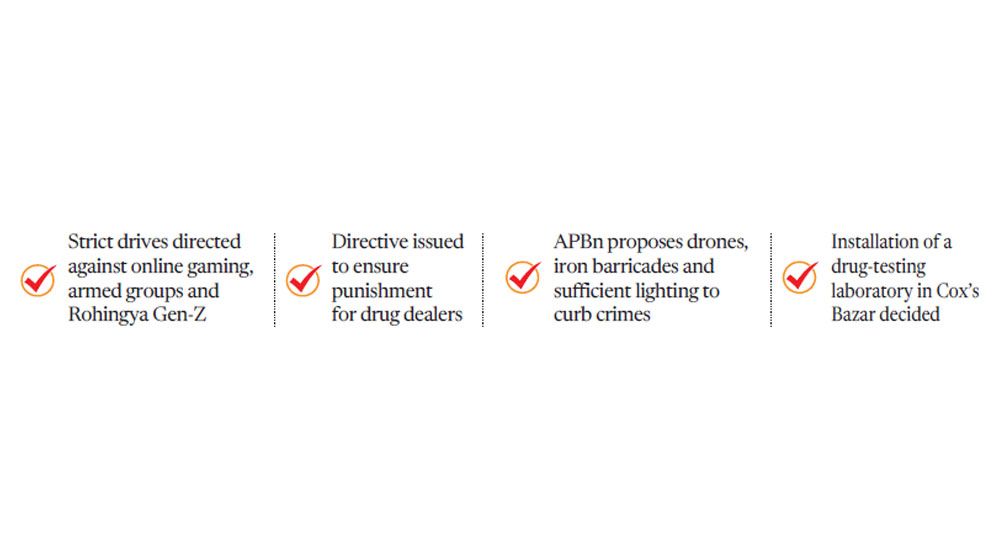
The Cox’s Bazar Armed Police Battalion (APBn) said that drones, iron barricades and sufficient lighting are needed to protect the CCTV cameras. It wrote to APBn Headquarters on 13 July this year seeking necessary steps.
The meeting chaired by Home Minister Salahuddin Ahmed decided to repair the fence and reinstall the missing and damaged equipment.
The Armed Forces Division will design and submit a proposal for the work. Police Headquarters will prepare a budget and submit it to the home ministry’s budget section.
Online gaming
Home ministry sources said that teenagers and young Rohingyas are mainly engaged in online gaming. Besides, organised armed groups and young Rohingyas belonging to Generation Z are carrying out illegal activities in the camps, worsening law and order.
According to the meeting minutes, the APBn regularly conducts mobile courts, special drives and joint operations against gaming and other criminal activities.
The RRRC office said that action is being taken against Rohingya Gen-Z individuals involved in criminal activities. Executive magistrates, the APBn, Battalion Ansar, district police, the SRB, the BGB and the army carried out 32 joint operations from January to August this year. The meeting decided to hold regular drives against online gaming, armed groups and Rohingya Gen-Z groups or individuals involved in criminal activities.
Drugs
The meeting also decided to set up a temporary narcotics laboratory in 2,675 square feet of space at the Cox’s Bazar Development Authority. Equipment will come from the Department of Narcotics Control (DNC) Chattogram divisional office.
It also decided to ensure punishment for those involved in illegal drugs. The DNC will be informed if any bank delays providing information on drug traders. Previous case records will be checked before cases are filed.
Representatives of the Criminal Investigation Department (CID) said that they had written to all units about ensuring exemplary punishment. The CID has also arranged training for its officers. The CID said that 18 drug cases in the Cox’s Bazar area were disposed of from 1 January to 30 June this year. Some 32 others are under investigation.
The APBn said that it recovered 119,530 Yaba tablets, 790 grams of cannabis, nine litres of locally made liquor and 12 cans of beer from the camps from January to August this year. It filed 44 cases against four drug kingpins.
The Special Response Battalion (SRB) said that it conducted 53 drives in the camps from May to August. It recovered two shotguns, a foreign pistol, 354 bullets, 65,522 Yaba tablets and five kilograms of cannabis. It also rescued five trafficked Rohingyas and arrested 66 people.
The RRRC office said that 257 mobile courts were held in the camps from May to August this year.
Thirty-three people received prison terms of varying lengths. Authorities demolished 122 illegal establishments.
Several officers at the office of the RRRC and APBn told the Daily Sun that around 18 lakh Rohingya people, ranging from children to adults, live in Ukhiya and Teknaf upazilas of Cox’s Bazar district.