




 For all latest news, follow the Daily Sun's Google News channel.


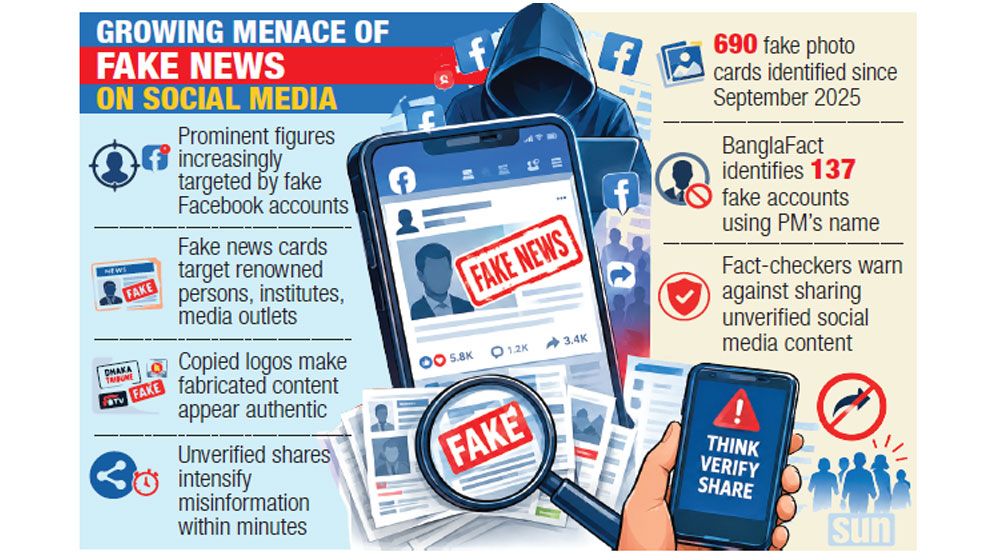
A surge in fake Facebook pages and fraudulent news cards impersonating prominent individuals and established news outlets is flooding social media platforms, triggering serious concerns over political stability, public confusion, and nationwide digital security risks.
Exploiting copied logos, typography, and familiar media layouts, these unverified accounts routinely pass off fabricated statements and manipulated photo cards as authentic journalism. The coordinated campaign targets figures across the political spectrum, from the prime minister and family members to cabinet ministers and opposition leaders.
Old photographs are frequently paired with invented quotes, whilst snippets of genuine remarks are selectively edited with misleading text to manipulate public perception.
The scale of the threat is well documented.
Parliamentary data disclosed last September revealed that BanglaFact, the fact-checking unit of the Press Institute of Bangladesh, identified 137 fake Facebook profiles and pages impersonating the Prime Minister alone. A further 100 fraudulent accounts across Facebook and X, alongside 16 clone websites designed to mimic national media portals, were also flagged for disseminating malicious content.
Independent digital media research group Dismislab noted that this wave of political disinformation began escalating sharply in September 2025 before reaching a crescendo ahead of the 12th February 2026 parliamentary election.
Dismislab’s analysis showed that at least 690 fake news cards were identified by various fact-checking organisations between September 2025 and February 2026, primarily engineered to artificially boost or damage political reputations ahead of the polls.
The momentum has shown little sign of abating post-election. Local fact-checking platform Rumor Scanner verified at least 275 distinct pieces of online misinformation circulated in September alone, highlighting how deceptive photo cards have become the primary vehicle for digital deception in Bangladesh.
Speaking to the Daily Sun, Khaleda Begum, deputy commissioner of DB Cyber and Special Crime (North), warned that fabricated online content poses a direct threat to the country’s social, religious, and political harmony.
“It is a clear criminal offence and has become a growing menace,” she said, confirming that law enforcement agencies are collaborating with the Bangladesh Telecommunication Regulatory Commission (BTRC) to trace, verify, and dismantle malicious networks.
She added that digital tactics are constantly evolving as perpetrators deploy new methods to exploit unsuspecting users. Calling for greater public vigilance, particularly during major events such as the Sharadiya Durga Puja, she urged citizens to scrutinise information before liking, commenting, or sharing.
Legal enforcement is also set to tighten significantly.
Under the draft Cyber Security (Amendment) Act 2026, the publication and deliberate dissemination of online rumours and fake news carry severe penalties, including a maximum prison sentence of up to 10 years and fines reaching Tk40 lakh.