


 For all latest news, follow the Daily Sun's Google News channel.


BEYOND HOSPITALS AND CLASSROOMS
The unseen battle families wage for children with disabilities

Not long ago, 11-year-old Rabiul Hasan was begging beside his mother on a roadside in Narayanganj’s Fatullah area. Today, he is regarded as one of the brightest students at Madinatul Uloom Visually Impaired Orphanage Madrasah in Dhaka, and is on his way to becoming a Hafez of the Holy Quran.
His life changed in 2022, when the madrasah’s Founding Director Mohammad Abul Kalam Azad arranged his admission.
Rabiul’s story shows what a child with a disability can achieve when someone opens a door. It also points to a larger one: thousands of families across Bangladesh are fighting, mostly unseen, to keep such doors open at all.
“Not only Rabiul – I have picked up several children with disabilities who were begging on the roadside,” Azad told Daily Sun. About 70 of his 150 students live with a disability and study free of charge. “They come from extremely poor families, so I have to look after everything, from medical treatment to education,” he said.
“Some of my classmates had a disability when I was a student, and they were very brilliant. That is what made me decide to set up an institution for children with disabilities,” he said, adding that some families refuse to admit their children because they earn more by begging than they would gain from an education.
Azad insists his students learn faster than most. “They grasp lessons easily, and they pick up computer and technology skills quickly,” he said, adding, “If we nurture them properly, they will not be a burden on their families, society or the state – they can become entrepreneurs, in technology or in agro-farming.”
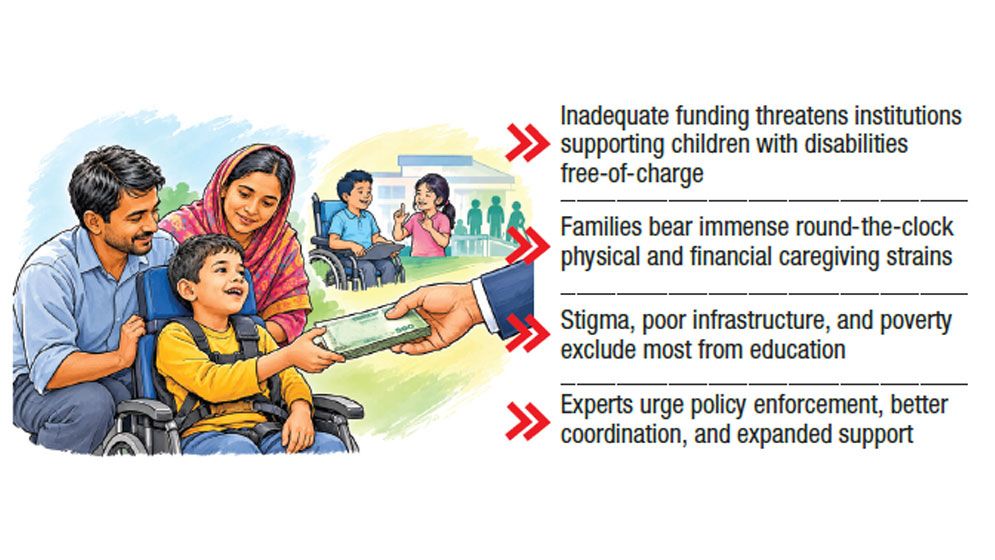
His biggest obstacle is money: the madrasah needs roughly Tk8 lakh a month to run, and he is appealing for support beyond the government alone.
Inside the home
Outside institutions like Azad’s, the struggle goes on largely out of public view, inside the home.
Najma Begum of Chandpur has three children with disabilities; only one attends school. “I cannot fully explain what a family goes through,” she said.
“If a child cannot move on their own, someone has to do everything for them – feeding, bathing, helping them sleep, taking them to the toilet.” With inflation squeezing household budgets further, she wants the government allowance raised. “If the state does not share the cost, how can a family cope?”
Someone must stay with such a child around the clock – often a mother, who gives up work, rest and sometimes her own health. Behind many such households sits one unanswered question: what happens to the child once the parents are gone.
Nazrul Khan, a rickshaw puller in Demra, has cared for his son’s cerebral palsy for more than 15 years, even as he and his wife battle their own illnesses.
“He cannot move on his own. After I get home with my tired body, I still have to look after him – even at night, when he wakes, so neither of us sleeps,” he said. He spends more than Tk5,000 a month on medicine; the state allowance, he said, barely registers against that cost.
A national picture
According to the National Survey on Persons with Disabilities (NSPD) 2021, run by the Bangladesh Bureau of Statistics with UNICEF’s technical support, only 65% of children with disabilities aged 5-17 were enrolled in primary school and just 35% in secondary school – with around 60% of children with disabilities overall not participating in education at any level.
The same survey found 1.7% of Bangladeshi children live with one of twelve disabilities defined under the Rights and Protection of Persons with Disabilities Act 2013, while 3.6% face functional difficulty in areas such as seeing, hearing, walking, communication or behaviour.
Older UNICEF data from 2012 found 8% of child beggars surveyed had a disability, nearly three-quarters of them a physical one; only 14% had ever been taken to a hospital, with most relying instead on a pharmacy. Rights groups estimate roughly seven lakh beggars nationwide, 40,000 of them in Dhaka alone.
Shahin Islam, sector lead for education at Save the Children in Bangladesh, said children with disabilities face overlapping barriers – attitudinal, physical, financial and institutional.
“Negative attitudes, stigma and low expectations remain particularly significant, affecting enrolment, participation and retention,” he said, pointing also to inaccessible ramps, toilets and classrooms, a shortage of trained teachers, and weak referral systems between services.
The barriers are worse, he added, for girls with disabilities and for children in rural, remote or disaster-affected areas – meaning real progress requires more than higher enrolment figures: accessible buildings, trained teachers, assistive devices, and an end to stigma itself.
He called for strict enforcement of the 2013 Act, early screening, and inclusive schools built around Individualised Education Plans.
Kazi Mafizur Rahaman, a senior manager at the same organisation, added that protection from violence and early marriage, better disability-disaggregated data, and the inclusion of children with disabilities and their representative organisations in decisions that affect them should all be national priorities.
A policy response still catching up
Experts say Bangladesh’s roughly 4.6 million people with disabilities – about 2.8% of the population, according to the NSPD – cannot be meaningfully included in the country’s development without far deeper structural change.
Despite the explicit pledge to "leave no one behind" under the Sustainable Development Goals (SDGs), children with disabilities in Bangladesh continue to confront severe systemic barriers, leaving a vast pool of human potential entirely untapped.
Experts stress that with millions living with physical and cognitive impairments, their full and active integration into national growth strategies is indispensable if the country hopes to attain its SDG targets.
In particular, SDG Target 4.a mandates the creation and upgrading of learning environments that are fully child-, gender-, and disability-sensitive, ensuring accessible, safe, and effective education for all.
According to the BBS survey, only 33.78% of working-age persons with disabilities are in formal employment, while 54.42% rely on self-employment.
Mohammad Abdur Razzaque, chairman of Research and Policy Integration for Development (RAPID), identified persistent structural hurdles, including inconsistent identification systems, unreliable data, poor rights awareness, legal gaps, and severe job deficits, as major roadblocks.
He emphasised that disability-inclusive policies must explicitly incorporate gender- and child-focused provisions to ensure equity and meet international commitments.
Mohammad Abdur Razzaque pointed to inconsistent disability identification, unreliable data and gaps in legal protection as the core obstacles. “Raising awareness and building capacity are indispensable for the successful implementation of disability-inclusive policies,” he said.
Daud Jibon Das, executive director of Caritas Bangladesh, said government programmes – allowances, healthcare, rehabilitation, education – exist but remain inadequate against the scale of need, with NGOs similarly stretched.
Speaking to Daily Sun, he highlighted that ensuring equal access to basic public services, quality education, sustainable livelihoods, and civil decision-making remains an uphill struggle.
He noted that while NGOs continue to fill critical service gaps, their organizational capacity remains dwarfed by the sheer magnitude of the population in need.
“Greater coordination among government, NGOs, international partners and donors is needed,” he said, “with expanded programmes and resources from both government and the private sector” if Bangladesh is to meet its Sustainable Development Goal commitments.
The government, for its part, points to expansion already under way.
Social Welfare Minister Dr AZM Zahid Hossain said the country now has around 4.5 million registered persons with disabilities and roughly 2,600 schools serving children with disabilities, of which 85 are registered and 75 draw government salary support; more than 1,700 schools have already been inspected.
“The government is working to set up one quality school for children with disabilities in every district, and at least one in every upazila,” he said, adding that Prime Minister Tarique Rahman has directed several ministries and bodies, including the Department of Social Services and the Disability Development Foundation, to work together on inclusion – alongside a stated goal of making Bangladesh free of street begging within four years.
The Department of Social Services says disability allowance recipients have risen from 3.45 million to 3.8 million in FY27 fiscal year, each receiving Tk1,000 a month, with 81,000 students currently receiving education stipends under a Tk4,587.36 crore allocation.
State Minister for Health Dr MA Muhit said, “Shishu Swarga” facilities are being rolled out across 22 districts to deliver integrated treatment and rehabilitation for an estimated 350,000 children living with cerebral palsy, and called for a genuinely universal, inclusive healthcare system to match.