


 For all latest news, follow the Daily Sun's Google News channel.


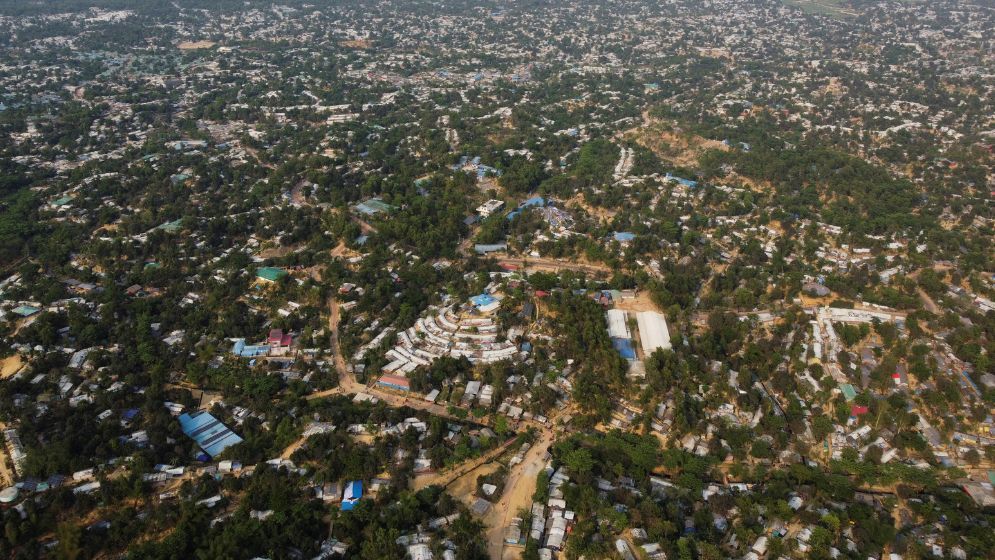
A drone view of Rohingya refugee camps in Cox's Bazar, 17 April 2026. Photo: Reuters
The government has so far distributed 7,985 SIM cards to Rohingyas living in camps in Cox’s Bazar as part of a plan to bring them under control, monitor their communications and curb the use of foreign SIM cards.
The interim government initiated the move in 2025, with an initial target of distributing 10,000 SIM cards.
To enable SIM issuance, the UNHCR was asked to grant data access to the BCC, and a committee was formed to speed up and monitor the data transfer.
On 10 November last year, Refugee Relief and Repatriation Commissioner (RRRC) Mizanur Rahman inaugurated the SIM distribution programme by handing over 100 SIM cards.
“A total of 7,985 SIM cards have been distributed since,” a RRRC delegation told a meeting of the National Committee on Forcibly Displaced Myanmar Nationals at the home ministry on Thursday.
As Rohingya refugees do not hold national identity cards (NIDs), SIM cards have been issued on the basis of registration numbers provided by the United Nations High Commissioner for Refugees (UNHCR), according to the minutes of the meeting.
Only those aged 18 and over are eligible, the RRRC delegation said.
However, another major part of the initial plan – to restrict mobile network coverage in Rohingya camps to 2G – has yet to be implemented, with Rohingyas still enjoying access to 3G and 4G networks.
According to sources at the Home Ministry, Rohingyas in Bangladesh have long been using SIM cards from different countries, including Myanmar and Malaysia. Many of them carry out criminal activities using foreign SIM cards.
The failure to impose the 2G restriction has left Rohingyas with access to high-speed networks, enabling them to communicate with people outside the camps, elsewhere in Bangladesh and abroad, the sources said.
While acknowledging that Rohingyas use foreign SIM cards, RRRC said, “The switch from 3G/4G to 2G will hamper relief work. In the event of a disaster, it is not possible to communicate easily or to get messages through.”
“It is also not possible to report the true state of the law-and-order situation. Adverse reactions to this measure have also been noted from government, non-governmental and international organisations,” it said.
Nowsher Ibni Halim, assistant secretary at the RRRC, told the Daily Sun that the area was hilly and network coverage was often poor, making 2G unsuitable.
“2G has not yet been implemented. The matter is still pending,” he said.
When contacted by the Daily Sun, Mohammad Anowar Hossain, secretary at the Bangladesh Telecommunication Regulatory Commission (BTRC), which is responsible for implementing the 2G restriction, declined to comment on the matter.
Meanwhile, Siraj Amin, commander of the 14th Armed Police Battalion (APBn) and an additional deputy inspector general of police, told the Daily Sun that they had recovered SIM cards from different countries from Rohingyas, including suspected drug traders, during several raids.
He said police faced difficulties in stopping people from playing online gambling games using the SIM cards and a virtual private network (VPN), as the activity appeared to originate from abroad rather than Bangladesh.
Although police cybercrime units were working on the issue, they needed greater capacity, he added.
Additional Inspector General Hasib Aziz, chief of the Armed Police Battalion (APBn), which is responsible for security in the camps and surrounding areas, told the Daily Sun that Rohingyas had long been using SIM cards from Myanmar, Malaysia and several other countries.
“We are in communication with the BTRC on how to stop the SIMs. Our efforts and process continue. We hope for a good solution soon,” he said.
He could not provide the exact number of illegal SIM cards recovered by the APBn. Asked whether the number could be several thousand, he said it might be.