



 For all latest news, follow the Daily Sun's Google News channel.


Govt mulls involving NGOs in projects as funding falls
Foreign grants drop 31% in five years; banks’ CSR spending plunges 69% in three years
Daily Sun Report, Dhaka
Published: 07 Oct 2026, 12:00 AM
Foreign funding for NGOs in Bangladesh has declined by nearly 31% in five years, while spending from banks’ corporate social responsibility (CSR) funds has fallen by around 69% in three years, putting increasing financial pressure on the country’s non-governmental organisations.
Against this backdrop, the government is considering bringing NGOs more directly into development projects under a new policy framework, officials and policymakers said at a seminar in Dhaka on Tuesday.
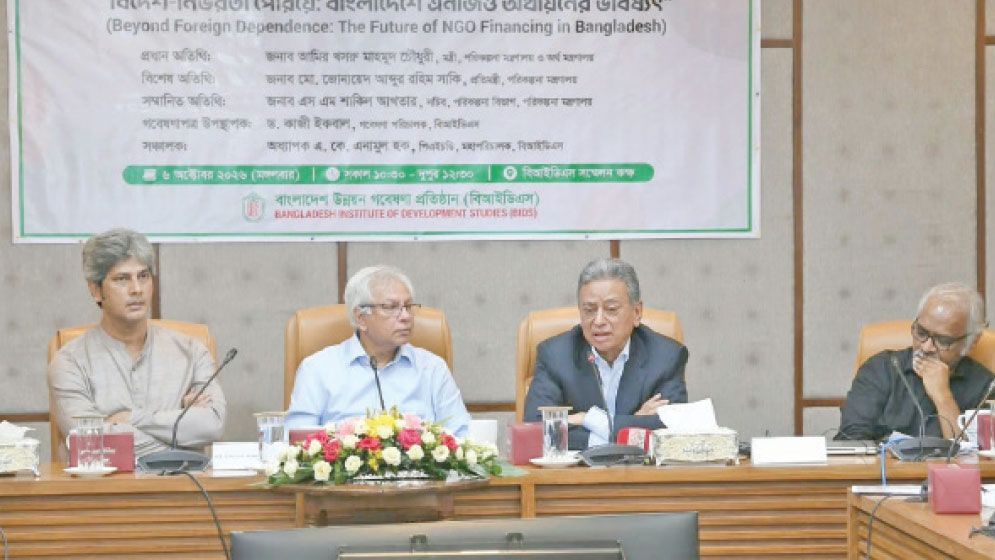
The issues were discussed at a seminar titled “Beyond Foreign Dependence: The Future of NGO Financing in Bangladesh”, organised by the Bangladesh Institute of Development Studies (BIDS).
Finance and Planning Minister Amir Khosru Mahmud Chowdhury attended the event as the chief guest, while Planning State Minister Zonayed Abdur Rahim Saki was present as a special guest.
BIDS Director General AK Enamul Haque moderated the event, while BIDS Research Director Kazi Iqbal presented the keynote paper.
According to the keynote presentation, foreign grants received by NGOs stood at US$955 million in the fiscal 2018-19, but declined to $655 million in FY24, representing a drop of about 31% over five years.
The decline in domestic CSR financing has added to the pressure. The paper said banks spent Tk1,129 crore from their CSR funds in 2022, but the amount fell sharply to Tk345 crore in 2025, a decline of nearly 69%.
The falling flow of both foreign grants and CSR funds has created growing uncertainty over the financial sustainability of NGOs, many of which play a significant role in delivering services to communities at the grassroots level.
Speaking at the seminar, Finance Minister Amir Khosru Mahmud Chowdhury said the government needs to develop an appropriate financing model for collaboration between the government and NGOs.
“We have to think about what the financing model between the government and NGOs should be. NGOs can deliver services to places where the government often cannot reach. So, we want to work with NGOs on the basis of partnership,” he said.
The minister earlier stressed the need for a stronger institutional partnership among the government, NGOs and the private sector to address development challenges and ensure sustainable financing.
He said NGOs are already contributing in areas including human development and the creative economy, and that their existing activities should be given a more organised, institutional and policy-based framework.
Planning State Minister Zonayed Saki said foreign financing for NGOs was gradually declining as Bangladesh moves towards graduation from the Least Developed Country (LDC) category.
He said new financing mechanisms, including green finance and carbon finance, were now being discussed as possible alternatives to traditional foreign funding.
“The government is trying to transform NGOs from being dependent on foreign funding into a supportive force for the government,” Saki said, adding that discussions were underway to involve NGOs in the country’s development process.
The government is also considering how NGOs can be incorporated into public development projects under a new policy framework, officials said.
The move could create a more structured role for NGOs in implementing development programmes while helping them diversify their sources of funding.
The speakers also emphasised the importance of establishing a sustainable financing framework within specific timelines so that NGOs can continue their grassroots activities despite declining foreign and CSR funding.
The seminar also discussed the need for greater private-sector participation, stronger accountability and more effective coordination among the government, NGOs and other stakeholders in addressing Bangladesh’s emerging development challenges.