




 For all latest news, follow the Daily Sun's Google News channel.


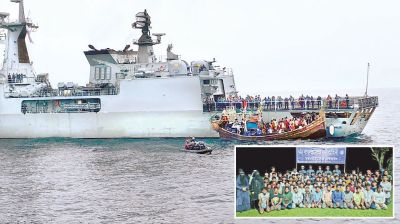
The government is preparing to evict illegal occupiers from Sonadia Island with the help of the Bangladesh Navy, in a major effort to restore an ecosystem severely damaged by years of encroachment, shrimp farming, salt cultivation and mangrove destruction.
Once known for its rich mangrove forests, wetlands and diverse wildlife, Sonadia is now facing a difficult ecological recovery. The government plans to reclaim illegally occupied land and restore the island through a phased operation.
The initiative is being implemented under a project titled “Strengthening Capacity of MoEFCC, DoE and BFD for Natural Resource Management and Improved Climate Resilience”, funded with Swedish assistance.
Fahmida Hoque Khan, joint secretary (development) at the Ministry of Environment, Forest and Climate Change and project director, told the Daily Sun that parts of Sonadia were handed over to the Bangladesh Economic Zones Authority (BEZA) in 2016 and 2018.
“An area of 9,466 acres was handed over in 2016 and another 12,270 acres in 2018. Later, illegal occupiers took control of the areas. They cut down vegetation and converted the land into salt fields and shrimp farms, causing extensive damage to biodiversity and the ecological balance of the entire island,” she said.
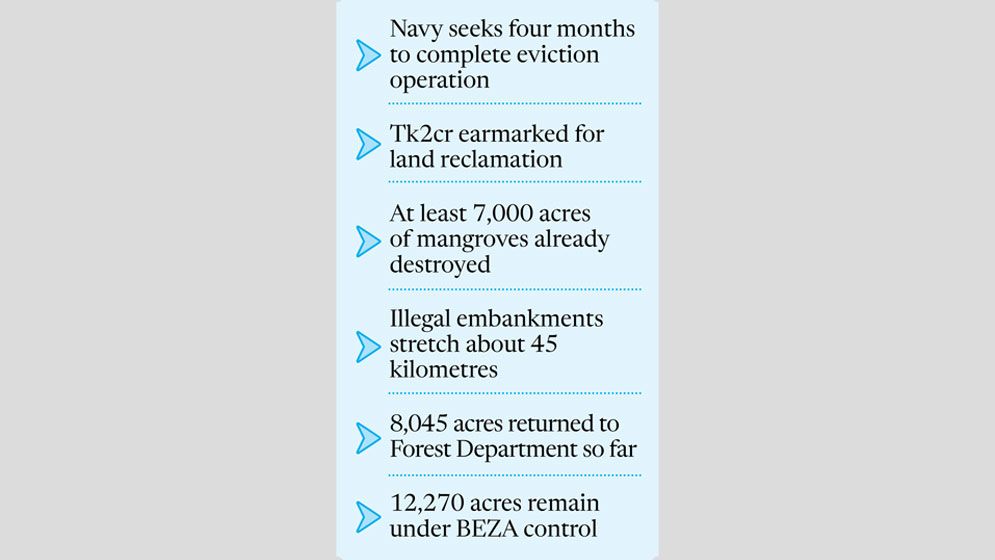
The project has a total allocation of Tk6.45 crore, of which Tk2 crore is earmarked for land reclamation and restoration.
According to Fahmida, the ministry wants the Navy involved because of the sensitivity of the situation and the scale of illegal occupation.
“Several meetings have already been held with the Bangladesh Navy, and the prime minister approved the proposal in August. We are now in the process of implementing it,” she said.
A meeting was also held with the Armed Forces Division on Sunday to discuss the operation.
The eviction will initially focus on Sonadia Island and its principal mouza, followed by other occupied mouzas. The Navy has sought four months to complete the operation, although the government has yet to decide whether the clearance will be carried out in one phase or several.
Officials from the ministry and Swedish representatives are scheduled to inspect Sonadia on 16-17 October. The field visit will help determine the scale and cost of the operation.
“If the donor agrees to provide the additional funds required, we may complete the work at once. Otherwise, we will have to proceed in phases,” Fahmida said.
Sonadia was declared an Ecologically Critical Area (ECA) in 2006 because of its environmental importance. Activities harmful to soil, water, air and other environmental components are prohibited under the ECA regime.
Despite that protection, the island has suffered extensive mangrove loss. Forest Department estimates suggest that at least 7,000 acres of mangrove forest have been cleared, with large areas converted into shrimp farms, salt fields and other enclosures. In 2017, the then Awami League government allocated 9,466.93 acres of Sonadia forestland to BEZA for Tk1,001 for an eco-tourism park. The project, however, never materialised. After BEZA took possession, significant eco-tourism activities did not begin, while the Forest Department lost legal authority over the forestland, making protection increasingly difficult.
Environmentalists say mangrove destruction has reduced biodiversity and weakened Sonadia’s natural defence against cyclones, tidal surges and coastal erosion. The forests also provide breeding and feeding grounds for fish, birds, crustaceans and other wildlife, making their degradation a wider threat to the Maheshkhali coastal zone.
In March 2025, the government decided to return 9,466 acres of Sonadia forestland to the Forest Department. So far, about 8,045 acres covering three mouzas have been returned, while around 12,270 acres across six mouzas remain under BEZA’s control.
The island’s crisis is further complicated by extensive illegal embankments and enclosures. A 2025 survey by the Maheshkhali upazila administration identified around 45 kilometres of embankments linked to illegal occupation and land use. The administration sought Tk4.20 crore for their removal and demolished 11 illegal shrimp enclosures that year.
Officials acknowledge that eviction alone will not restore Sonadia. Once illegal structures, shrimp enclosures and salt fields are removed, damaged land will need ecological restoration, including mangrove regeneration and protection against renewed encroachment.
The proposed Navy-led operation could therefore mark a major turning point, but its long-term success will depend on preventing reoccupation and ensuring sustained restoration and protection of the island’s remaining ecosystem.
Read More