


 For all latest news, follow the Daily Sun's Google News channel.


Air conditioners’ condensed water has been a problem for interior walls and floors at the Department of Public Health Engineering (DPHE), but the water which was earlier drained is now being used for drinking, washing cars and gardening after collection and purification.
The innovative thinking of the DPHE engineers to reuse air conditioner (AC) water by installing a collection network and purification system with a small investment can be a supplementary source of water in a city like Dhaka that has a water crisis and a huge problem of underground water reserve depletion.
Experts from public health and water sectors said that AC water can be a supplementary source for daily use in administrative, university, business, hospital and other buildings where there are large numbers of AC units.
Besides, the AC water collection system can help control the breeding of Aedes mosquitoes in the collected water.
If anyone visits the DPHE headquarters at Kakrail, a water dispenser can be seen at the entrance from where people are usually collecting water.
Officials said on average 50 people, mostly visitors, collect water from the dispensers daily. Besides the drinking water facility, there is another dispenser for collecting water for car washing and pouring it into a WASA water tank when the water overflows.
The DPHE head office now has two 1,000-litre-capacity tanks for AC condensate water at the ground level and
one 50-litre-per-hour treated AC water dispenser.
The DPHE recorded daily water consumption from their dispenser from October 2025 to February 2026. Based on daily meter readings, the water consumption rate was 13-36 litres at that time. In the hot season, consumption rose to 50-60 litres per day.
DPHE pioneers water recycling in Dhaka
Officials at DPHE said that they were facing regular problems with AC water and rainwater which would dampen their walls and floors.
Shishir Kumar Biswas, former executive engineer of Survey Investigation and Research Division and one of the pioneers of the project, said, “My job was to look after the operation and maintenance of the DPHE buildings. We were concerned about AC water, which was damaging our floors and walls. We were searching for a sustainable solution. We don’t need to renovate our building exterior over and over again.”
“Then, the idea of collecting AC water crossed my mind. I submitted a proposal to establish a pipe network covering all AC pipes to the chief engineer to protect the building exterior from AC condensate water on 12 December 2024. He approved it on 24 January 2025. AC water receiving pipe installation could be completed by the end of June 2025,” he said.
He said that a private company, Green Dot Limited, provided two water storage tanks.
Sushanta Roy, executive engineer of the Research and Development Division of the DPHE, was also part of the initiative. He said, “Very often, I would notice that AC condensate water was rolling down through the pipe. Water was stagnant on the floor. I then called my staff and asked him to put a bucket to contain the water.”
“I observed that we were getting a litre of water an hour on average from the AC. Then I asked him to put more buckets. We tested the AC water in our laboratory and found no heavy metals or other contaminants.”
Four DPHE engineers, Sushanta Roy, Shishir Kumar Biswas, Md Jibon Ahmed and Md Golam Rabby, presented a paper titled “Reusing AC Condensate: A Sustainable Solution for Water Scarcity in Hot, Humid Climatic Conditions” at the Water and Development Congress and Exhibition held in Bangkok, Thailand, from 8 to 12 December 2025.
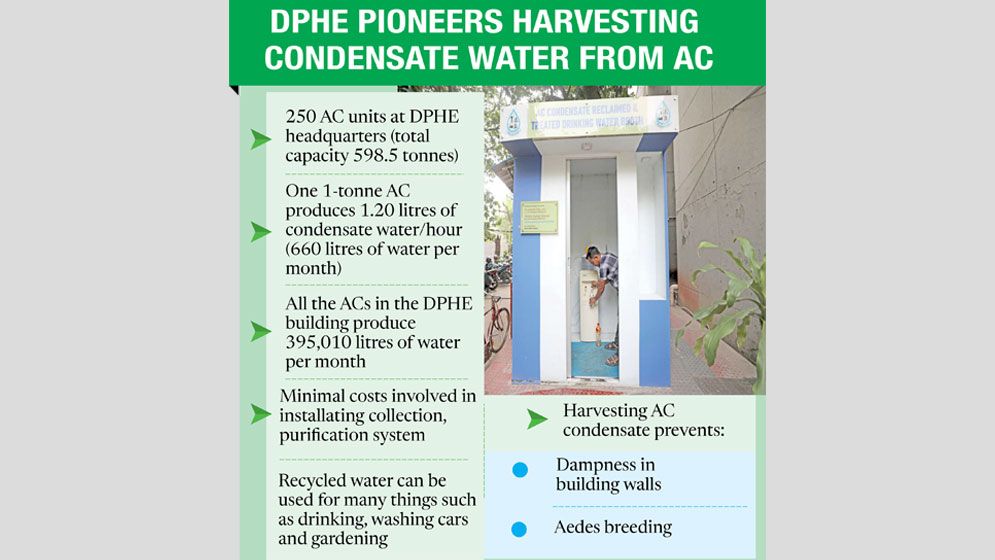
The paper details the AC water collection and purification system, which said that the DPHE buildings have 250 AC units with capacities of 1, 1.5, 2, 2.5, 3 and 5 tonnes in operation at the DPHE headquarters and the total capacity of these air conditioners is 598.5 tonnes.
It also said that one tonne of air-conditioning capacity produces 1.20 litres of condensate water per hour. If an air conditioner is operated for five hours a day, five days a week and 22 days a month, one tonne of AC capacity can generate approximately 660 litres of water per month and accordingly, all the air conditioners at the headquarters can produce approximately 395,010 litres of water per month and around 3.16 million litres annually, considering an eight-month summer period.
Low investment needed for water recycling
According to the DPHE research, a pipeline network has been installed to collect air-condensed water from the air conditioners and channel it to a central point. Two 1,000-litre water storage tanks have also been installed to store the collected water. The collected condensate water is purified using reverse osmosis and UV sterilisation technologies and made suitable for drinking.
The DPHE's Central Water Testing Laboratory tested the water and found no heavy metals or harmful pathogenic bacteria in the water. A mineral kit has also been added to increase the pH of the water and maintain its mineral quality. Excess water is stored in the building's underground reservoir.
The water is cheap, as there are minimal costs involved in the installation of the collection and purification system and a regular charge for electricity to operate a reverse osmosis system and the mineral kit.
A supplementary source of water
Talking to the Daily Sun, Professor Dr Rowshan Mamtaz, who is an environmental engineer and director of International Training Network, said that the AC water can be a supplementary source and that the use of the water is safe.
“Though the air of Dhaka city is polluted, no toxic element is present in the water. The source of the water is moisture in the air. In the AC system, water is evaporated and then condensed again. In the process, particulate matter and other things are eliminated. The condensed water is pure but tasteless; that’s why minerals are added for drinking.”
She also said, “AC use is common in big cities in residential, administrative, hospital, business and office buildings, so the water from the ACs can be a supplementary source of water. The quality of the water is also far better than the water supplied by the different city authorities in Bangladesh.
She added, “The AC water use reduces pressure on groundwater and the cost of treating surface water with high chemical costs. It has other benefits as the transparency of AC water can facilitate the breeding of the dengue vector Aedes, as well as moss growth on floors and walls and dampness in the walls.”