


 For all latest news, follow the Daily Sun's Google News channel.


Yam cultivation gains ground in Jashore as farmers eye higher profits
Daily Sun Report, Benapole
Published: 04 Oct 2026, 12:00 AM
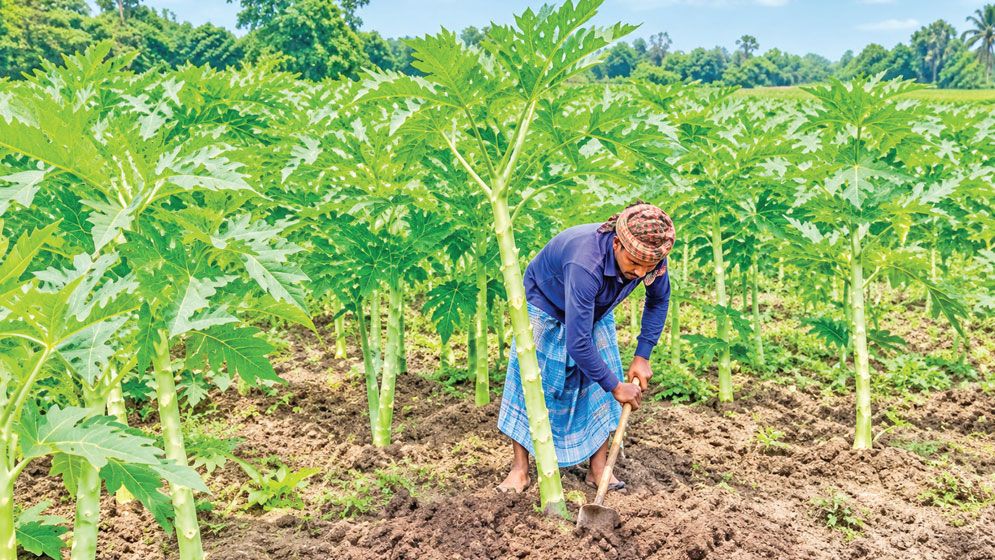
Yam cultivation is gaining popularity among farmers in Jashore as good yields, relatively low production costs and favourable market prices are encouraging more people to grow the tuber crop.
Farmers are increasingly cultivating yam on unused land around homesteads, while its stalks are also becoming popular as a vegetable in local markets.
According to the Department of Agricultural Extension (DAE) in Jashore, yam is cultivated to varying degrees in all eight upazilas of the district. Chaugachha, Sharsha, Jashore Sadar and Jhikargachha are the major commercial production areas. During the Kharif-2 season of the 2025-26 fiscal year, early vegetables were cultivated on 6,665 hectares of land in Jashore. Of the total, yam was grown on 510 hectares, with a production target of 13,806 tonnes. Farmers are cultivating several varieties, including BARI Ol-1, BARI Ol-2, Madras and local varieties.
BARI Ol-1 and BARI Ol-2, developed by the Bangladesh Agricultural Research Institute (BARI), are high-yielding varieties. The Madras variety grows quickly and produces larger tubers, while local varieties remain popular for their taste.
Al-Amin, a farmer from Ichhapur village in Chaugachha, has been cultivating yam on an experimental basis for the past few years.

“This year, I planted around 4,500 pieces of BARI Ol-1 on 66 decimals of land. Considering the production cost and the current market price, I expect to earn nearly three times my investment,” he said. “One major advantage of yam cultivation is that cattle and goats usually do not eat the plants, so there is little need for additional guarding. Pesticide use is also almost unnecessary. Yam is now selling for Tk 60 to Tk 70 per kilogramme in the market,” he added.
Alongside the tubers, yam stalks are also fetching good prices in local markets.
“The underground tuber is nutritious, but the stalks are equally popular among people in this region,” Al-Amin said. “Yam stalks are in high demand as a vegetable in both rural and urban markets. They taste particularly good when cooked with coconut milk,” he added. Tarek Iqbal, a teacher from Jhikargachha, has cultivated yam on 30 decimals of land around his homestead. “Demand in our local markets is now very high not only for the tubers but also for yam stalks,” he said.
“Yam stalk chachchari cooked with hilsa, shrimp or small fish is a traditional and popular dish in this region. Besides meeting my family’s nutritional needs, I have earned more than Tk 1.5 lakh in profit after covering production costs,” he added. Tanvir Islam, a teacher at the Department of Food and Nutrition Science at Jashore University of Science and Technology, said yam is not only tasty but also rich in nutrients. “Yam contains significant amounts of calcium, phosphorus, iron and vitamins A, B and C,” he said.
“It is also rich in dietary fibre, which helps maintain a healthy digestive system. The antioxidants present in yam are also beneficial for the body,” he added.
Abul Hasan, acting deputy director of the DAE in Jashore, said the district’s soil and climate are highly suitable for tuber crops. “We are providing farmers with quality seeds of improved varieties and encouraging them to use environmentally friendly organic fertilisers,” he said.
“As yam cultivation involves relatively low risk and offers good returns, it is contributing to the rural economy,” he added. He said field-level sub-assistant agriculture officers are also providing farmers with necessary advice and technical support.