




 For all latest news, follow the Daily Sun's Google News channel.


BAY OF BENGAL CONVERSATION 2026
Experts call for Bangladesh’s deeper integration with Asia’s supply chains
Indian envoy stresses dialogue, trust to address Dhaka-Delhi issues
Daily Sun Report, Dhaka
Published: 04 Oct 2026, 12:00 AM
Experts on Saturday called for Bangladesh’s deeper integration with Asia’s regional supply chains and markets to capitalise on the region’s growing economic importance.
They said the rise of major economies such as China and India is driving greater trade, investment and technology exchanges within Asia, creating opportunities for Bangladesh.
The remarks came at the three-day Bay of Bengal Conversation (BoBC) 2026, organised by the Centre for Governance Studies (CGS) at the Pan Pacific Sonargaon Hotel in the capital. Prime Minister Tarique Rahman inaugurated the conference in the morning.
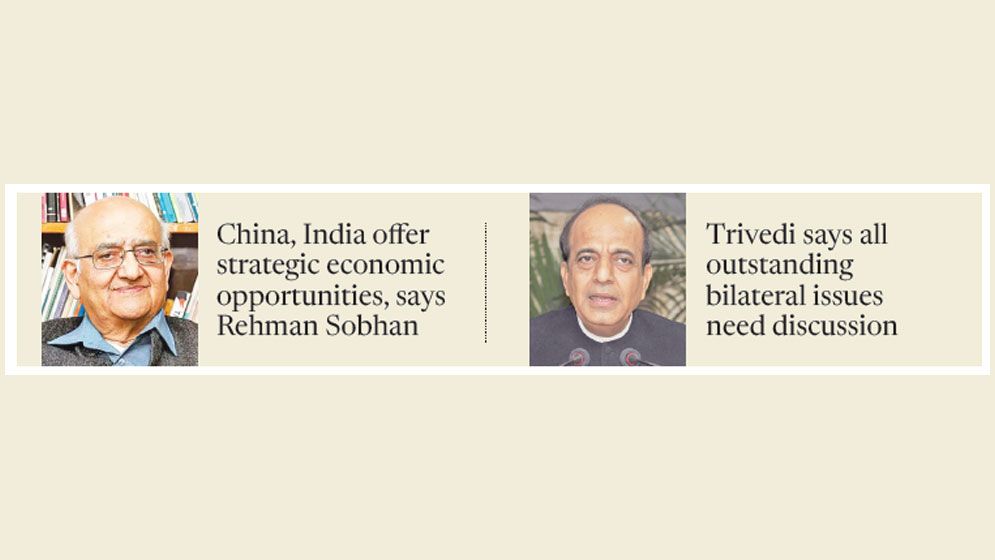
Speaking at a session, Centre for Policy Dialogue (CPD) Chairman Professor Rehman Sobhan said Bangladesh must become more closely integrated with Asian supply chains and markets to benefit from the region’s economic rise.
He said the centre of gravity of the global economy is shifting towards Asia and Bangladesh is strategically positioned between two major economies, China and India. However, he said, the country has yet to fully capitalise on this geographical advantage.
Rehman Sobhan said the influence long exercised by Western countries over the global economy is declining as Asia emerges as a major centre of global trade and investment.
Read More
“Asian countries have strengthened their export capabilities, resulting in greater economic capacity across the region. As a result, developing countries are no longer as dependent on the Western world as they once were for foreign aid, investment and capital,” he said.
He said most Asian countries now have other countries in the region as their principal trading partners, while Asian economies are also playing an increasingly important role in trade with countries in Africa and Latin America.
Asia’s strength extends to technology
Rehman Sobhan said Asia’s growing influence is not limited to trade but also extends to technology.
He pointed to China’s advances in sectors including artificial intelligence, research and intellectual property, saying the country has also emerged as a major trading partner and source of loans, aid and capital for many countries.
He said Bangladesh’s exports remain dependent on a limited number of markets, while a large share of its imports and an increasing amount of capital come from Asia. The country therefore needs deeper integration into Asian supply chains, he said.
He also highlighted Bangladesh’s geographical position next to China and India, noting that China could become the world’s largest economy and India the third-largest within the next decade.
He said Bangladesh’s strategic importance extends beyond the Bay of Bengal to its land connectivity, recalling the Bangladesh-China-India-Myanmar (BCIM) initiative for regional connectivity.
More dialogue needed on bilateral issues
Speaking at a session titled “Power and Prudence: Managing Great-Power Competition without Conflict”, Indian High Commissioner to Bangladesh Dinesh Trivedi stressed continuous dialogue, mutual respect and trust between the two countries to address bilateral issues.
He said Bangladesh and India should discuss all outstanding issues, including water, trade, culture, sports, communication and transportation, through appropriate forums.
“There’s no point hiding the issues, and there’s no point not talking about the issues,” he said.
“In a democracy, the dialogue has to be there at the proper forum. And the dialogue has to be a continuous dialogue,” he said, adding that the engagement process may be slow but has not stopped.
“I can guarantee you, there is no stoppage of process. The process is ongoing,” Trivedi said.
“Believe me, there has to be a solution, and there will be a solution,” he added. The Indian envoy said Bangladesh, as an independent and sovereign country, understands its own security interests and has the right to make its own decisions. “Bangladesh is an absolutely independent country and people have elected democratically. So whatever decision Bangladesh takes is the decision of Bangladesh government,” he said.
He added that India’s relationship with Bangladesh does not depend on Dhaka’s relations with other countries. Trivedi also said good neighbours should support each other during calamities or security challenges while respecting each other’s sovereignty and domestic policies.
“No neighbour has any reason to interfere in each other’s policies,” he said.
President of the Bangladesh Institute of Peace and Security Studies Maj Gen (Retd) ANM Muniruzzaman, former Indian Army commander Arun Kumar Sahni, Georgetown University Professor Carol Christine Fair and foreign relations adviser to the mayor of Istanbul Metropolitan Municipality Mustafa Osman Turan also took part in the discussion. Managing Director of Cnsltng-Bsnss-Dvlpmnt, Bosnia and Herzegovina, Faris Hadrovic moderated the session.