


 For all latest news, follow the Daily Sun's Google News channel.


Despite promising results from laboratory trials that have raised hopes for developing effective locally
produced antivenom for snakebite victims, uncertainty looms over the country’s first venom research due to a prolonged funding crisis.
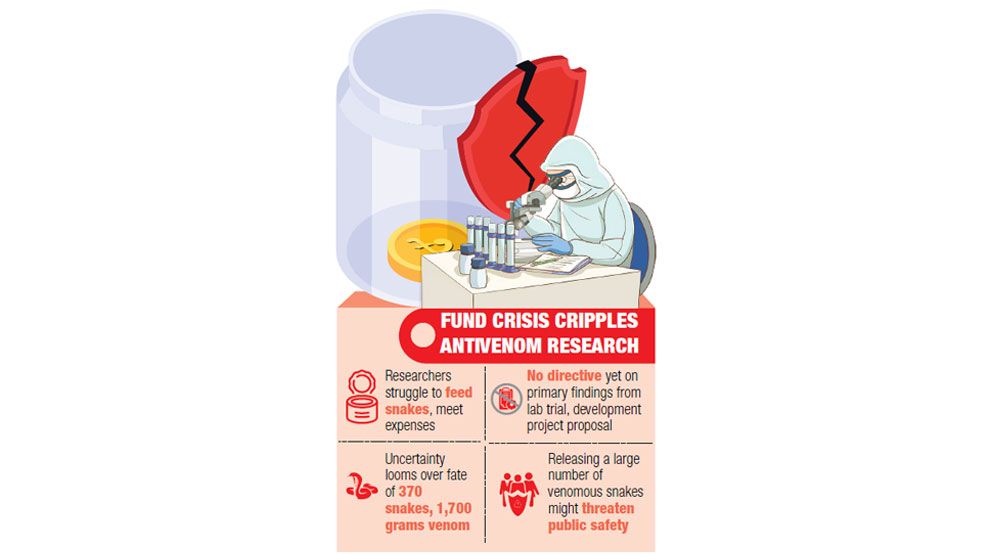
Funding for the project has remained suspended for over two years, leaving researchers struggling to feed the 370 venomous snakes, pay salaries and allowances of research associates and staff, and maintain around 1,700 grams of venom at the Venom Research Centre (VRC).
VRC Coordinator and Chattogram Medical College (CMC) Medicine Department Assistant Professor Abdullah Abu Sayeed told the Daily Sun that he said, “Nobody has paid heed to the issues over the past
two years. We have already spent around Tk35 lakh by borrowing and using our own funds. We are now facing difficulties even in providing food to the snakes.”
Researchers have the option to release the venomous snakes such as Russell's viper, cobra, and krait into the wild, but they fear the move would pose a risk to people.
“We will have to take a decision within the next two months. The research associates and staff have already been asked to look for alternatives as there is no other option for us,” the coordinator said.
Sources at the VRC said that they had earlier sent the primary research report following successful lab trials and Detailed Project Proposal (DPP) for funding to the relevant wing of the health ministry. However, they are yet to receive any response in this regard.
Health Directorate Additional Director General (Planning and Development) Prof Dr Foara Tasmim told the Daily Sun over phone that she had no updated information on the DPP and would inquire about it soon.
Trial results raise hope but fund eludes
Earlier, after obtaining positive results from laboratory trials at the beginning of this year, Prof Dr Aniruddha Ghose, the principal researcher of the VRC, said that several stages of evaluation would be required before the project can proceed to clinical trials and eventual commercial production.
The antibody developed at the laboratory against Russell’s viper venom demonstrated effectiveness comparable to commercially available antivenoms.
They submitted the final report to the Health Ministry several months ago for evaluation of whether the
procedures were scientifically appropriate.
However, they are yet to receive clearance regarding the research work conducted under the “Integrated Health Science and Research and Development Fund” of the ministry.
Funding for the VRC has remained suspended since August 2024 after the government halted the relevant Operational Plans. A development project proposal was subsequently submitted this year seeking funding for the centre.
A team of researchers from various organisations, including CMC, Chittagong University (CU), the
Toxicology Society of Bangladesh, and Goethe University of Germany, has been working on development of antidotes against venomous snakes at the VRC.
The centre, developed under the supervision of Medicine Department at an abandoned building of Chattogram Medical College Hospital (CMCH), began operations in March 2018 under a project of the Non-Communicable Disease Control (NCDC) programme of the DGHS.
Research on developing antivenom against Russell’s viper and the centre’s routine research were being carried out through separate funds from the ministry.
The centre collects, houses and rears venomous snakes under scientific protocols, while conducting
collaborative research using venom collected from species native to Bangladesh.
Its ultimate goal is to provide scientific guidance and high-quality biological materials for the production of safe, effective, affordable and locally appropriate antivenom on a pilot basis.
The clinical trials, commercial production and other subsequent stages would require approval for the research findings from the ministry.
According to the VRC, around 4 lakh persons are bitten by snakes and around 7,500 persons die from
envenomation every year in Bangladesh.
The country currently relies on antivenom produced against the venoms of India’s ‘big four’ snake species. Scientifically, this is not fully effective in neutralising the venoms of local snake species because the properties of venom from the same species vary depending on geographical location.
Due to its global impact, the World Health Organisation (WHO) has categorised snakebite as one of the most neglected tropical diseases, while the World Health Assembly passed a resolution urging each member state to take necessary steps to mitigate the suffering of millions of people affected by snakebite globally and to reduce deaths to 50% by 2030.