


 For all latest news, follow the Daily Sun's Google News channel.


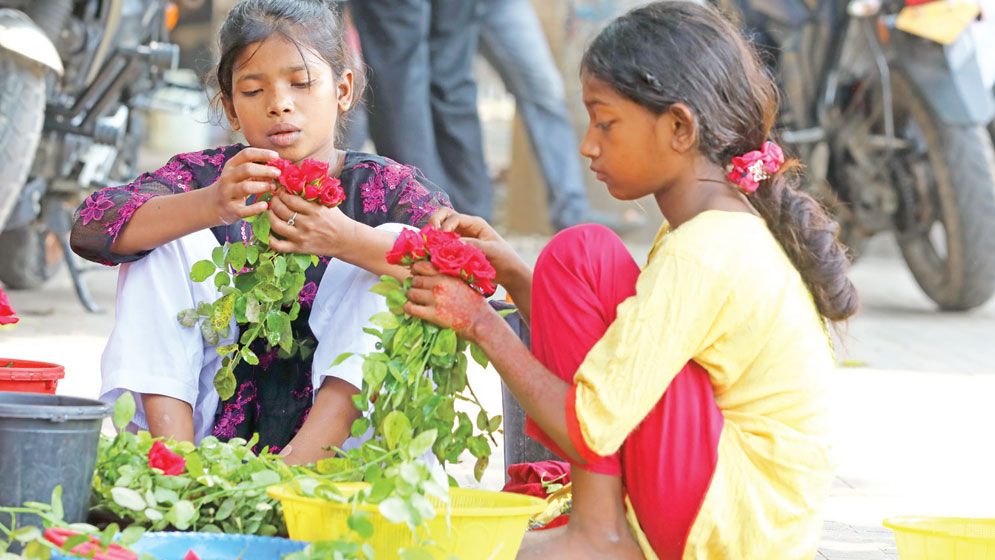
Two street children arrange flowers for sale by the roadside at TSC on the Dhaka University campus on Thursday, highlighting the everyday struggle of children living and working on the streets. Their resilience reflects the quiet strength of countless street children who face hardship each day while holding on to hope for a better future. - Reaz Ahmed Sumon
The traffic light turns red at Bijoy Smarani. Within seconds, a girl slips between buses, private cars and other vehicles, knocking on windows with garlands of flowers in her hands and asking drivers to buy one.
Some drivers lower their windows. Others turn away. A few stare at their phones. When the light turns green, the girl waits for another red light to approach the next row of cars.
For her, the intersection is not merely a place to earn money. It is a workplace, a playground and, on some nights, a place to sleep.
She gives her name as Runa and says she is eight years old. She sells roses and garlands of Arabian jasmine and Spanish jasmine.
“For each rose, I take Tk10 to Tk20, and each garland of Arabian jasmine and Spanish jasmine costs Tk20,” she says.
Runa, who sleeps at the Farmgate Overbridge at night, says her father divorced her mother three years ago and married another woman. Her mother died six months ago.
“I have no contact with my father. My mother worked as a domestic helper. When she was alive, we used to live in Korail slum. A few months after my mother’s death, the landlord threw me out of the house, keeping all our belongings because I could not pay the rent,” she says.
Speaking about her struggle to survive, Runa says, “I can hardly earn Tk200. Food is too expensive. The price of flowers is increasing and people do not buy flowers either. It’s really difficult to make a living selling flowers.”
Thousands of children in Dhaka live parts of their lives on the streets like Runa, surviving on whatever work they can find. Their daily struggle is increasingly documented not through anecdotes alone, but by surveys showing how poverty, unsafe work, violence and exclusion from education reinforce one another.
A 2024 UNICEF qualitative study estimates that more than 3.4 million children in Bangladesh are living in street situations without parental care. The figure is national rather than Dhaka-specific, but it underscores the scale of a population that remains among the country’s most vulnerable and least protected.
According to recent research by Hasan Reza, an associate professor at Indiana University in the United States, 27% of these children have no known parental identity, while physical, psychological and sexual abuse have become part of their daily lives.
Hasan Reza says, “Extreme poverty, family instability, physical and psychological abuse, and climate-induced migration from villages to cities are pushing children on to the streets. Under economic pressure, many of them are forced to work. Their education is disrupted, trapping them in a cycle of persistent poverty.”
“Often we speak about development and different other achievements. If these children are not nurtured properlyall accomplishments will go in vain,” he adds.
The BBS-UNICEF Survey on Street Children 2022 was the most recent detailed official survey on street children. It interviewed 7,200 children aged five to 17 at street hotspots in the capital and eight divisions.
It found that 82% were boys, while about 13% were separated from their families. The numbers become more disturbing when their living conditions and means of survival are examined.
More than 30% of the surveyed children slept in public or open spaces without basic amenities such as a bed, toilet or a door that could be locked for safety. Around half slept on the ground using jute bags, cardboard, plastic or thin blankets.
Many children collect waste, beg or work in tea stalls, factories and workshops. About one in three reported being injured while working, while half said they had experienced violence.
Nearly half of working children had started working at around the age of nine, and most worked between 30 and 40 hours a week for less than Tk1,000 a week, according to the survey.
About 72% could neither read nor write, the survey found. More than half had fallen sick during the three months preceding the survey, while 79% did not know about organisations or services that could support them.
The survey found that 30.4% of reported incidents of violence occurred while children were sleeping at night. Eight in 10 children who reported abuse or harassment identified passers-by as the perpetrators.
Despite repeated attempts, no officials from the Ministry of Social Welfare or the Ministry of Women and Children Affairs agreed to comment.
Asked about the rights and rehabilitation of street children, Kudrat-A-Elahi, secretary of the National Human Rights Commission, said, “Unfortunately, we have failed to create a just society where everyone’s rights will be preserved. The state has the biggest responsibility. But individuals have also come forward to stand by them.”
The real test remains whether Bangladesh can offer these children something beyond survival – a safe place to sleep, a classroom to return to, healthcare when they are sick and protection when they are vulnerable.
Until then, every red light will continue to offer the same unsettling scene: children running between vehicles while the rest of the city waits for the signal to turn green.