


 For all latest news, follow the Daily Sun's Google News channel.


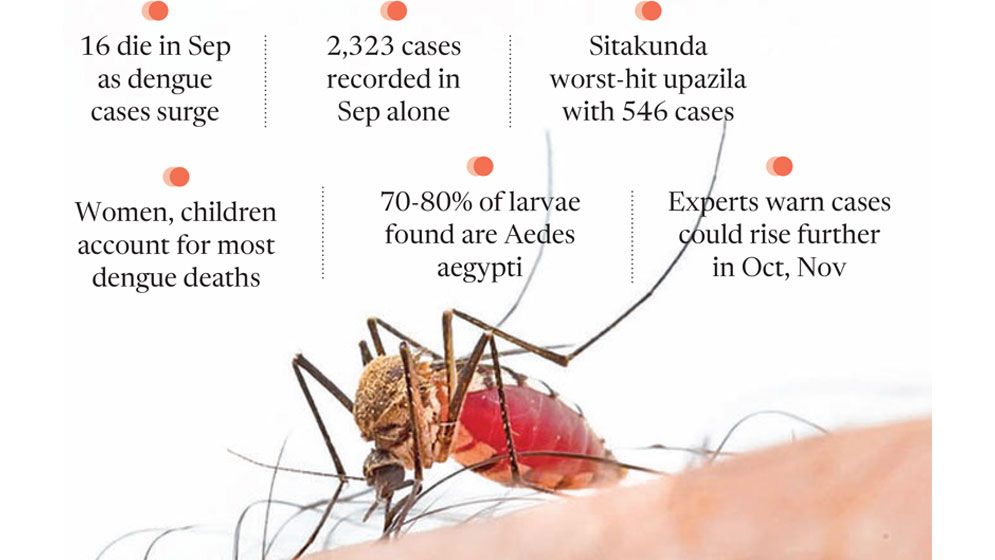
Dengue has taken a serious turn in Chattogram, with infections and deaths rising sharply in September, accounting for more than half of the cases recorded in the district this year.
According to the latest report from the Civil Surgeon’s Office, 4,359 people have been diagnosed with dengue in Chattogram this year. Of them, 2,323 were admitted to hospitals in September alone, accounting for 53.3% of the year’s total.
The death toll has also risen sharply, with 21 people dying of dengue this year, including 16 in September.
Public health experts warn that stagnant water left behind after the monsoon is providing breeding grounds for Aedes mosquitoes. They fear cases could rise further in October and November if breeding sites are not eliminated.
Cases surge in September
Dengue cases remained relatively low from January to June before rising to 536 in July and 1,202 in August. The number jumped to 2,323 in September.
No death was reported until May. July and August each recorded two deaths, while September saw 16 deaths.
Chattogram Civil Surgeon Dr Sajedur Rahman said stagnant water following the monsoon was helping Aedes mosquitoes breed rapidly.
“People must keep their homes and surroundings clean and make sure water does not remain stagnant for more than three days,” he said.
He said government hospitals had also strengthened preparations to deal with the growing number of patients.
Dengue spreads beyond city
Of this year’s 4,359 patients, 1,999 are from Chattogram City Corporation areas, 1,875 from 15 upazilas and 485 from other districts.
Sitakunda is the worst-hit upazila, with 546 cases, followed by Karnaphuli with 260, Rangunia 142, Banshkhali 141, Satkania 109 and Anwara 103.
Of the 21 deaths, nine were city residents, 10 were from upazilas and two were from other districts.
Dr Altaf Hossain, health and family planning officer of Sitakunda upazila, said population movement, climate change and poor waste management were among the factors behind the spread of dengue to rural areas.
Women, children face higher death risk
Of the total patients, 2,142 are men, 1,243 women and 974 children. However, women and children account for a larger share of the deaths, with 11 women and six children among the 21 fatalities, compared with four men.
At present, 238 dengue patients are receiving treatment in hospitals, including those admitted in the last 24 hours.
Chattogram Medical College Hospital treated 1,820 patients this year, with seven deaths. Private hospitals and clinics treated 752 patients, with 12 deaths, while the 250-bed General Hospital treated 563 patients, with two deaths. BITID treated 576 patients.
Aedes aegypti dominant
Health authorities conducted mosquito surveys in Chattogram city in June and later in Sitakunda and Karnaphuli after cases increased in those areas.
The surveys found that 70-80% of the larvae were Aedes aegypti, the main vector of dengue, while the remaining 20-30 per cent were Aedes albopictus.
Warnings ignored
A senior entomologist at the Directorate General of Health Services, speaking on condition of anonymity, said health authorities had earlier warned that the dengue situation could worsen in August and September.
“But prevention work was not stepped up accordingly, and this is the result,” the entomologist said.
Divisional Health Director of Chattogram Sekh Fazle Rabbi said destroying mosquito breeding sites was the most important step in preventing dengue.
“Everyone must make sure no water is left standing around homes, schools and workplaces,” he said, urging people with fever or dengue symptoms to seek medical attention promptly.