



 For all latest news, follow the Daily Sun's Google News channel.


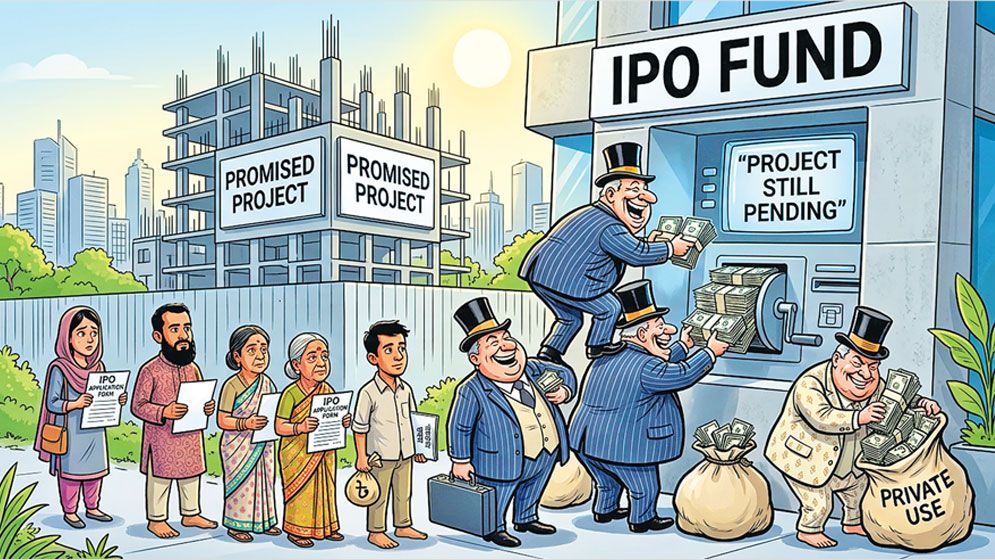
A significant portion of the money that companies raised from investors through initial public offerings (IPOs) to list on Bangladesh’s capital market has not gone towards the expansion plans or projects named in their prospectuses.
Instead, several companies have placed the funds in fixed deposit receipts (FDRs) and booked the resulting interest as income, according to audit reports and Dhaka Stock Exchange (DSE) data.
In some cases, the money has sat unused for years or been redirected to associate companies.
Between 2011 and June 2024, 132 companies raised a combined Tk10,402 crore through IPOs and repeat public offerings (RPOs). Of that, 114 companies utilised Tk9,539 crore as intended, while Tk863 crore remains unused across 18 companies, much of it held in FDRs or savings accounts.
Shahidul Islam, chief executive officer of VIPB Asset Management Company, said the regulator’s central task should be ensuring good governance and accountability at listed companies.
He said controlling shareholders had exploited gaps in the earlier regulatory framework to use IPO proceeds for personal ends, calling it fundamentally a governance failure.
Shahidul argued that closer scrutiny of a company’s quality, governance and management capacity before listing would do more than blanket restrictions on how all companies may use IPO proceeds, adding that uniform curbs imposed because of a few bad actors risk penalising sound companies too.
Unused funds and FDRs
Aman Cotton Fibrous PLC raised Tk80 crore through an IPO in 2018 to buy machinery and repay loans. As of April 2026, only
Tk8.25 crore (10.31%) had been utilised, leaving roughly Tk71.75 crore (89.69%) unused. Of this, Tk73 crore sits in FDRs – Tk38 crore with First Security Islami Bank and Tk35 crore with Al-Arafah Islami Bank – which have earned close to Tk9.27 crore in interest.
The FDRs have also been pledged as collateral against loans taken by associate companies Akin Carriers Limited and Aman Food Limited.
Though the Bangladesh Securities and Exchange Commission (BSEC) has repeatedly extended its deadline, the company has now sought time until December 2028.
Company Secretary Shariful Islam told the Daily Sun, “Some of our IPO funds have already been used. We have already applied to BSEC regarding the utilisation of the IPO money. We hope that, in accordance with the rules, the utilisation of the entire IPO amount will be ensured soon.”
ACME Pesticides Limited raised about Tk31.54 crore through its IPO. By November 2025, Tk21.86 crore had been utilised, with Tk9.68 crore still unused; of that, Tk8 crore sits in a three-month FDR with Southeast Bank, generating roughly Tk1.54 crore in interest, and portions have also been pledged as collateral.
Associated Oxygen Limited raised Tk15 crore through its IPO. Company filings show most of the sum has been used, but the remainder has been placed in FDRs, with interest booked as income.
Bangladesh Shipping Corporation raised Tk313.70 crore through an RPO in 2011 to buy ships and construct a building, with utilisation due by June 2012. As of June 2024, Tk220.27 crore (70.22%) remained unused.
Funds diverted to associate firms
Regent Textile Mills Limited raised Tk125 crore through a 2015 IPO earmarked for BMRE and a new garments unit. Roughly Tk80.11 crore of the unused funds, including interest, was instead used to acquire a 99% stake in Legacy Fashion Limited, a company under the same family’s control – a use barred under BSEC rules governing associates and subsidiaries.
The company was ordered to return Tk90 crore; when it failed to comply, five directors were fined a combined Tk100 crore.
Dominage Steel Building Systems Limited raised Tk30 crore through a 2020 IPO. A BSEC probe found the company had forged proxy votes to show 51% shareholder approval before buying a cutter suction dredger with IPO funds – recorded at Tk14.73 crore in company accounts but registered at just Tk21.42 lakh. Of Tk5.83 crore earmarked for factory expansion, Tk3.27 crore was found to be inflated and misappropriated.
Directors and former officials were fined Tk5.10 crore in total. Company Secretary Shamim Bhuiyan said he was unable to comment when contacted.
Sikder Insurance Company raised Tk16 crore through a 2023 IPO. Its prospectus earmarked Tk4 crore for FDR, Tk4.8 crore for capital-market investment and Tk6.08 crore to buy an office floor.
Instead, Tk4.20 crore went into FDRs – above the stated limit – and the office-floor purchase never took place, changes made without public shareholders’ approval. Eleven directors and officials were fined a combined Tk11 lakh.
Rules on paper
Under BSEC’s Public Offer of Equity Securities Rules, 2025, IPO proceeds must go only towards purposes stated in the prospectus.
Up to 30% may be used to repay loans tied to a project or BMRE, though classified or rescheduled loans are excluded, and any change requires approval from at least 51% of public shareholders excluding sponsor-directors.
Companies must submit a quarterly utilisation report audited by a foreign-affiliated auditor and publish it on their website; funds cannot move outside banking channels, and transfers to other accounts before listing are prohibited.
DSE requires regular utilisation reports and conducts its own factory and account inspections.
Where BSEC finds irregularities, it appoints special auditors, imposes fines and orders funds returned – action it has recently taken against directors of Sikder Insurance, Dominage Steel, Regent Textile and others, alongside earlier fines and a lien cancellation order in the Aman Cotton case.
Region and beyond
India’s Securities and Exchange Board mandates a monitoring agency for main-board IPOs raising over Rs100 crore, typically a credit-rating agency, which files quarterly reports; SEBI has also capped the “general corporate purposes” category and penalises non-cooperation.
The UK relies on oversight from investment banks or advisory firms. Bangladesh, by contrast, depends on BSEC’s quarterly audits and DSE inspections without a dedicated independent monitoring agency, with deadline extensions more freely granted and fines sometimes stayed by courts.
Debobrota Kumar Sarker, former head of research at BRAC EPL Investment Limited, told the Daily Sun that unutilised IPO funds stall company expansion, hold back production capacity and dent profits.
He said Aman Cotton Fibrous and ACME Pesticides were among companies booking FDR interest income while core projects went unbuilt, adding that investors had committed money on the strength of prospectus promises of expansion and dividends.
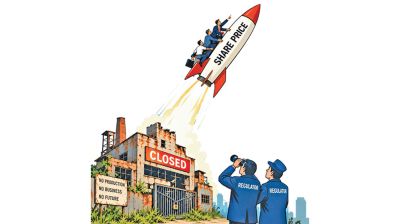
Diverting or parking that money, he said, erodes confidence, weighs on share prices and discourages future IPOs.
He said BSEC and the exchanges could look to regional models for monitoring listed companies, noting that while the new commission has tightened oversight in several cases, the practice will otherwise persist.