



 For all latest news, follow the Daily Sun's Google News channel.


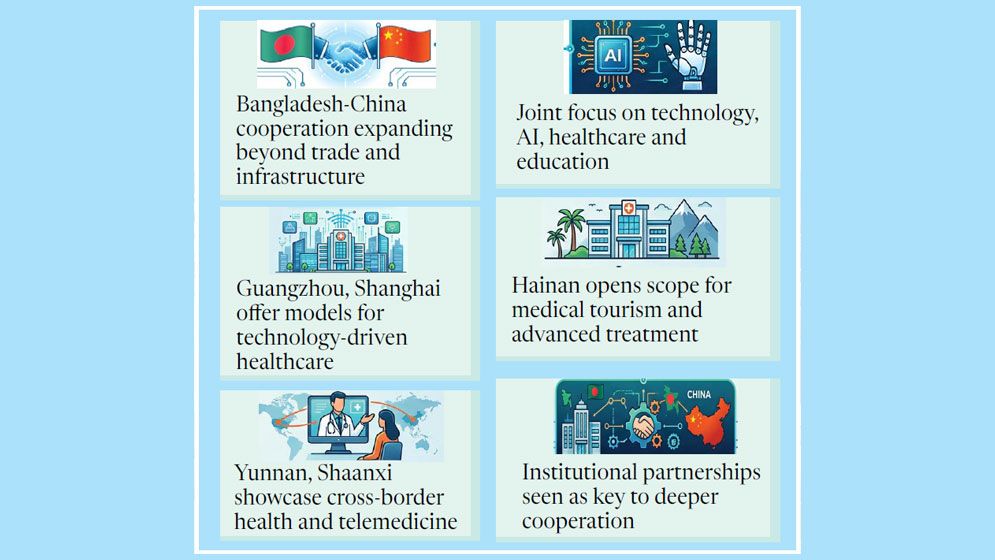
Bangladesh’s relationship with China has moved well beyond trade and infrastructure. It is now expanding into technology, healthcare, education, human resource development and innovation.
During Prime Minister Tarique Rahman’s official visit to China in June 2026, the two countries agreed to deepen cooperation in science and technology, ICT, green energy, artificial intelligence, education and healthcare. They also agreed to strengthen ties between universities and technical institutions, and to keep open opportunities for Bangladeshi students to study in China.
My four-month stint under the China International Press Communication Centre (CIPCC) programme let me observe these areas of cooperation first-hand. I arrived with more doubts than expectations, but the programme took me across six provinces and one global city, each with its own economy, culture and social character – together offering a fuller picture of a country in rapid transformation.
What stood out was not just the scale of China’s economic development, but how deeply technology has been woven into healthcare and education. Hospital visits showed digital systems, advanced equipment, AI and specialised services increasingly built into care delivery – from smart hospitals to telemedicine and AI-assisted diagnostics. University and school visits revealed a similar emphasis on research, innovation and skills aligned to a fast-changing economy.
Crucially, none of this was confined to Beijing. Local governments, universities, hospitals and technology institutions across the provinces are building their own capacity in these fields: Guangzhou in technology and health infrastructure, Hainan in international medical services, Shanghai in AI-driven healthcare, Yunnan in cross-border education and health cooperation, Shaanxi in telemedicine and AI, Shandong in AI education, Qinghai in digital education for remote areas, and Beijing in 5G and smart hospital systems.
Guangzhou, Hainan, Shanghai: models worth studying
In Guangzhou, technology, industry and healthcare are developing as one interconnected system. The Shenzhen-Hong Kong-Guangzhou innovation cluster topped the WIPO Global Innovation Index’s top 100 clusters in 2025, having held second place since 2020. Guangdong is also expanding investment in medical technology and biomedicine; a Bangladesh Ministry of Health delegation visited in April 2026 to discuss cooperation in healthcare, technology, renewable energy and skills development. Bangladesh could similarly link its technology sector more closely with medical manufacturing, research institutions and industry.
Hainan offers a different model: the Boao Lecheng International Medical Tourism Pilot Zone, China’s only zone of its kind. By 2025 it hosted more than 30 domestic and foreign medical institutions, and special policy allowed 485 overseas-approved drugs and devices – not yet licensed on the mainland – to be used there, benefiting over 130,000 patients. It has tie-ups with more than 180 pharmaceutical and device firms from 20 countries. For Bangladesh, it is a working example of how advanced treatment and medical tourism can become an economic sector in their own right.
Shanghai, meanwhile, is building AI into medicine through its 2025-2027 medical AI plan, spanning brain science, brain-computer interfaces, medical large language models, imaging and health information management, alongside AI-based medical training.
Yunnan to Qinghai: Closing gaps in health and education
Yunnan matters to Bangladesh because of its proximity and growing engagement with South and Southeast Asia. Dhaka has already welcomed opportunities for Bangladeshi patients to receive treatment there, and recent bilateral talks have touched on local-level health cooperation. Yunnan is also expanding education ties with neighbouring countries through digital learning, teacher training and technical education – suggesting scope for Bangladesh beyond medical tourism, into universities, nursing colleges and joint research.
Shaanxi, and its capital Xi’an in particular, showcases telemedicine and smart healthcare. At the Shanghai Cooperation Organisation’s Hospital Cooperation Conference in Xi’an in 2025, experts discussed cross-border care using telemedicine, AI and big data – tools that could help Bangladesh reach patients in areas short of specialists. Xi’an is also targeting AI education in over 70% of its schools by 2027.
Shandong has pushed AI education from an early stage, launching its “Ten Major Actions” in 2025 to build digital infrastructure, train teachers and link schools with universities, research bodies and technology firms – a school-to-skills model relevant to Bangladesh’s young workforce.
Qinghai, despite starkly different geography, shows how to serve remote and scattered communities: smart education platforms, digital learning materials and an integrated, tiered medical system.
Beijing: From policy to practice
Beijing remains the centre where high-level cooperation is agreed and implementation frameworks are built. At the announcement of a new phase of Bangladesh-China cooperation there in June 2026, science and technology, ICT, AI, green development, healthcare and education were all given particular weight, alongside renewed commitments on university ties and student exchange.
Beijing’s own 2025 three-year action plan targets large-scale 5G rollout by 2027, including wider use in industry, healthcare and digital education, and envisages 400 “5G smart hospitals.” Its significance lies not in the technology alone, but in how it is integrated across healthcare, education, industry and urban management.
The opportunity for Bangladesh
Across the eight regions I visited, one picture emerged clearly: technology, healthcare and education are no longer developing in isolation. Universities research, hospitals apply, technology firms build solutions, and policy connects the parts.
The 2026 joint communiqué between the two countries reflects this, calling for deeper cooperation in science and technology, ICT, education, human resource development, public health and traditional medicine, alongside continued university partnerships and student exchange.
For Bangladesh, the greater opportunity may not be importing Chinese technology or equipment, but building lasting institutional partnerships – joint research, training for doctors and nurses, medical technology development, university links, AI-based healthcare, telemedicine and technical education.
From Guangzhou’s innovation ecosystem to Hainan’s medical services, Shanghai’s medical AI, Yunnan’s health and education links, Shaanxi’s telemedicine, Shandong’s AI education, Qinghai’s digital transformation and Beijing’s policy-driven push – these strands show how the sectors reinforce one another. As Bangladesh-China relations enter a new phase, technology, healthcare and education stand out as three bridges to deeper, more people-centred cooperation.