


 For all latest news, follow the Daily Sun's Google News channel.


PM pledges to build country anew
His maiden UNGA speech vows prosperous, democratic Bangladesh with political, economic empowerment of people
Daily Sun Report, Dhaka
Published: 26 Sep 2026, 12:00 AM
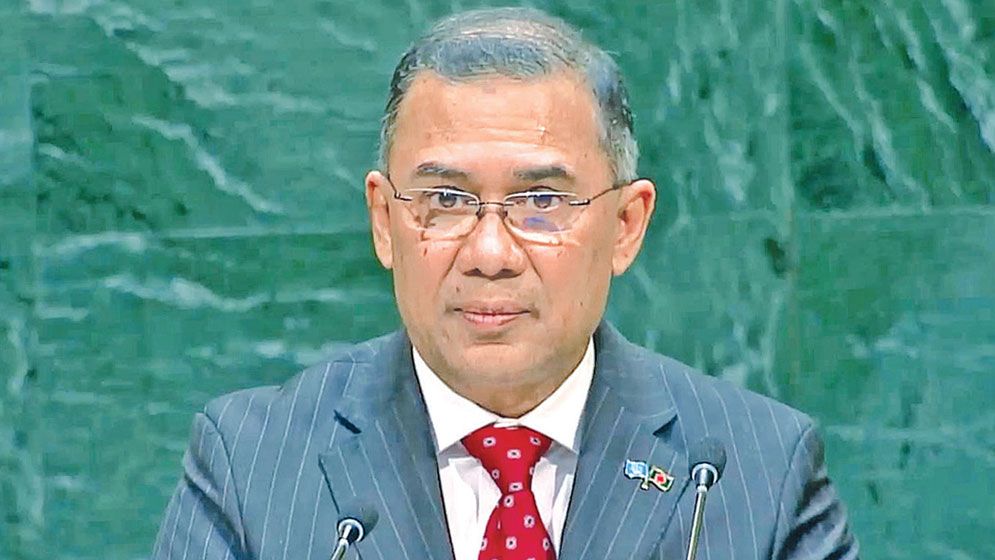
Prime Minister Tarique Rahman has pledged to put people at the heart of Bangladesh’s development, envisioning a democratic, self-reliant and welfare-oriented state where every citizen has equal opportunities and greater scope for political and economic empowerment.
“We want to establish a prosperous, self-reliant, welfare-oriented democratic state where everyone, irrespective of political affiliation, religion or race, can live without anxiety and in safety, with equal rights, respect and dignity,” he said in his maiden address at the General Debate of the 81st session of the United Nations General Assembly at the UN headquarters on Thursday (Bangladesh time early Friday).
He said that the government was focused on building a safe and stable Bangladesh with a business-friendly investment climate, alongside stronger democracy, human rights, good governance, accountability and political stability.
Tarique said that the government was pursuing a “3-R” strategy – Recovery, Restoration and Reconstruction – to rebuild the country.
“Bangladesh is now once again embarking on the path of democracy,” he said, adding that the government was working to turn the country’s working-age population into skilled human resources and reap the benefits of its demographic dividend.
The government has also taken measures to create jobs and develop Bangladesh as a “manufacturing hub”, he said, announcing $50 million in the current fiscal year to support young entrepreneurs, researchers and innovators in launching start-ups.
Women are central to the government’s socio-economic transformation plans, Tarique said, noting that they account for more than half of the population.
“The government is giving priority to women’s education, women’s employment and the creation of women entrepreneurs,” he said.
The prime minister said that the government has expanded cash financing for women, particularly in the small and medium-sized industries sector, and introduced free education opportunities for women up to the undergraduate level.
Tarique also said that the government wanted to go beyond electoral democracy by democratising the economy so that the gains of growth reached every family and citizen.
It has introduced support programmes for disadvantaged people through initiatives including the Family Card, Farmers’ Card, Sports Card and e-Health Card.
“The government considers the ‘Family Card’, issued in the name of the female head of each household, to be a symbol of women’s economic empowerment,” he said.
The government also plans to introduce a “Universal Card” by integrating the various cards used to provide support in different sectors.
Education, health, sports prioritised
 Education, health and sports have received special priority, Tarique said, noting that the government had made the highest-ever budget allocation for education.
“There are plans to gradually increase education spending to 5% of GDP within the next five years,” he said.
A new curriculum has been developed with greater emphasis on technical and practical learning to create an ethical, employment-oriented education system, he said.
School bags, uniforms and free midday meals are being provided to primary students from the first grade, while sports have been introduced into the curriculum for the first time to help create opportunities for sports as a profession.
More than two million students took part in a month-long nationwide football tournament in June, he said.
AI, biotechnology ushers in new era
Turning to technology, Tarique said that artificial intelligence (AI), biotechnology and scientific advances were opening a new era, offering Bangladesh opportunities through its young population and growing digital capabilities.
But access to advanced technology, knowledge and research must be widened, he said.
“We do not want today’s digital divide to become tomorrow’s artificial intelligence divide,” he said.
Tarique stressed the importance of innovation, intellectual property protection, technology transfer, skills development and affordable access to modern technologies.
“It is now time for the United Nations to adopt an effective policy framework so that the benefits of the development and rapid expansion of artificial intelligence and social media can be used positively in countries around the world,” he said.
International support urged for resolving Rohingya crisis
Addressing the Rohingya crisis, Tarique said that the Rohingya crisis could be resolved only through the safe return of the displaced population to Myanmar, calling for firm and sustained support from the United Nations and the international community to ensure a lasting solution.
“The only solution to this problem is the safe return of the displaced Rohingya population to their homeland, Myanmar,” he said.
The prime minister also said that Bangladesh had hosted more than 1.2 million forcibly displaced Rohingyas from Myanmar for more than nine years, shouldering the burden of the protracted crisis.
The prolonged presence of the Rohingyas has placed immense pressure on Bangladesh’s resources, environment, security and host communities, he said.
“Bangladesh, a densely populated country, believes the source and origin of the Rohingya crisis lie in Myanmar; therefore, its solution also lies there,” he said.
The prime minister urged the United Nations and the international community to maintain life-saving humanitarian assistance for the displaced Rohingyas until their safe return to Myanmar.
The prime minister said that man-made conflicts were fuelling unrest, mass displacement and humanitarian crises in many countries while placing growing strain on the global economy.
“We believe that any conflict should be resolved through dialogue, diplomatic processes and mutual cooperation,” he said.
‘Fairness, respect, dignity should underpin international relations’
The premier said that equality, fairness, mutual interests, respect and dignity should underpin bilateral and multilateral relations among states, particularly in times of conflict.
“We aspire to a peaceful world, a humane global community where reason and dialogue, diplomacy, education and humanity, rather than nuclear weapons, become the instruments of change,” he said.
Bangladesh views the United Nations as the centre of global efforts to build a community based on understanding that respects the independence and sovereignty of all states, the prime minister said.
He said that the tendency in various countries to divert development budgets towards military expenditure was an obstacle to world peace. "As a peace-loving nation, Bangladesh remains committed to the goal of complete and general disarmament, preventing the proliferation of nuclear weapons and arms control," he said.
Speaking about Palestine, Tarique Rahman said that the people of Bangladesh, who cherish democracy, were deeply concerned about the suffering of the freedom-seeking Palestinian people.
“Bangladesh reaffirms its unwavering support for their legitimate demands, including their right to self-determination and their right to establish an independent State of Palestine,” he said.
He also called for stronger global cooperation to protect the rights, dignity and welfare of migrants.
“Bangladesh expects stronger global cooperation to ensure the rights, dignity and welfare of migrants,” he said, noting that migration was as old as human civilisation and that migrants made vital contributions to the economies of both origin and destination countries.
Bangladesh, he said, remained committed to promoting regular, safe and orderly migration.
Tarique said that Bangladesh was advancing democracy, human rights, good governance, accountability and political stability while working to improve its investment climate.
“In the present democratic Bangladesh, we welcome partnership, innovation and both domestic and foreign investment,” he said.
The prime minister said that the government envisioned a Bangladesh where young people could pursue their dreams without fear, women could live and lead with confidence, and every child would have the opportunity to reach their full potential.
“Above all, the people will have the assurance of a safe and peaceful life. That is why we say, ‘Bangladesh First: Bangladesh for All’,” he said.