


 For all latest news, follow the Daily Sun's Google News channel.


The government is set to complete the appointment of new fertiliser dealers by the end of September as part of a major overhaul of the distribution network aimed at breaking local monopolies and ensuring fertiliser reaches farmers at government-fixed prices.
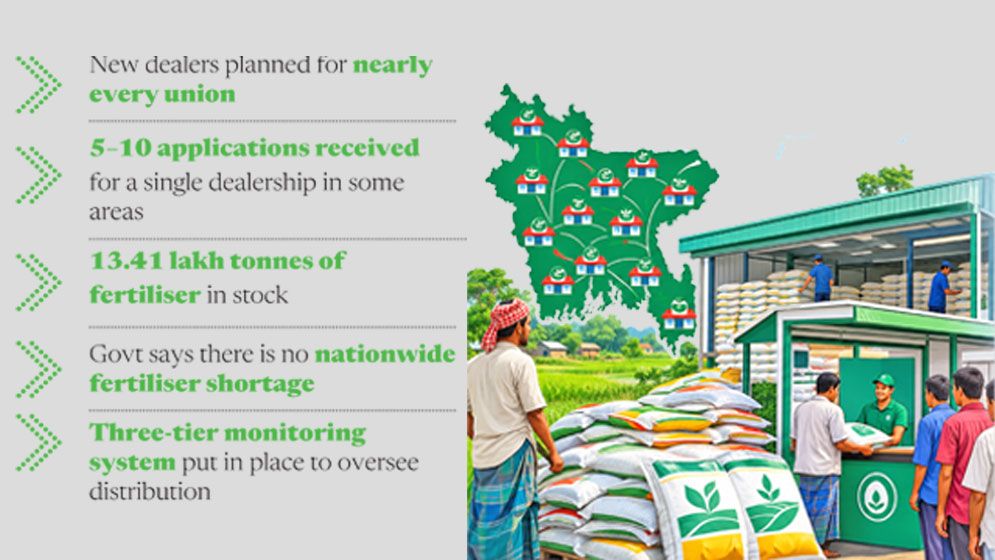
Agriculture Secretary Md Selim Khan told the Daily Sun that authorities expect to complete scrutiny of applications and finalise the new dealers within this month, with nearly one new dealership planned for each union.
“We hope the process will be completed within this month,” he said.
The secretary said a large number of applications had been submitted at the district level, with five, seven and even 10 applicants seeking a single dealership in some areas.
“Those whose documents are in order and who are genuine businessmen will get the dealership. We have set criteria, and only those who fulfil the criteria will be selected,” he said.
He said the government was not rushing the process despite pressure to appoint new dealers before the peak fertiliser-use season.
“We want to ensure that fertiliser reaches farmers’ doorsteps at the government-fixed price and at the right time,” he said.
According to the secretary, expanding the dealership network is also intended to prevent existing dealers from forming cartels or exercising monopoly control over fertiliser distribution in particular areas.
13.41 lakh tonnes in stock
The latest government stock statement shows that the country had 13.41 lakh tonnes of fertiliser in stock as of 21 September.
Of the total, 3.997 lakh tonnes were urea, 4.183 lakh tonnes TSP, 3.088 lakh tonnes DAP and 2.143 lakh tonnes MOP.
The stock compares with an estimated requirement of 58.05 lakh tonnes for the 2026-27 fiscal year, comprising 26.20 lakh tonnes of urea, 7.50 lakh tonnes of TSP, 14.85 lakh tonnes of DAP and 9.50 lakh tonnes of MOP.
The government had an opening stock of about 18.01 lakh tonnes at the beginning of the current fiscal year.
The agriculture secretary said there was no nationwide shortage of fertiliser, describing reports of shortages in some areas as isolated incidents.
“There is no general shortage of fertiliser. There is sufficient fertiliser in the country and the supply chain is functioning,” he said.
He alleged that attempts were being made in some areas to create panic over fertiliser availability.
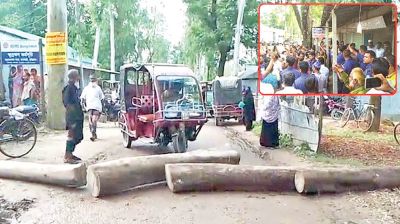
Kurigram has recently emerged as a particular focus of the ministry following repeated complaints over fertiliser availability.
The secretary said the district had received more fertiliser than in any of the previous five years, including an additional 1,000 tonnes over the past week. Despite the additional supply, repeated incidents in the district have prompted the ministry to take administrative action.
The ministry is withdrawing the deputy director of the Department of Agricultural Extension in Kurigram and plans to replace him with what the secretary described as a more efficient officer.
Three-tier monitoring mechanism
The government has also strengthened monitoring to prevent disruptions in fertiliser distribution.
According to the secretary, a ministry-level monitoring committee comprising two joint secretaries and two deputy secretaries is overseeing the situation.
In addition, a tag officer has been assigned to each district to maintain regular communication with the respective deputy commissioners and collect information on fertiliser distribution.
A control room has also been established at the ministry to monitor the situation continuously.
The secretary said the three mechanisms — ministry-level monitoring, district-level tag officers and the control room — were working together to identify problems and respond quickly.
The government is also seeking to improve coordination between dealers and local administrations to ensure announced distribution schedules are followed.
The secretary raised concerns over possible diversion and resale of fertiliser.
He questioned how fertiliser could be smuggled or diverted when private imports of the fertiliser concerned are not allowed, suggesting that misuse of farmers’ allocations and resale through intermediaries could be a source of such irregularities.