


 For all latest news, follow the Daily Sun's Google News channel.


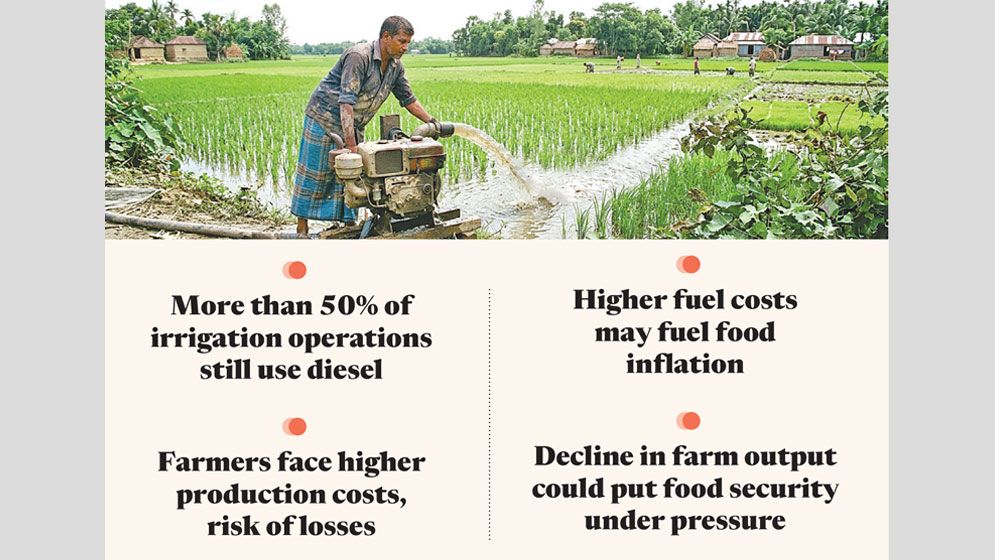
The sharp increase in diesel and kerosene prices is likely to raise agricultural and transport costs, with economists warning of increased pressure on food inflation.
The higher fuel prices are expected to put direct pressure on agricultural and industrial production costs by increasing expenses for irrigation, farm machinery, power generation and transportation.
Economists and stakeholders said the increase could also push up transport charges and the prices of essential and agricultural commodities, adding to the overall cost of living.
The government has raised the prices of diesel, kerosene, petrol and octane by Tk20 per litre. The new rates are expected to have an immediate impact on transport costs, while higher expenses for moving goods could eventually feed into the prices of agricultural produce and other essential items.
Diesel-run buses, trucks, covered vans and launches will face higher operating costs. The increased cost of transporting goods from production areas to markets could further raise the prices of agricultural products and other commodities.
Agro-economist Dr Jahangir Alam told the Daily Sun that the price hike would increase farmers’ production costs and could fuel cost-push inflation and food inflation.
“For the past five years, our food inflation has remained above 5 per cent, which has put Bangladesh on the World Bank’s red list. Whenever the prices of widely used agricultural inputs increase, production costs naturally go up. This will raise inflation and food prices and further fuel food inflation,” he said.
He said the Tk20 increase in both diesel and kerosene prices would particularly affect rural people and farmers, as the two fuels are widely used in rural areas.
“Due to repeated load-shedding, people still use kerosene lamps, while many rural households use kerosene.
Kerosene is also used in cooking stoves, and some small shops and roadside businesses use it. So, poor people living in villages will be severely affected by the price hike,” he said.
Jahangir said more than 50 per cent of fuel used for irrigation is still diesel. Diesel-powered pumps are used for deep-tube wells and shallow-tube wells, while power pumps are also operated with diesel in many areas.
He said diesel was also widely used for land preparation, harvesting and threshing, with tractors, power tillers, harvesters and threshing machines depending on the fuel.
“Another impact will be on transportation costs. The marketing costs of agricultural products will also increase. Overall, farmers’ production costs will rise. But the prices of agricultural products are not increasing accordingly. Farmers will therefore suffer losses and the number of loss-making farmers will increase,” he said.
“This could lead to a decline in production and, ultimately, disrupt our overall food security,” he added.
Jahangir called for subsidies and cash assistance for farmers to offset higher irrigation and other fuel-related costs.
Agriculture Secretary Md Selim Khan told the Daily Sun that the government was carrying out agricultural activities in a way that ensured farmers did not face hardship. “If farmers are affected in any way by the price hike, the Agriculture Ministry is vigilant to ensure that they are not harmed and we will take necessary measures accordingly,” he said.
According to the Bangladesh Agricultural Development Corporation (BADC)’s Minor Irrigation Survey 2024-25, around 1.22 million diesel-powered irrigation pumps and nearly 500,000 electric-powered pumps are being used across the country.
The impact is particularly significant during the six-month irrigation season from December to May, when farmers rely heavily on diesel-powered irrigation equipment.
According to Bangladesh Petroleum Corporation (BPC) data, around 1.053 million tonnes of diesel are used annually for agricultural irrigation, with a financial value of approximately $1.04 billion.
Read More