



 For all latest news, follow the Daily Sun's Google News channel.


Islamic banking sheds 6,000 jobs in 2 years
Workforce cuts concentrated in full-fledged Islamic banks as sector grapples with restructuring, liquidity pressure and automation

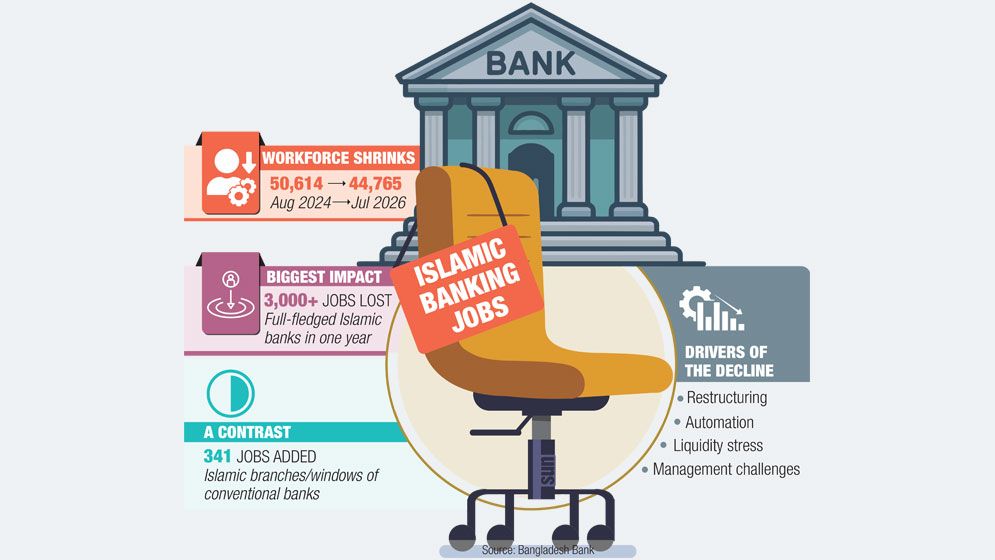
Employment in the country’s Islamic banking sector has continued to decline, with the sharpest fall recorded among full-fledged Islamic banks.
The sector’s workforce fell to 44,765 in July 2026 from 50,614 in August 2024, meaning nearly 6,000 jobs were lost in less than two years, according to the latest Islamic Banking and Finance Statistics report of Bangladesh Bank.
The report shows that employment has been on a declining trend since November 2023. The workforce also fell 1.02% month-on-month in July and by nearly 6% from a year earlier.
The decline was concentrated mainly in full-fledged Islamic banks, where the workforce dropped by more than 3,000 in a year to 42,115 in July 2026.
In contrast, Islamic banking branches and windows operated by conventional banks increased their workforce during the same period.
The number of employees at Islamic banking branches of conventional banks rose to 1,931 in July 2026 from 1,590 a year earlier, an increase of 341.
Bangladesh Bank Executive Director and spokesperson Arief Hossain Khan said employees of merged banks cannot be terminated within three years under central bank guidelines.
However, assessment tests introduced to evaluate employees’ qualifications could create uncertainty among them.
Industry insiders said instability, liquidity pressure and management challenges following turmoil in the banking sector have contributed to the decline in employment, particularly at full-fledged Islamic banks.
The sector has also been undergoing major restructuring following the financial difficulties of five Islamic banks – EXIM Bank, First Security Islami Bank, Global Islami Bank, Union Bank and Social Islami Bank.
The five banks were merged to form Sammilito Islami Bank amid financial weakness and liquidity stress.
A Bangladesh Bank report published in November 2025 said around 16,000 employees were working at the five banks at the time. The merger process also involved efforts to harmonise salaries, allowances and other employee benefits.
Job losses subsequently became a major concern among employees.
In March 2026, former employees of the five banks staged a human chain in front of Bangladesh Bank demanding reinstatement.
They claimed that around 10,000 employees had lost their jobs, although the figure was not reflected in Bangladesh Bank’s July 2026 employment statistics.
Meanwhile, Bangladesh Bank attributed part of the broader employment decline to digitalisation and automation, which have reduced the need for manual administrative and operational work. However, conventional banks expanding Shariah-based services have increased staffing alongside the expansion of their Islamic banking operations.
Other indicators present a mixed picture
Islamic banking deposits increased modestly year-on-year to Tk4.68 lakh crore in July, while total investment reached Tk6.12 lakh crore.
Foreign trade through Islamic banks weakened during the period. Export proceeds declined to US$684 million in July from $771 million a year earlier, while import payments fell to $933 million from $1.18 billion.
Remittances through Islamic banking channels also declined year-on-year to $543 million in July, although they rose sharply from the previous month.
Deposits through agent banking outlets operated by full-fledged Islamic banks also declined slightly year-on-year, indicating continued pressure on some segments of the Islamic banking business.