



 For all latest news, follow the Daily Sun's Google News channel.


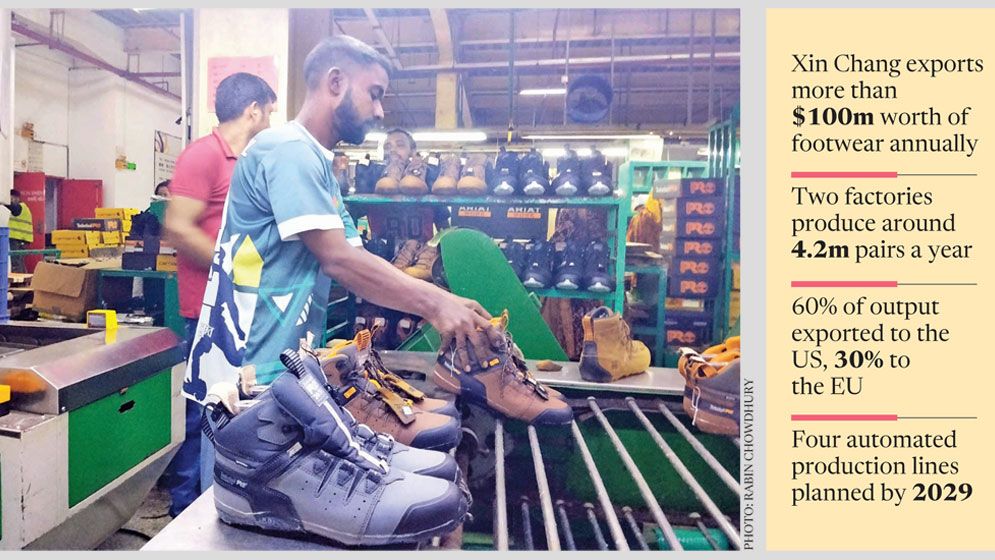
PHOTO: Rabin chowdhury
A soldier training at a US Army training centre in Missouri, a worker operating a drill at an oilfield in Alberta, a miner working deep underground in China, or a European mountaineer climbing the snow-covered peaks of the Alps — all may have one thing in common: footwear made in Bangladesh.
These are not ordinary fashion shoes. They are specially designed safety shoes that protect workers from workplace hazards, including heavy objects, sharp materials, water and extreme temperatures.
Such world-standard footwear is being made at the Karnaphuli Export Processing Zone (Karnaphuli EPZ) in Chattogram by export-oriented Taiwanese-owned Xin Chang Shoes (BD) Ltd.
Xin Chang has helped Bangladesh move beyond its traditional strength in ready-made garments and emerge as a growing manufacturing base for safety and functional footwear.
From battlefields to oilfields
Xin Chang mainly produces leather-upper, rubber and plastic, waterproof and aluminium-toe protective footwear, along with various footwear components. Its main focus, however, is safety and functional footwear.
The company manufactures footwear for hazardous workplaces, including construction sites, oil and gas operations, chemical plants and other high-risk industries, for global brands such as Wolverine World Wide, Timberland and 5.11 Tactical.
Tony Hsieh, operations manager of the company, told the Daily Sun that a pair of its military-style boots costs around $22, while high-end safety shoes can cost up to $40 a pair.
From $2.4 million to a $100 million milestone
When Xin Chang began commercial operations at the EPZ in 2010, its annual revenue was only around $2.4 million.
Today, the Chattogram factory alone generates around $10 million to $11 million in revenue a month. Last fiscal year, it exported more than $100 million worth of products from the factory.
Around 60% of its total production is exported to the United States, 30% to the European Union and the remaining 10% to markets in Asia.
According to trade intelligence platform Trademo, Xin Chang’s exports to Timberland alone rose from $45.77 million in 2022 to $91.39 million in 2025.
The company’s two factories in Chattogram and Cumilla now have an annual production capacity of around 4.2 million pairs, up from 3.7 million pairs last year.
Highlighting the export performance, Tony Hsieh said, “Our export volume exceeded $100 million in the last fiscal year.”
Exports eye bigger share of $23.6bn market by 2033
According to market research firms, the global safety footwear market is expanding rapidly as workplace safety regulations become stricter and infrastructure and industrial construction increase worldwide.
The global market, valued at around $11.6 billion in 2023, is projected to reach $23.6 billion by 2033.
Xin Chang is now seeking to tap into growing global demand by implementing one of its biggest expansion plans in Bangladesh.
The company currently operates nine production lines at the Karnaphuli EPZ. It plans to add four more automated lines by 2029.
The new lines are expected to create more skilled employment opportunities in Bangladesh.
The company expects the expansion to raise its annual production capacity in Chattogram and Cumilla to between six million and eight million pairs.
Tony Hsieh said the decision to invest in Bangladesh had proved to be the right one.
“We started investing in Vietnam and Bangladesh at the same time. But orders in Vietnam are declining and it has become difficult to recruit new workers there. So, our decision to invest in Bangladesh was absolutely right,” he said.
From 14 workers to 12,000
The Taiwan-based footwear manufacturer decided to invest in Bangladesh in 2008. Xin Chang Shoes (BD) Ltd began operations at the Chattogram EPZ in 2010 with only 14 workers.
A year later, in 2011, the company set up its second production unit at Cumilla EPZ.
Over the past one and a half decades, the company has grown from those 14 workers to around 12,000 employees in Bangladesh. Of them, around 6,000 work at the company’s two units at Karnaphuli EPZ in three shifts, with women accounting for the majority of the workforce.
During a visit to the Xin Chang Shoes (BD) Ltd factory on Saturday, this correspondent found hundreds of workers working in rows with intense concentration.
Some were fitting waterproof linings inside leather shoes, while others were doing reinforced double stitching.
Skilled workers were using automated and hydraulic cutting machines to cut premium leather and textile materials to precise measurements. At the end of each production line, dedicated quality-control teams check the products.
Talking to this correspondent, Dipankar De, one of the 14 Bangladeshis who joined the company 18 years ago, said, “This is more than a workplace for me. It is my home.”
“Over the past 18 years, we have worked to take shoes made in Bangladesh to the global market. When I travel abroad and see ‘Made in Bangladesh’ written on shoes in different brand stores, I feel proud.”
Read More