





 For all latest news, follow the Daily Sun's Google News channel.


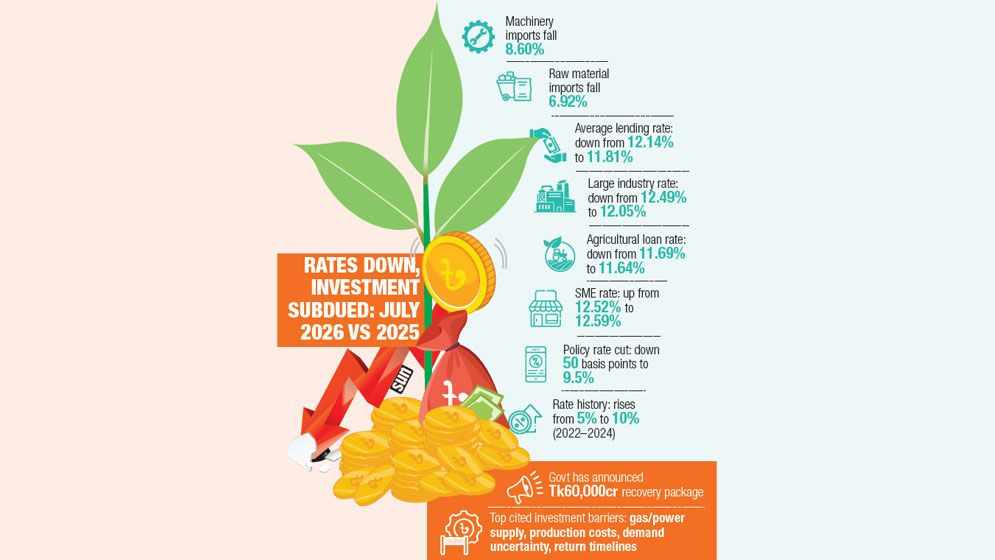
Private sector investment has yet to gather pace despite a gradual easing in bank lending rates, ample liquidity in the banking system and a softer policy stance from Bangladesh Bank, with capital machinery imports – a key gauge of future industrial activity – falling by 8.60% year-on-year in July, the first month of the current fiscal year.
Imports of industrial raw materials fell 6.92% over the same period, central bank data show.
Economists and businesspeople say the figures suggest the investment slowdown cannot be pinned on lending rates or fund availability alone.
Subdued business confidence, concerns over energy supply, rising production costs and broader market conditions are also weighing on the climate, they say – meaning that even as borrowing costs ease, many entrepreneurs remain hesitant to take on new loans or expand operations.
The average interest rate on bank loans eased to 11.81% in July this year from 12.14% a year earlier, a decline of 0.33 percentage points, according to Bangladesh Bank.
The fall was steepest in lending rates for large industries, which dropped to 12.05% from 12.49% -- down 0.44 percentage points. Agricultural loan rates eased slightly, from 11.69% to 11.64%, while SME lending rates edged up marginally, from 12.52% to 12.59%.
Even so, cheaper credit for large industries has not translated into a corresponding rise in investment. Entrepreneurs say a reduction of a few percentage points rarely tips the balance on its own; the more pressing question, they say, is whether a new factory can operate smoothly once established.
Shams Mahmud, president of the Bangladesh-Thai Chamber of Commerce and Industry (BTCCI), told the Daily Sun that entrepreneurs now weigh a wider set of concerns before investing – uninterrupted gas and electricity supply, contained production costs, steady demand and realistic returns within a reasonable timeframe.
He said periodic gas shortages in recent months had affected output at factories across several industrial zones, with some scaling back and others briefly suspending operations, while several companies had turned to costlier alternative fuels to keep running.
Against this backdrop, he said, many entrepreneurs were focused on sustaining existing operations rather than expanding capacity.
Dr Zahid Hussain, former lead economist at the World Bank’ s Dhaka office, said boosting fund supply alone would not lift investment, which depends equally on policy stability, manageable costs, reliable energy, efficient infrastructure and access to new markets.
He noted that private sector credit growth has stayed tepid despite considerable excess liquidity in the banking system, which he said points to weak demand for productive investment rather than a shortage of funds.
Dr Hussain said the government’s Tk60,000 crore recovery package should help over time, though results would take a while to show.
A further easing of the policy rate once inflation moderates, alongside sustained efforts to restore business confidence, would aid private sector credit growth, he added.
Bangladesh Bank cut its policy rate by 50 basis points to 9.5% in July, marking a shift after more than two years of tight monetary policy, during which the rate had been raised gradually from 5% to 10% since 2022 and held there from October 2024.
The tightening had aimed to curb inflation by restraining the flow of money, though officials say inflation stayed elevated even after a prolonged period of high rates, while the higher borrowing costs added to business financing expenses, some of which were passed on to consumers through higher prices.
The central bank is now placing greater emphasis on boosting supply, reasoning that lower interest rates could ease production and import costs, potentially increasing output and easing inflationary pressure as per-unit costs decline.
Russell Ahmed, an entrepreneur in the Manipur handloom industry, told the Daily Sun that entrepreneurs would be more willing to borrow and invest with greater assurance of steady utility supply, manageable costs, policy continuity and firm demand at home and abroad.
Otherwise, he said, rising bank deposits would not necessarily translate into productive investment, with excess liquidity continuing to accumulate at Bangladesh Bank while the funds needed for new factories, machinery, production and jobs remained largely unused.