


 For all latest news, follow the Daily Sun's Google News channel.


Just six days after police uncovered one of the largest organised cyber-fraud operations in the country in Cox’s Bazar, another group of foreign nationals was arrested in Chattogram, raising fresh concerns over the spread of foreign-linked cybercrime in Bangladesh.
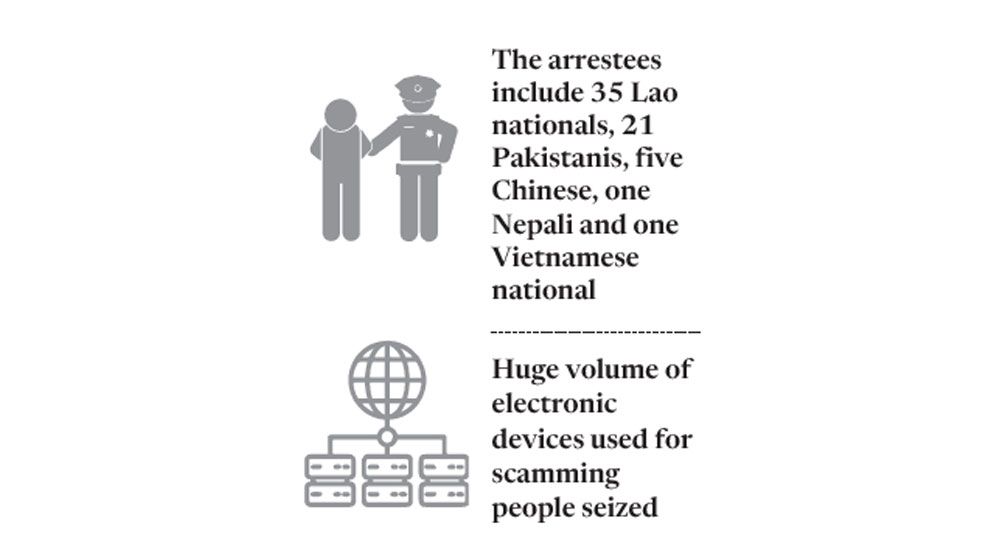
Police on Thursday night raided a residential building in Chattogram city and arrested 63 foreign nationals and seized 134 mobile phones, 57 laptops and a total of 206 electronic devices reportedly used to run hundreds of fake online identities.
The arrestees include 35 Lao nationals, 21 Pakistanis, five Chinese, one Nepali and one Vietnamese national, ageing between 22 and 36 years. Of them, 21 were women while police also rescued a child during the drive.
Many of the detainees told police that they had entered Bangladesh about six weeks ago on visas on arrival.
A soundproof computer centre
Acting on a tip-off, the Chattogram Metropolitan Police (CMP) Counter Terrorism and Transnational Crime (CTTC) and Khulshi police raided the building in Krishnachura Residential Area at around 11:30pm on Thursday.
CMP Additional Commissioner (Crime and Operations) Muhammad Faisal Ahmed said that the arrestees had been staying in Bangladesh for an extended period and were using digital platforms and websites to commit financial fraud, illegally obtain money and carry out unauthorised e-transactions.
“Our concern is that governments across Southeast Asia have increased pressure on scam centres over the past years. As a result, these groups may now consider Chattogram, and Bangladesh, a safer place to operate,” he said.
Officer in-Charge (OC) Abdur Rahim of Khulshi police station told the Daily Sun that the foreign nationals had rented the entire building.
“Several soundproof rooms had been turned into a fully equipped technical facility for conducting online fraud,” he said.
CTTC Deputy Commissioner Mohammad Shamim Hossain said that the group had been conducting online scams from Chattogram targeting people in different Southeast Asian countries.
Police detected a Thai website that advertised discounts on various products, he said.
However, customers who ordered products through the site allegedly had their money stolen as they never received the products.
He said that the operation appeared to have similarities with “pig-butchering” scams, in which victims are first drawn into fake relationships or persuaded to trust operators before being encouraged to invest money through fraudulent platforms.
Police hunt for a link with Cox’s Bazar incident
Police investigating a similar case in Cox’s Bazar found that a hall at Marina Beach Villas had been converted into a computer facility, with six soundproof rooms.
They seized 1,938 iPhones, around 50 monitors, 44 CPUs, 30 keyboards, two laptops, two printers and 24 connection boards during the raid.
The CTTC unit is now investigating whether the facility was involved in investment fraud using fake market analysis, fraudulent investment offers, fake trading platforms and so-called “exit fraud”.
CTTC Deputy Commissioner Shamim said that the exact nature of the operation could not be confirmed until forensic examination of the seized devices is completed.
Police are also looking for possible links between the Cox’s Bazar and Chattogram operations, he added.
Bangladesh not outside the international web
Chattogram University Criminology and Police Science department Assistant Professor Md Sakhawat Hossain said that there is not yet enough evidence that Bangladesh has become a regional scam hub on the scale of Cambodia or Myanmar, but the Cox's Bazar and Chattogram cases could be early warning signs.
"Bangladesh faces vulnerabilities that help such networks take root: easy entry for foreign nationals, weak oversight of rented properties, limited capacity for cybercrime investigation, and readily available local facilitators," he said.
According to related sources, the US Department of Justice, FBI and Secret Service formed a Scam Center Strike Force last year and have seized billions of dollars in cryptocurrency linked to Southeast Asian scam networks. China has also prosecuted major scam groups, including in Myanmar’s Kokang region.
Yet the networks are becoming more mobile and dispersed. Sri Lanka arrested 1,093 foreign nationals in cybercrime cases as of 14 August this year, nearly double the total for 2024, while Malaysia recently detained 335 people in a raid on online centres in Forest City.
Against this backdrop, the recent operations in Cox’s Bazar and Chattogram raise concerns that foreign-linked scam networks may be moving into Bangladesh and using rented hotels, resorts and residential properties.