


 For all latest news, follow the Daily Sun's Google News channel.


Defaults push 15 banks’ provision gap to record Tk2.29 lakh crore
Economists warn of risk to depositor confidence
Daily Sun Report, Dhaka
Published: 11 Sep 2026, 12:00 AM
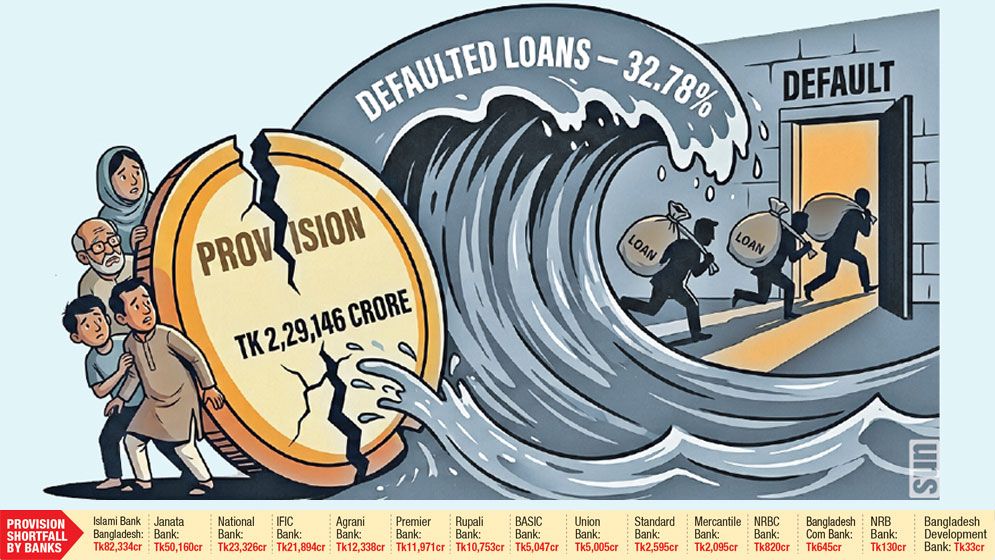
A relentless rise in defaulted loans has pushed the combined provision shortfall at 15 state-owned and private banks to Tk2,29,146 crore as of end-June, the highest figure in the country’s banking history, according to Bangladesh Bank data.
The record gap reflects years of loan fraud, money laundering and unrecovered lending disbursed under various names, with banks now unable to set aside adequate provisions against the mounting bad debt even as their income declines.
Central bank figures show total outstanding loans in the banking sector stood at Tk18,50,595 crore at end-June, of which Tk6,06,555 crore, or 32.78%, was classified as defaulted. A substantial portion of these defaulted loans is considered unlikely to be recovered.
Banks are required to hold provisions against loans according to their quality: 0.25% to 5% for regular loans, 20% for substandard loans, 50% for doubtful loans and 100% for bad or loss loans.
Dr Zahid Hossain, former lead economist at the World Bank’s Dhaka office, attributed the sector’s predicament primarily to the rapid rise in defaulted loans and policy leniency by the central bank.
“The fundamental problem is defaulted loans. If there were no defaulted loans, there would be no provision shortfall,” he told the Daily Sun.
He said repeated policy concessions for loan defaulters, together with allowing banks to pay dividends despite provision shortfalls, were sending the wrong message to the sector, and warned this could put depositors’ money at serious risk.
He called for the immediate withdrawal of such policies and tougher measures to recover defaulted loans.
Mustafa K Mujeri, former chief economist of Bangladesh Bank, said banks with higher non-performing loan ratios were particularly vulnerable because their operating income was no longer sufficient to meet three obligations simultaneously: paying interest to depositors, covering operating expenses and maintaining mandatory provisions.
He attributed the widening shortfall to weak recovery of defaulted loans, prolonged leniency towards large borrowers, and the long-standing practice of repeatedly rescheduling and writing off loans.
“If this continues, depositor confidence will inevitably be undermined, posing a serious threat to financial stability,” he told the Daily Sun.
State-owned banks under severe strain
Five state-owned banks together recorded a provision shortfall of Tk78,330 crore. Janata Bank accounted for the largest share, at Tk50,160 crore, followed by Agrani Bank (Tk12,338 crore), Rupali Bank (Tk10,753 crore) and BASIC Bank (Tk5,047 crore). Bangladesh Development Bank’s shortfall stood at around Tk33 crore.
The absence of adequate provisions and financial buffers is weakening the capital base of these banks and raising concerns about their capacity to protect depositors’ funds.
Private banks also face massive deficits
Ten private banks together recorded a provision shortfall of more than Tk1.50 lakh crore. Islami Bank Bangladesh recorded by far the largest deficit, at Tk82,334 crore, followed by National Bank (Tk23,326 crore) and IFIC Bank (Tk21,894 crore).
The remaining banks on the list were Premier Bank (Tk11,971 crore), Union Bank (Tk5,005 crore), Standard Bank (Tk2,595 crore), Mercantile Bank (Tk2,095 crore), Bangladesh Commerce Bank (Tk645 crore), NRBC Bank (Tk820 crore) and NRB Bank (Tk130 crore).
The scale of these deficits has raised concerns about the stability and resilience of the private banking sector.