




 For all latest news, follow the Daily Sun's Google News channel.


More women enter banking, few reach senior posts
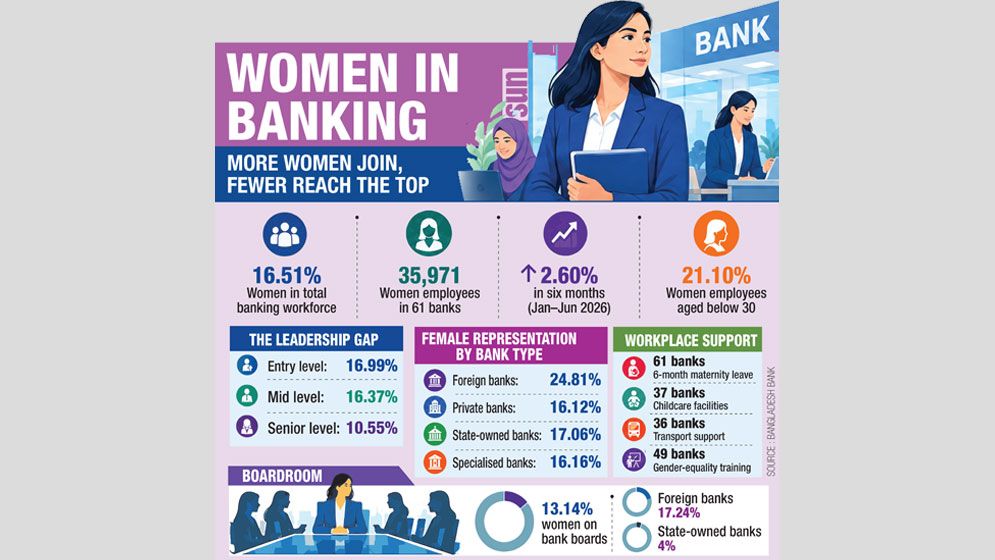
Women make up 16.51% of the bank workforce, but their share drops to 10.55% at higher positions, BB data shows
Daily Sun Report, Dhaka
Published: 10 Sep 2026, 12:00 AM
More women are entering banks at entry-level positions, while improved workplace facilities, maternity leave, childcare support and transportation arrangements are making it easier for them to pursue banking careers.
According to the latest Bangladesh Bank data, the number of women working in the country’s 61 scheduled banks rose to 35,971 in January-June 2026, up 910, or 2.60%, from 35,061 in July-December 2025.
Women now account for 16.51% of the banking sector’s total workforce of 217,818.
The growing participation of young women is particularly encouraging. During the period, women under 30 accounted for 21.10% of the female banking workforce, nearly twice the 11% share of women aged over 50.
For many young women, banking is increasingly seen not merely as a job but as a structured career offering professional growth, financial independence and opportunities to work in a corporate environment.
“Banking has become much more accessible and attractive to women than it was in the past. Young women now see it as a profession where they can build a long-term career while developing skills and financial independence,” said Nusrat Jahan, an assistant director of Bangladesh Bank.
Private commercial banks employ the largest number of women in absolute terms.
Read MoreThe 43 private commercial banks employed 23,524 women, representing 16.12% of their total workforce. The six state-owned commercial banks employed 9,471 women, or 17.06% of their employees.
The three specialised banks employed 2,045 women, accounting for 16.16% of their workforce.
Foreign commercial banks had the smallest number of female employees, at 931, but recorded the highest proportion of women in their workforce at 24.81%.
The figures show that while private banks employ the largest number of women, foreign banks have a comparatively higher share of female employees.
Entry easier, climbing ladder remains difficult
While more women are entering banking, the data reveal a persistent challenge: fewer women reach senior positions.
Women accounted for 16.99% of entry-level employees and 16.37% of mid-level employees. But their representation fell to just 10.55% at higher positions. This suggests that the challenge is no longer simply bringing women into banks. Retaining them and ensuring their progression into decision-making and leadership positions is becoming a bigger issue.
bang
“The number of women entering banking is definitely increasing, but the real challenge is retaining them and ensuring their career progression.
Women need equal opportunities for promotion, leadership roles and professional development,” said Fahmida Rahman, a joint director of Bangladesh Bank.
“Facilities such as maternity leave, childcare and transport make a significant difference. Without these support systems, many women may find it difficult to continue in a demanding profession like banking after marriage or motherhood,” she added.
Banks have taken several measures to create more women-friendly workplaces.
According to the data, all scheduled banks provide six months of maternity leave for female employees and have policies to prevent and raise awareness about sexual harassment.
As many as 37 banks have established or joined childcare centres for employees’ children, while 36 provide transportation for female employees travelling after designated working hours.
During January-June, 49 scheduled banks organised gender-equality awareness training for their employees.Such facilities are increasingly important in helping women balance professional responsibilities with family obligations.
Despite progress in workforce participation, women remain underrepresented at the highest levels of decision-making. During January-June, women accounted for only 13.14% of bank board members.
Foreign commercial banks recorded the highest female representation on their boards at 17.24%, while state-owned banks had the lowest at just 4%.
Industry insiders say banks need to focus not only on recruitment but also on creating transparent career paths for women.
Recruitment is only the first step; genuine gender equality will require ensuring women have equal opportunities to become branch heads, senior executives, managing directors and board members.
Recommended News