


 For all latest news, follow the Daily Sun's Google News channel.


‘Illegal auto charging costs govt Tk4,000cr in revenue a year’
Daily Sun Report, Dhaka
Published: 10 Sep 2026, 12:00 AM
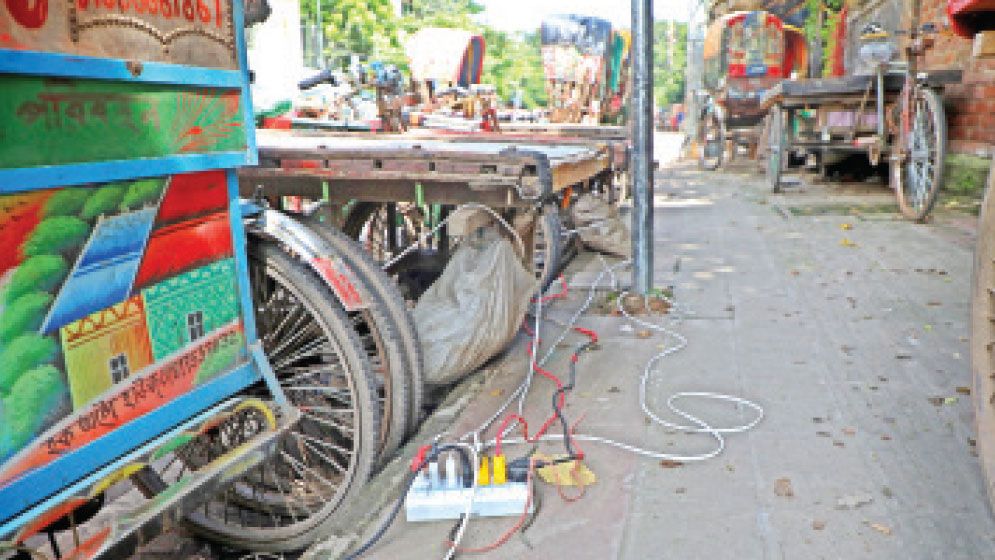
Battery-run autorickshaws are being illegally charged at makeshift points in various alleyways of the capital, adding to pressure on the power distribution system amid rising load-shedding. The photo was in the capital's Tejgaon on Wednesday. -Reaz Ahmed Sumon
The government is losing around Tk4,000 crore in annual revenue due to the illegal charging of battery-run auto-rickshaws, as authorities prepare to bring the vehicles under a formal registration and digital monitoring system.
Home Minister Salahuddin Ahmed disclosed the revenue loss in Parliament on Monday while replying to a notice submitted by reserved women’s seat MP Rehana Akter Ranu over the uncontrolled movement of auto-rickshaws.
The disclosure came during the third session of the 13th Jatiya Sangsad, chaired by Speaker Hafiz Uddin Ahmed.
According to the minister, between 50 lakh and 80 lakh electric three-wheelers are currently operating across the country, against only around 3,300 authorised charging centres.
Dhaka alone has more than 48,000 informal or illegal charging centres, he said.
Many of these centres reportedly use illegalelectricity connections, including direct connections from power poles, leaving electricity consumed for commercial charging outside the regular billing system.
The government estimates that charging the country’s large fleet of electric three-wheelers consumes around 5% or more of total electricity generation.

The widespread use of residential connections for commercial charging and excessive loads on transformers are also putting pressure on local distribution networks and contributing to power disruptions in different areas, the minister said.
MP Rehana Akter Ranu said around 1,000 megawatts of electricity is consumed daily to charge auto-rickshaws, identifying it as one of the factors behind load-shedding.
Against this backdrop, the government is preparing a new policy to bring battery-run auto-rickshaws under a controlled regulatory framework.
Under the proposed system, approved auto-rickshaws will be given number plates and QR codes, while drivers will be registered, trained and issued licences. Digital monitoring will also be introduced to prevent multiple vehicles from operating under the same registration number.
The MP also proposed making registration with the Bangladesh Road Transport Authority (BRTA) mandatory, introducing solar-powered charging facilities and restricting auto-rickshaws to designated areas.
The growing number of battery-run vehicles has also raised road safety and environmental concerns.
According to information placed before parliament, Bangladesh recorded 6,729 road accidents in 2025, in which 911 people were killed and 14,812 injured. Battery-powered auto-rickshaws were involved in 13.54% of the accidents.
Unregistered vehicles, untrained drivers, faulty designs, weak brakes and inadequate lighting were cited as factors increasing accident risks. Their presence on highways also adds to the danger, according to the information presented in Parliament.
Meanwhile, the government is expanding the use of artificial intelligence-based cameras to strengthen traffic control in Dhaka. Fifty AI-based cameras are currently operating at 17 traffic signals, while another 200 are being installed under the Ramna and Tejgaon traffic divisions.
The government plans to gradually bring other major intersections under the AI-based monitoring system.
Read More